You all remember the story of the hare and the tortoise. In that race, the hare moved quickly while the tortoise moved slowly. This difference is because of their speed, how fast or slow?
But how do we decide whether something is fast or slow?
- One way is to compare the distance covered in the same amount of time.
- If an object covers more distance in the same time, it is moving faster.If it covers less distance in the same time, it is moving slower.
- We can also compare by time taken, for the same distance.
- If two friends run 100 metres, the one who finishes in less time is faster.
 |
Fast | Covers more distance in same time or the same distance in less time |
 |
Slow | Covers less distance in the same time or the same distance in more time |
You already know in the story that the hare was faster than the tortoise. But if we compare the hare with a race car, suddenly the hare seems slow. And if we compare the tortoise with a snail, the tortoise now appears fast.
This shows that speed is a relative concept, whether something is fast or slow depends on what you are comparing it with.
So, in the race, the hare was fast relative to the tortoise, but slow relative to a car.
Speed:
Speed is defined as the distance travelled by an object in unit time.
\(\text{Speed} = \frac{\text{Distance travelled}}{\text{time}}\)
SI unit of speed:
Speed is measured in the units of \(cm/s\) or \(m/min\) or even \(km/h\) since, \(\text{Speed} = \frac{\text{Distance travelled}}{\text{time}}\)
But the SI unit of distance is metre (\(m\)) and time is second (\(s\)).
Hence the SI unit of speed is metre/second, expressed as \(m/s\).
Important!
To convert the unit from \(m/s\) into \(km/h\), multiply the given distance value by \(18/5\).
To convert the unit from \(km/h\) into \(m/s\), multiply the given distance value by \(5/18\).
A car moving at a constant speed covers a distance of \(100\) kilometres in one hour, implying that it had travelled at a speed of \(100\) kilometres per hour. This shows that the total distance covered by the car in one hour is \(100\) kilometres. It is not compulsory that the car must travel at a constant speed because it is the average speed of the car that is calculated.
The term average speed can be used to determine speed.
Speed or average speed is the total distance covered divided by the total time taken.
\(\text{Average speed} = \frac{\text{Total distance covered}}{\text{Total time taken}}\)
Actual speed is the distance travelled by a body at a particular time.
Activity:
To observe and understand the concept of speed by comparing it with one another.
| Objects | Distance covered (\(km\)) | Time taken (\(h\)) | Speed (\(km/h\)) |
 |
\(60\) | \(1\) | \(60\) |
|
\(12\) | \(0.5\) | \(24\) |
|
\(1\) | \(0.5\) | \(2\) |
 |
\(0.02\) | \(0.5\) | \(0.04\) |
Formula used:
\(\text{Speed} = \frac{\text{Distance travelled}}{\text{time}}\)
Explanation:
-
Car: Covers a large distance in less time, that is high speed.
-
Hare: Faster than tortoise and snail.
-
Tortoise: Slow, covers little distance in same time.
-
Snail: Very slow, covers very little distance.
Objects with high speed cover more distance in less time, like a car or a hare. Those with low speed cover less distance in more time, like a tortoise or a snail. Whether something appears fast or slow depends on what it is compared with this is called relative speed or speed.
Relationship between speed, distance, and time:
The formula to calculate the speed is given by,
\(\text{Speed} = \frac{\text{Total distance covered}}{\text{Total time taken}}\)
We use this, if the distance travelled and time taken for it are known.
The distance moved by an object can also be calculated by knowing the speed and the time taken of an object. The formula is given by,
\(\text{Total distance covered} = {\text{Speed of an object}}\times{\text{Total time taken}}\)
The time taken by an object can also be calculated with the help of speed and the distance covered by an object. The formula is given by,
\(\text{Total time taken} = \frac{\text{Total distance covered}}{\text{Speed of an object}}\)
Speedometer:
Odometer:
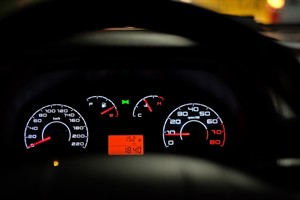
A speedometer is an instrument in vehicles that shows the speed at which the vehicle is moving at a particular moment. It is usually marked in kilometres per hour (\(km/h\)).
An odometer is an instrument in vehicles that measures the total distance the vehicle has travelled. It is usually displayed in kilometres (\(km\)).
These two devices can be seen in the dashboard of vehicles like buses and cars. With the help of these devices, the distance and the speed of a vehicle can be easily found.