

Sundial:
A sundial is a device that uses the Sun's shadow to tell the time. As the Sun moves across the sky, the shadow of a stick changes its position. The movement of the shadow shows the time in a periodically repeating way each day.
Water clock:
A water clock measures time by the steady flow of water. Water either drips out or fills up a container at a constant rate. The changing water level shows the passage of time. It is one of the oldest periodically repeating time-measuring devices.
Floating bowl water clock:
In a floating bowl water clock, a bowl with a small hole at the bottom is placed in a larger container filled with water. Water slowly enters the bowl through the hole. After a fixed time, the bowl fills up and sinks. This process repeats and helps measure time in a periodically repeating way.
Hourglass:
An hourglass shows time by letting sand fall from the top part to the bottom. It takes the same amount of time, every time the sand flows. When we turn it over, the sand starts falling again, so it repeats periodically.
Candle clock:
A candle clock measures time by the slow and steady burning of a candle. Marks are made on the candle, and as it burns down, each mark shows how much time has passed. It works in a periodically repeating way, as the candle burns at a constant rate.
Modern clock:
A modern clock uses mechanical, electrical, or digital parts to measure time accurately. It shows time in hours, minutes, and seconds, and works in a periodically repeating way. Today, most clocks are either quartz clocks, which use vibrations of a tiny crystal, or digital clocks, which run on electricity and display time electronically.
The working of clocks are based on the concept of periodic motion.
Periodic motion:
The objects which are in repeated motion for equal intervals of time are in periodic motion. It is also known as oscillatory motion.
Example:
Girl swinging on a swing, motion of Earth around the Sun, the pendulum.
Simple Pendulum:
The simple pendulum consists of a metallic ball or a stone piece, a thread and a rigid stand. The metallic ball is generally called as the bob of the pendulum. Initially, in the mean position, the bob is at rest. The bob begins to move to and fro when the pendulum is released from one side, which is an example of a periodic or an oscillatory motion.
Working:
The bob starts from its mean position \(O\) goes to one end \(A\), then moves to the other end \(B\) and back to the point \(O\) in the middle. This to and fro motion is said to have completed one oscillation.
Time Period:
Time period is the time taken by the pendulum to complete one oscillation. Time period of a pendulum is constant.
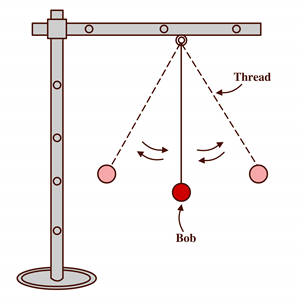
A simple pendulum
Calculation of time period of a pendulum:
\(\text{Time period} = \frac{\text{Time taken for 10 oscillation}}{\text{10 oscillations}}\)
Time:
Time is measured in the units of second (\(s\)), minute (\(min\)) and hour (\(h\)). The larger units of time are minutes (\(min\)) and hours (\(h\)) whereas second (\(s\)) is a smaller unit.
The SI unit of time is the second. Its symbol is \(s\).
Important!
- Units of time like second, minute, and hour should always begin with a lowercase letter, unless they appear at the start of a sentence.
- Their symbols , ‘\(s\)’ for second, ‘\(min\)’ for minute, and ‘\(h\)’ for hour are also written in lowercase and always in singular form.
- Do not place a full stop after these symbols unless it ends the sentence.
- When writing time, make sure to leave a space between the number and the unit. For example: 45 \(s\). Avoid using incorrect forms like ‘sec’ for second or ‘hrs’ for hour.