

We know that a magnetic compass responds to a magnet placed near it. In this section, we investigate whether an electric current can also influence a magnetic compass, indicating a magnetic effect.
Activity: To observe the magnetic effect of electric current in a coil
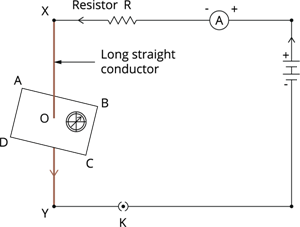
A current-carrying wire
Step 1: Take an insulated copper wire, a magnetic compass, an electric cell with holder, and a simple switch.
Step 2: Wind the insulated copper wire into a circular coil of about 5–6 turns.
Step 3: Place the magnetic compass at the centre of the coil on a flat surface.
Step 4: Connect the ends of the coil to the cell and switch to form a complete electric circuit.
Step 5: Keep the switch OFF and note the original north–south direction of the compass needle.
Step 6: Turn the switch ON to allow current to flow through the coil and carefully observe the compass needle.
Observation:
- When the switch is turned ON, the compass needle deflects from its original north–south direction, showing that a magnetic field is produced around the coil due to the flow of electric current.
- The amount of deflection indicates the presence and strength of this magnetic field.
- When the switch is turned OFF, the electric current stops flowing, the magnetic field around the coil disappears, and the compass needle returns to its original direction.
- This behaviour is observed every time the circuit is switched ON and OFF.
Conclusion:
The deflection of the compass needle proves that a current-carrying coil produces a magnetic field around it. The magnetic effect exists only as long as electric current flows through the coil and disappears when the current stops. Hence, electric current can produce magnetism, confirming the magnetic effect of electric current.
Magnetic compass:
A magnetic compass contains a tiny magnet that responds to magnetic fields. When electric current flows through a wire, it creates a magnetic field around it. This magnetic field acts on the compass needle and causes it to deflect. When the current stops flowing, the magnetic field vanishes and the compass needle aligns itself with Earth’s magnetic field again.
Magnetic effect of electric current:
The phenomenon in which a current flowing through a conductor produces a magnetic field around it is called the magnetic effect of electric current.
Magnetic field:
The region around a magnet or a current-carrying conductor where its magnetic influence can be detected, such as by the deflection of a compass needle, is called a magnetic field.
Scientist behind the discovery:
In \(1820\), the Danish scientist Hans Christian Oersted discovered that an electric current can produce a magnetic field. While demonstrating an electric circuit, he noticed that a nearby compass needle deflected whenever the circuit was switched on or off. This experiment proved the link between electricity and magnetism, leading to further scientific developments.
Applications:
Electromagnet:
When electric current flows through a coil of wire, it produces a magnetic field. If an iron object is placed inside this coil, the magnetic effect becomes much stronger. Such a magnet formed using electric current is called an electromagnet.
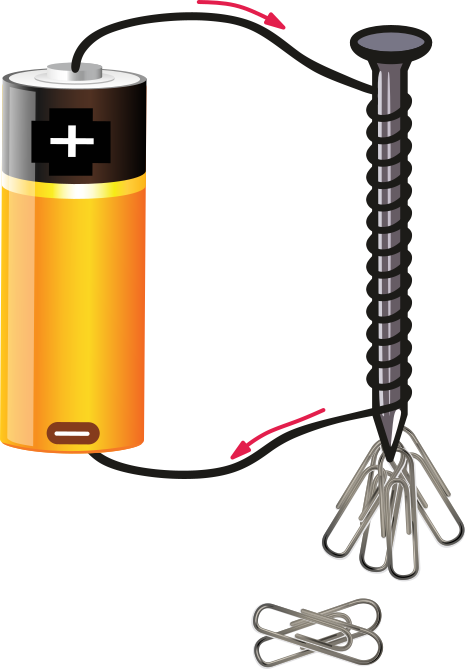
Construction of an electromagnet
Let us perform an activity to investigate more about the electromagnet.
Activity: To investigate the strength of an electromagnet.
Step 1: Take a long insulated copper wire (about 100 cm), a hollow pen refill, a soft iron rod, an electric cell, two magnetic compasses, and small steel screws.
Step 2: Wind about \(40\) – \(50\) tight turns of the insulated wire around the plastic tube to form a cylindrical coil and secure it with adhesive tape.
Step 3: Place one magnetic compass near each end of the coil and keep the circuit open initially.
Step 4: Connect the coil to the cell to allow current to flow and observe the deflection of both compass needles.
Step 5: Disconnect the cell and note whether the compass needles return to their original north–south direction.
Step 6: Insert the soft iron rod into the coil, reconnect the cell, and observe the increased deflection of the compass needles and attraction of steel washers or screws.
Observation:
- When electric current flows through the coil, the compass needles placed near its ends deflect, showing that a magnetic field is produced.
- After inserting the soft iron rod inside the coil, the deflection of the compass needles becomes larger, indicating a stronger magnetic field.
- The steel screws are attracted towards the ends of the rod only when current flows.
- When the current is switched off, the magnetic effect disappears and the washers fall down.
Conclusion:
A current-carrying coil behaves like a magnet, and inserting a soft iron core significantly increases its strength. The magnetic effect exists only while electric current flows through the coil. Such a temporary but strong magnet formed using electric current is called an electromagnet.
Electromagnet:
An electromagnet is a temporary magnet formed when electric current flows through a coil of wire wound around a soft iron core, which becomes magnetic only while the current is flowing.
Strength of an electromagnet:
The strength of an electromagnet is the intensity of its magnetic field produced by a current-carrying coil, which increases when a soft iron core is inserted and exists only as long as electric current flows.
Poles of an electromagnet:
The poles of an electromagnet are the two opposite magnetic ends produced at a current-carrying coil, whose polarity depends on the direction of electric current and disappears when the current is switched off.
Factors affecting the strength of an electromagnet:
- Increasing the number of cells increases the current and strengthens the electromagnet.
- Increasing the number of turns of the coil increases the magnetic field.
- Changing the direction of current reverses the poles of the electromagnet.
Lifting electromagnets:
Lifting electromagnets are powerful electromagnets attached to cranes. When electric current is switched ON, the electromagnet becomes strong and can lift heavy iron or steel objects. When the current is switched OFF, the magnetic field disappears and the objects are released. These electromagnets are commonly used in factories and scrap yards to lift, move, and sort heavy metal items efficiently.
Earth as a magnet:
The Earth itself behaves like a giant magnet. Deep inside the Earth, the movement of molten iron in the core produces electric currents, which create Earth’s magnetic field. Many birds and animals use this magnetic field for navigation. This field also protects the Earth by deflecting harmful charged particles coming from space.