

Magnetism can be produced not only by permanent magnets but also by electric current. When current flows through a coil of wire, it creates a magnetic field. This principle is used to make an electromagnet, which works only when electricity is supplied.
Activity:
To construct a simple electromagnet using a coil of wire and a soft iron core.
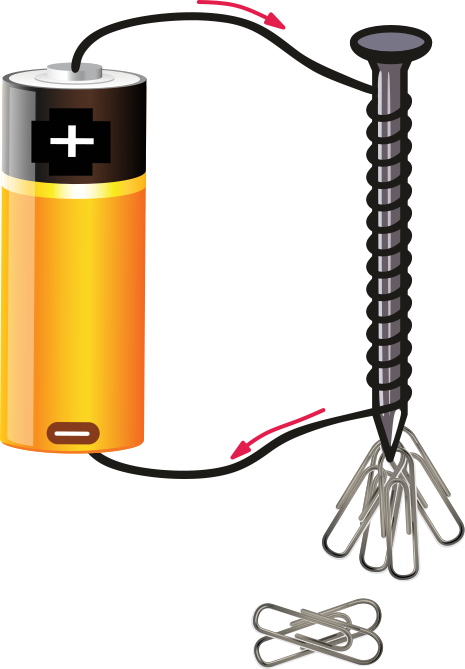
Construction of an electromagnet
Step 1: Take an iron nail and insulated copper wire.
Step 2: Wind the wire tightly around the nail to form a coil.
Step 3: Connect the ends of the wire to a battery using connecting wires.
Step 4: Bring the nail near small paper clips and observe.
Step 5: Disconnect the battery and observe the change.
Observation:
The nail attracts paper clips when the battery is connected, but does not attract them when the battery is disconnected.
Conclusion:
The iron nail becomes a magnet only when electric current flows through the coil, showing that an electromagnet is formed.
Electromagnet:
- An electromagnet is made by winding an insulated wire around a soft iron core (such as an iron nail) to form a coil.
- The ends of the wire are connected to an electric cell or battery.
- When electric current flows through the coil, a magnetic field is produced around it, and the iron core becomes magnetised.
- As a result, the setup behaves like a magnet and can attract magnetic materials such as iron clips.
- When the current is switched off, the magnetic effect disappears and the core loses its magnetism.
- For practical purposes, a soft iron core is used because it increases the strength of the electromagnet.
Magnetic behaviour of a current-carrying coil:
When electric current flows through a coil of wire, it produces a magnetic field around the coil. Due to this magnetic field, the coil behaves like a magnet and can deflect a magnetic compass needle. The coil shows properties similar to a magnet.
Properties:
It produces a magnetic field when current flows.
It can attract magnetic materials.
The magnetic effect disappears when current stops.
Thus, a current-carrying coil acts as a temporary magnet, known as an electromagnet.
Difference between an electromagnet and a permanent magnet:
An electromagnet is a magnet that is formed only when electric current flows through a coil. Its magnetism is temporary and disappears when the current is switched off. Its strength can be increased or decreased by changing the current or the number of turns in the coil.
A permanent magnet, on the other hand, has magnetism on its own and does not require electric current. Its magnetic strength remains constant and cannot be easily changed.