

When electric current passes through a conductor, it can produce heat as a result of the resistance offered to the flow of current. This heating effect can be observed in simple experiments and is also used in many everyday appliances.
Resistance in conductors:
When electric current flows through a conductor, it experiences resistance, which is the opposition to the flow of current. Different conductors offer different amounts of resistance. For example, a nichrome wire; which is an alloy of Nickel and Chromium, has a much higher resistance than a copper wire of the same length and thickness.
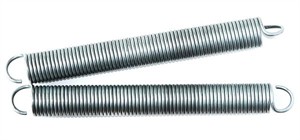
Nichrome coil
Heating due to electric current:
Because of this resistance, a part of the electrical energy is converted into heat energy as current passes through the conductor. As a result, the conductor becomes warm. This effect can be easily observed in a nichrome wire when current flows through it.
Heating effect of electric current:
The warming of a conductor due to the flow of electric current is called the heating effect of electric current. This effect is widely used in devices such as electric heaters, irons, and bulbs.
Heating effect of electric current in household appliances:
An incandescent bulb glows because its filament becomes hot when electric current passes through it. This heating of the filament produces light.
The same heating effect of electric current is used in many household appliances such as electric heaters, stoves, irons, immersion rods, water heaters, kettles, and hair dryers.
These appliances contain a wire or coil called a heating element, which becomes hot when current flows through it. In some appliances, the heating element is visible and can be seen glowing red hot.
Harmful effects and safety measures:
Sometimes, the heating effect can be harmful. Electrical energy may be wasted as heat during transmission through wires. Excessive heating can damage plugs and sockets by melting plastic parts and may even cause fires. To prevent such accidents, safety devices such as fuses are installed in household electric circuits to protect appliances and ensure safe use.
History of the Voltaic cell:
The Voltaic (Galvanic) cell is named after the Italian scientists Alessandro Volta and Luigi Galvani. Galvani observed that a dead frog's leg moved when touched with two different metals. Volta later proved that the electric current was produced by the combination of different metals and a liquid, not by the frog. His discovery led to the invention of the first battery, known as the Voltaic cell.
Voltaic cell vs. Dry cell:
| Voltaic cell | Dry cell |
| A Voltaic cell, also called a Galvanic cell, is a device that produces electricity from chemical reactions. | A dry cell is a portable type of voltaic cell commonly used in everyday electrical devices. |
| Consists of two metal plates made of different materials placed inside a glass or plastic container filled with an electrolyte. | Consists of a zinc container, a carbon rod with a metal cap at the centre, and a paste-like electrolyte. |
| Two different metal plates act as the electrodes. | Zinc container acts as the negative terminal, and the carbon rod acts as the positive terminal. |
| A liquid electrolyte, usually a weak acid or salt solution, in which the electrodes are partially dipped. | A thick, moist paste electrolyte surrounds the carbon rod. |
| A chemical reaction between the electrodes and the electrolyte produces electrical energy. When connected to an external circuit, electric current flows through the circuit. | Works on the same chemical principle as a voltaic cell, but uses a paste electrolyte to provide electrical energy safely and conveniently. |
| Stops producing electricity when the chemicals are completely used up and becomes a dead cell. | A single-use cell that cannot be recharged or reused after it is exhausted. |
Rechargeable batteries:
Rechargeable batteries can be charged and reused many times, reducing waste and saving money. They are used in devices such as watches, mobile phones, laptops, tablets, inverters, and electric vehicles. However, after many charging cycles, their performance gradually decreases and they eventually need to be replaced.
Lithium-ion and Solid-state batteries:
Lithium-ion (Li-ion) batteries are the most commonly used rechargeable batteries today. These batteries rely on special metals like lithium and cobalt, which are mined and processed in limited parts of the world. They power devices such as mobile phones, laptops, and electric vehicles. Scientists are developing solid-state batteries, which use a solid electrolyte instead of a liquid or paste. These batteries are expected to be safer, charge faster, and last longer, making them an important part of future clean energy technologies.