

Electric current flows through a conductor and is used to operate devices like bulbs and fans, while magnets attract materials like iron and have their own magnetic field.
However, scientists later discovered that these two are actually connected.
This means that whenever current flows through a conductor, a magnetic field is formed around it. To understand this better, we study the magnetic field pattern, which shows how the magnetic field is arranged around the conductor.
Magnetic field pattern around a current-carrying conductor:
When electric current flows through a conductor, it produces a magnetic field around it. This can be observed using a magnetic compass, whose needle deflects when current flows and returns to its original position when current stops.
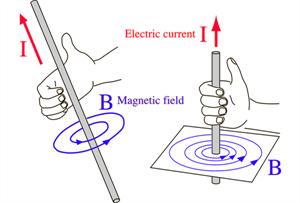
Magnetic field pattern
The magnetic field around a straight current-carrying wire forms a pattern of concentric circles (circles having the same centre) around the wire. The wire is at the centre, and the magnetic field lines form circular paths around it.
These circles are closer and stronger near the wire and become wider and weaker as the distance increases. This shows that the magnetic effect decreases as we move away from the conductor.
Direction of magnetic field around a straight current-carrying conductor:
- The direction of the magnetic field depends on the direction of electric current.
- When current flows through the wire, the compass needle deflects from its original position.
- If the direction of current is reversed, the compass needle deflects in the opposite direction.
- This shows that the magnetic field has a direction, and this direction changes when the current direction changes.
Hans Christian Oersted’s discovery:
- In 1820, Hans Christian Oersted discovered that electric current produces a magnetic effect.
- He observed that a compass needle near a wire deflected whenever current flowed through the wire.
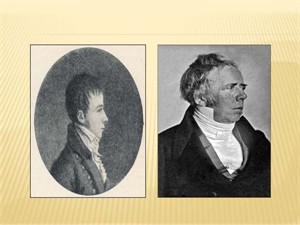
Hans Christian Oersted
- When the current was switched off, the needle returned to its original position.
- This showed that the magnetic effect was due to the electric current.
This discovery proved the link between electricity and magnetism, leading to many useful applications like electromagnets and electric devices. It is the basis of many useful devices like electromagnets, motors, and electric bells.