

Electric current produces both magnetic and heating effects as it flows through conductors, forming the basis of many useful applications. Electric cells and batteries supply the energy required to make these processes work in everyday life.
Magnetic compass:
A magnetic compass has a tiny magnet that responds to magnetic fields. When electric current flows through a wire, it produces a magnetic field around it. This field causes the compass needle to deflect. When the current stops, the magnetic field disappears and the needle returns to align with Earth’s magnetic field.
Magnetic effect of electric current:
The phenomenon in which a current flowing through a conductor produces a magnetic field around it is called the magnetic effect of electric current.
Magnetic field:
The region around a magnet or a current-carrying conductor where its magnetic influence can be detected, such as by the deflection of a compass needle, is called a magnetic field.
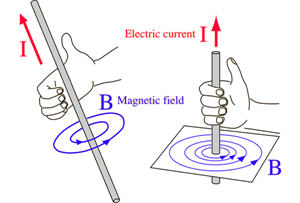
Magnetic field aroun a current carrying conductor
Scientist behind the discovery:
In \(1820\), the Danish scientist Hans Christian Oersted discovered that an electric current can produce a magnetic field. While demonstrating an electric circuit, he noticed that a nearby compass needle deflected whenever the circuit was switched on or off.
Applications of magnetic effect of electric current:
Electromagnets, Electric bells, Transformers, Induction cookers and stoves, Junkyard cranes, MRI (Magnetic Resonance Imaging), Electric motors, Fans, Loudspeakers, Relays, and Generators.
Electromagnet:
An electromagnet is a temporary magnet formed when electric current flows through a coil of wire wound around a soft iron core, which becomes magnetic only while the current is flowing.
Strength of an electromagnet:
The strength of an electromagnet is the intensity of its magnetic field produced by a current-carrying coil, which increases when a soft iron core is inserted and exists only as long as electric current flows.
Poles of an electromagnet:
The poles of an electromagnet are the two opposite magnetic ends produced at a current-carrying coil, whose polarity depends on the direction of electric current and disappears when the current is switched off.
Factors affecting the strength of an electromagnet:
- Increasing the number of cells increases the current and strengthens the electromagnet.
- Increasing the number of turns of the coil increases the magnetic field.
- Changing the direction of current reverses the poles of the electromagnet.
The Earth acts like a giant magnet. Movements of molten iron in its core generate electric currents, producing Earth’s magnetic field. Many animals and birds use this field for navigation. It also protects Earth by deflecting harmful charged particles from space.