
Forces are pushes or pulls that can change the state of motion of objects. They are mainly classified into contact forces, which need physical contact, and non-contact forces, which act without touching. These forces play an important role in everyday life and natural phenomena.
 
Contact forces:
Contact forces are forces that act only when two objects are in physical contact with each other.
Muscular force:
Muscular force is the force generated by the contraction and relaxation of muscles in the body during physical activity.
Role of muscular force:
 
It helps us perform movements like walking, running, lifting, pushing, and stretching. Animals and humans also use it for carrying loads and daily activities. Inside the body, it helps in chewing food and pumping blood through the heart. It is an important example of a contact force.
 
man85325701280w600.jpg
A Bullock cart
 
Friction:
Friction is the force that comes into play when an object moves or tries to move over another surface. It always acts in a direction opposite to the motion or the attempted motion of the object.
Cause of friction:
 
Friction is a contact force because it occurs when two surfaces are in contact. It exists only when objects touch each other.
Friction is caused by tiny irregularities on surfaces. Even smooth surfaces have small bumps that interlock and resist motion when they slide over each other.
 
Friction in liquids and gases:
 
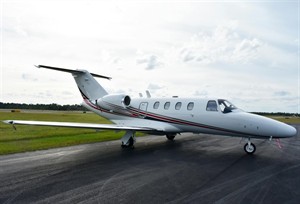
Friction also acts in liquids and gases, not just solids. Moving objects face resistance from air and water while passing through them. To reduce this drag, vehicles like aeroplanes, ships, boats, cars, and trains are given streamlined shapes for smoother and faster movement.
 
pexelsguskazi13528331w600.jpg
Streamlined shape of an aircraft 
 
Non-contact forces: 
Non-contact forces are forces that act on objects without any physical contact between them.
Magnetic force:
 
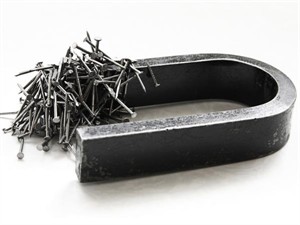
A magnet can attract objects made of magnetic materials like iron. When two magnets are brought close, like poles (North–North or South–South) push each other away, while unlike poles (North–South) pull each other towards each other.
 
shutterstock99525080w600 (1).jpg
A horseshoe magnet attracting iron nails
Magnetic force is the force exerted by a magnet on another magnet or a magnetic material from a distance, without direct contact, and hence it is a non-contact force. 
Static electric charges:
 
Static electric charges are formed when certain materials are rubbed together and charges build up on their surfaces. These charges stay at rest and the object becomes a charged object. A charged object can attract uncharged objects like bits of paper without touching them, so this is a non-contact force.
 
Types of static electric charges:
 
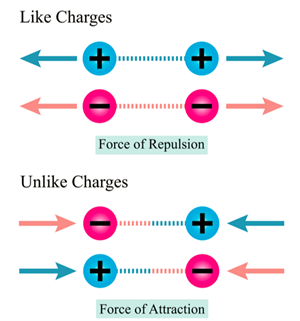
When two balloons are charged in the same way, they get similar charges and repel each other, showing that like charges repel. During rubbing, both objects get charged with opposite charges and attract each other, showing that unlike charges attract. The two types of static electric charges are positive and negative.
 
Screenshot20211026100726 (1).png
Like and unlike charges
 
Electrostatic force:
Electrostatic force is the force exerted by a charged object on another charged or uncharged object without direct contact, and hence it is a non-contact force. 
Electric current:
 
When electric charges start moving, they form an electric current in an electrical circuit. This current is responsible for making a lamp glow, producing heat, and creating magnetic effects.
 
Gravitational force:
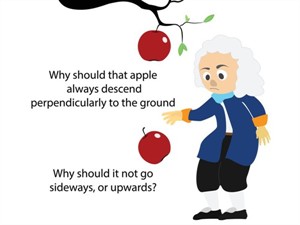
Gravitational force is the force by which the Earth attracts objects towards itself. It is also known as the force of gravity or simply gravity.
shutterstock1738168307w800w600.jpg
Force of gravitation on apple 
 
Gravitational force and vertical motion:
 
Gravitational force acts without direct contact, so it is a non-contact force. It is always attractive and pulls objects toward the Earth. When an object is dropped, it falls straight down, and when thrown upward, it slows down, stops at the highest point, and then falls back down. This movement under gravity is called vertical motion, where speed decreases while going up and increases while coming down.