Gravitational force is the force by which the Earth attracts objects towards itself. It is also known as the force of gravity or simply gravity.
Gravitational force as a non-contact force:
Gravitational force acts without direct contact between objects. Therefore, it is a non-contact force. Unlike magnetic and electrostatic forces, which can either attract or repel, gravitational force is always attractive.
Motion of objects under gravity:
When an object is dropped from a height, it moves straight downwards along a vertical path until it reaches the ground. Similarly, when an object is thrown straight upwards, it first moves upward, slows down, comes to a temporary stop at the highest point, and then falls back down along the same straight path.
Vertical motion:
While the object moves upward, its speed gradually decreases. After reaching the highest point, its direction changes, and as it falls downward, its speed increases. Such movement of an object in a vertical direction under the effect of gravitational force is called vertical motion.
The Earth attracts all objects toward itself due to gravity, giving rise to weight. This force can be measured using simple instruments such as a spring balance. When objects are placed in liquids, they also experience an upward force called buoyant force, which affects whether they float or sink.
Weight of an object:
The force by which the Earth attracts an object toward itself is known as the weight of the object.
Weight tells us how strongly the Earth pulls an object. Since weight is a type of force, it is measured using the same unit as force. Hence, the SI unit of weight is the newton (\(N\)).
A spring can be used to measure the weight of an object because the amount of stretch depends on the weight.
Spring balance:
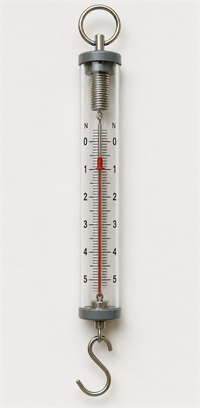
A spring balance is a simple instrument used to measure weight (force). It has a spring fixed at one end and a hook at the other end. When an object is hung from the hook, the spring stretches, and the amount of stretch indicates the weight of the object.
The balance has a scale marked in newtons (\(N\)) to show weight. It often also has a scale showing mass in grams (\(g\)). The mass readings are based on the assumption that the spring balance is used on Earth, where the Earth’s gravitational force acts on the object.
Activity: To determine the least count (smallest value that can be measured) of a spring balance by observing its scale.
A spring balance
Step 1: Observe the scale of the spring balance carefully.
Step 2: Note the difference in weight between two consecutive larger markings.
Step 3: Count the number of smaller divisions present between these two larger markings.
Step 4: Calculate the value of one small division using the formula:
\(Least\ count\ =\) \(\frac{\text{Difference between two consecutive larger markings}}{\text{Number of smaller divisions}}\)
Step 5: Record the least count of the spring balance.
Observation:
Difference between two consecutive larger markings \(=\ 1\ N\)
Number of smaller divisions between them \(=\ 10\)
Least Count of the spring balance \(=\ \frac{1N}{10}\ =\ 0.1\ N\)
Therefore, the smallest weight that can be measured by the spring balance is \(0.1\ N\).
Conclusion:
The least count of the given spring balance is \(0.1\ N\). Hence, the smallest weight that can be measured accurately using this spring balance is \(0.1\ N\). Before using any measuring instrument, its least count should always be determined to ensure accurate measurements.
Measuring mass and weight:
The mass of an object can be measured in two ways:
Indirectly by measuring its weight using a spring balance.
By comparing it with the weight of an object of known mass using a beam balance.
Since an object’s weight stays almost the same everywhere on Earth, it is usually acceptable to weigh an object to find its mass in practical situations.
Mass:
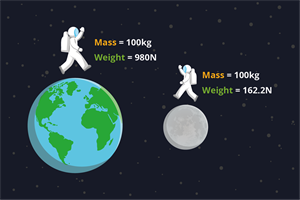
Mass is the amount of matter in an object. It is measured in grams (\(g\)) or kilograms (\(kg\)). Its value remains the same everywhere.
Weight:
Weight is the force of gravity acting on an object. It depends on the gravitational pull of the planet. Since gravity can vary slightly in different places on Earth (and greatly on other planets), weight can change, but mass does not.
Mass and weight in everyday life:
In daily life, we are usually more concerned with the amount of matter in an object (mass) rather than the gravitational force on it (weight). Often, we use the unit of mass but speak of it as weight.
For example, we say a wheat bag “weighs \(10 kg\)”, but scientifically, this actually refers to its mass, not weight. It is important to use the correct terms and units in scientific contexts, even if everyday language is more casual.
Mass and weight
Buoyant force:
The force exerted by a liquid on an object in the upward direction is called upthrust or buoyant force.
Buoyant force in liquids:
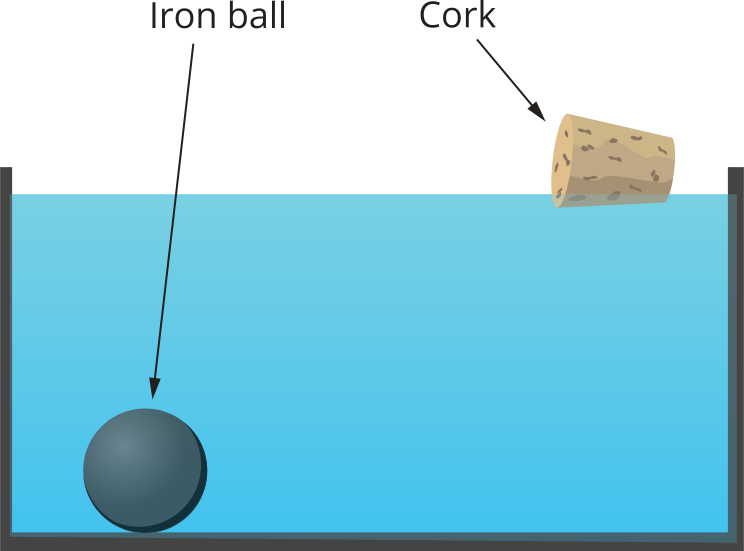
When an object is placed in a liquid, the Earth’s gravity pulls it downward, while the liquid applies an upward buoyant force on it.
If the gravitational force is greater than the buoyant force, the object sinks.
If the gravitational force equals the buoyant force, the object floats.
The magnitude of the buoyant force depends on factors such as the density of the liquid.
Buoyancy of cork and iron ball
Archimedes’ principle:
Archimedes, a famous Greek scientist, discovered that when an object is fully or partially immersed in a liquid, it experiences an upward force equal to the weight of the liquid it displaces. This is called Archimedes’ Principle.
If the weight of the liquid displaced is less than the weight of the object, the object sinks.
If the weight of the liquid displaced is equal to the weight of the object, the object floats.
Floating and sinking:
When you take water from a bucket using a mug, you might notice that the mug feels lighter when it is inside the water. This happens because the upward force (buoyant force) from the water partially supports the mug’s weight.
When objects are placed on water: Some float, while others sink. Even though gravity pulls all objects downward, the buoyant force from the liquid prevents some objects from sinking.