

Activity: To observe how different objects stretch a spring and understand that weight is the force with which the Earth pulls an object.
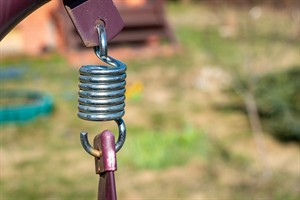
An object suspended in a spring
Step 1: Take a spring and objects of different masses, such as a pencil box, a tiffin box, and a small stone.
Step 2: Hang one end of the spring from a nail.Attach one object (for example, the pencil box) to the free end of the spring and observe if the spring stretches.
Step 3: Remove the first object and repeat the process with the other objects one by one.
Step 4: Notice and compare the amount of stretch caused by each object.
Observation:
The spring stretches when an object is hung from it. Different objects cause different amounts of stretch.
Conclusion:
The stretch in the spring is due to the force with which the Earth pulls the object (weight). Since different objects stretch the spring differently, the Earth exerts different forces on them.
A spring can be used to measure the weight of an object because the amount of stretch depends on the weight.
Spring balance:
A spring balance is a simple instrument used to measure weight (force). It has a spring fixed at one end and a hook at the other end. When an object is hung from the hook, the spring stretches, and the amount of stretch indicates the weight of the object.
The balance has a scale marked in newtons (\(N\)) to show weight. It often also has a scale showing mass in grams (\(g\)). The mass readings are based on the assumption that the spring balance is used on Earth, where the Earth’s gravitational force acts on the object.
Activity: To measure the weight of different objects using a spring balance.
Step 1: Take a spring balance and ensure that the object to be measured is within its maximum capacity.
Step 2: Suspend the object gently from the hook of the spring balance.
Step 3: Allow the spring to come to rest.
Step 4: Read the weight indicated on the scale carefully.
Step 5: Record the readings in the observation table and repeat the steps for other objects.
Observation:
| S.No. | Object | Weight (\(N\)) |
| 1. | Pencil box | \(2.0 N\) |
| 2. | Partially filled water bottle | \(4.0 N\) |
| 3. | Eraser | \(0.6 N\) |
| 4. | Geometry box | \(3.0 N\) |
Conclusion:
- The weight of different objects can be measured accurately using a spring balance by suspending them from the hook and noting the scale reading.
- Care should be taken to ensure that the object does not exceed the maximum limit of the spring balance to prevent damage.
Measuring mass and weight:
The mass of an object can be measured in two ways:
- Indirectly by measuring its weight using a spring balance.
- By comparing it with the weight of an object of known mass using a beam balance.
Since an object’s weight stays almost the same everywhere on Earth, it is usually acceptable to weigh an object to find its mass in practical situations.
Mass:
Mass is the amount of matter in an object. It is measured in grams (\(g\)) or kilograms (\(kg\)). Its value remains the same everywhere.
Weight:
Weight is the force of gravity acting on an object. It depends on the gravitational pull of the planet. Since gravity can vary slightly in different places on Earth (and greatly on other planets), weight can change, but mass does not.
Mass and weight in everyday life:
In daily life, we are usually more concerned with the amount of matter in an object (mass) rather than the gravitational force on it (weight). Often, we use the unit of mass but speak of it as weight.
For example, we say a wheat bag “weighs \(10 kg\)”, but scientifically, this actually refers to its mass, not weight. It is important to use the correct terms and units in scientific contexts, even if everyday language is more casual.
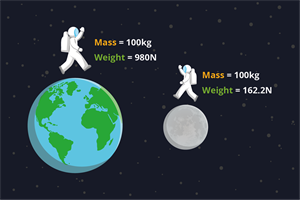
Mass and weight
Reference:
https://pixabay.com/photos/spring-swing-suspension-detail-5142429/