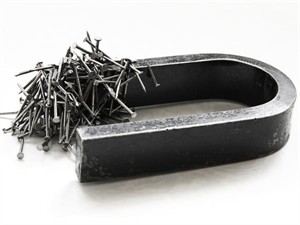
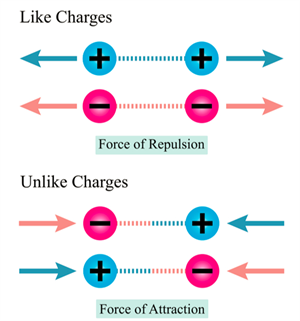
When you push a table, your hand applies a force on the table. In this situation, your hand and the table are two objects that interact with each other. This interaction results in the application of force.
Objects involved in applying force:
In all the actions, there are always at least two objects involved. For example, a bat and a ball, a hand and a drawer, or a foot and a football. Force is produced only when two objects interact with each other in some way.
From these examples, we can infer that a force comes into existence only when there is interaction between two objects. A single object by itself cannot produce a force.
Force:
A force is defined as a push or a pull on an object resulting from its interaction with another object.
Unit of force:
The SI unit of force is the newton, written with a small ‘n’, and its symbol is \(N\).
Forces acting on a stationary object:
If an object is at rest, it does not mean that no force is acting on it. Instead, it means that the forces acting on the object are balanced. When forces balance each other, there is no change in the state of rest or motion of the object.
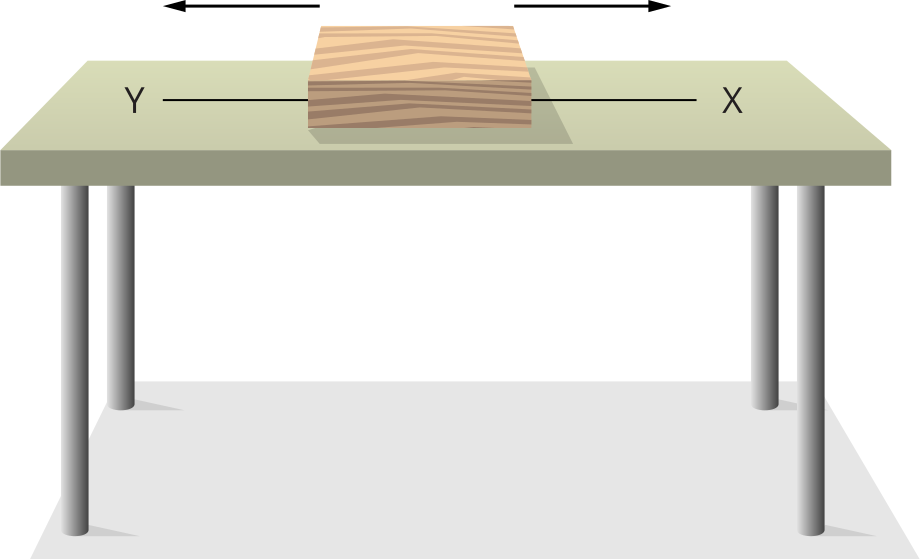
Balanced force acting on the wooden block
Forces act in pairs:
- When you push a table or car with your hand, you also feel a force acting on your hand.
- This force exists only as long as you are pushing the table or car.
- The moment you stop pushing, the force on your hand disappears.
- This shows that whenever two objects interact, each object experiences a force exerted by the other.
- When the interaction between the two objects stops, the forces acting on them also cease.