

Mirrors and lenses are important optical devices that help us understand how light behaves when it is reflected or refracted. Depending on their shape and structure, they can change the direction of light rays and form images of different sizes and orientations.
Concave mirror:
A concave mirror is a spherical mirror whose reflecting surface curves inward, like the inside of a bowl or spoon. The inner curved side is the reflecting surface and the non-reflecting surface of the mirror is the shaded part. It mostly forms enlarged and inverted images.
Convex mirror:
A convex mirror is a spherical mirror whose reflecting surface curves outward, like the back of a spoon. The outer curved side is the reflecting surface and the non-reflecting surface of the mirror is the shaded part. It forms erect and smaller images.
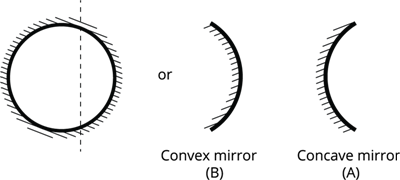
Mirrors and its types
Comparison of images formed by different mirrors:
| Type of mirror | Position of object | Orientation | Size of image |
|
Concave mirror
|
Close to the mirror | Erect (upright) | Enlarged |
| Concave mirror | Far from the mirror | Inverted | Smaller as the object moves away |
| Convex mirror | Close to the mirror | Erect (upright) | Smaller |
| Convex mirrror | Far from the mirror | Erect (upright) | Much smaller, size decreases slightly as the object moves away |
| Plane mirror | Any position | Erect (upright) | Same size |
The common characteristic of all the three mirrors is the lateral inversion.
Lateral inversion:
Lateral inversion is the phenomenon in which the left side of an object appears as the right side and the right side appears as the left side in its mirror image.
Uses of concave mirrors:
1. Torches and vehicle headlights:
- The reflectors are concave in shape.
- They focus light into a strong, bright beam.
2. Dentist’s mirror:
- Provides an enlarged view of teeth when held close to the mouth.
3. Telescopes:
- Most modern reflecting telescopes use concave mirrors as the main mirror.
- They gather and focus light from distant objects like stars and planets.
Uses of convex mirrors:
1. Vehicle side-view mirrors:
- Always form erect and smaller (diminished) images.
- Provide a wider field of view of the road behind.
2. Road safety at intersections and sharp bends:
- Allow drivers to see traffic coming from the other side.
- Help prevent collisions.
3. Security in large stores:
- Monitor a large area to deter thefts.
Lens:
A lens is a transparent piece of glass or plastic that bends (refracts) light rays passing through it. Lenses are thicker or thinner at the center or edges, which changes how light rays travel through them.
Convex lens:
A convex lens is a lens that is thicker in the middle and thinner at the edges. It converges the light rays passing through it at a point called the focus. Hence, it is also known as a converging lens.

Convex lens
Concave lens:
A concave lens is a lens that is thinner in the middle and thicker at the edges. It diverges the light rays passing through it. Hence, it is also called a diverging lens.
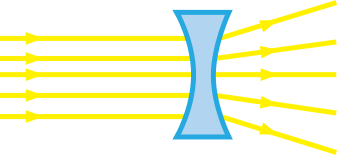
Concave lens
Characteristics of lenses:
- Convex lens: When the object is placed close to the lens, the image appears erect and enlarged. As the object is moved farther, the image becomes inverted. The image is initially enlarged, and then becomes smaller as the distance increases.
- Concave lens: The image is always erect and diminished in size. As the distance between the object and lens increases, the image size slightly decreases.
- A convex lens can form both erect and inverted images depending on the distance of the object.
- A concave lens always forms an erect, and diminished image irrespective of the distance.
- The convex lens brings parallel beams of light together, so it is called a converging lens.
- The concave lens spreads parallel beams of light apart, so it is called a diverging lens.
- The thin glass plate does not change the direction of the light beams.
Uses of lens:
1. Lenses in eyeglasses:
- Many people wear eyeglasses to correct their vision.
- Eyeglass lenses help focus light properly on the retina so we can see sharp, clear images.
2. Lenses in optical instruments:
- Lenses are the key parts of many scientific and optical instruments.
- Cameras use lenses to focus light and form clear pictures on a film or sensor.
- Telescopes use combinations of lenses to make distant celestial objects appear closer.
- Microscopes use lenses to magnify tiny objects that cannot be seen with the naked eye.
3. The lens in the human eye:
- Even our eye contains a convex lens inside it.
- This natural lens focuses light on the retina, forming images that our brain interprets.
- Unlike glass lenses, the eye’s lens is flexible, it can change its shape to adjust focus.