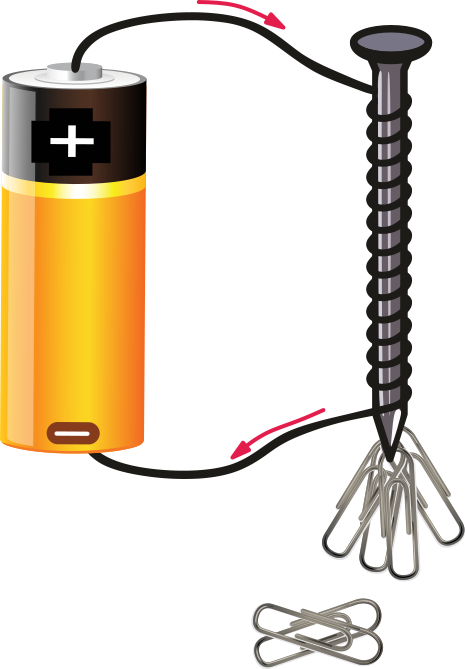
When electric current flows through a coil of wire, it produces a magnetic field. If an iron object is placed inside this coil, the magnetic effect becomes much stronger. Such a magnet formed using electric current is called an electromagnet
 
Let us perform an activity to understand about this electromagnet.
Activity: To make a simple electromagnet.
 
shutterstock1586415382.svg
 
Step 1: Take a flexible insulated copper wire (about 50 cm long), a soft iron nail, an electric cell, and a few small steel pins.
Step 2: Wind the insulated wire tightly around the soft iron bolt to form a coil and secure it with adhesive tape.
Step 3: Connect the free ends of the wire to the terminals of the electric cell for a few seconds.
Step 4: Bring the bolt close to the steel pins and try to lift them.
Step 5: Observe whether the steel pins stick to the bolt when electric current flows.
Step 6: Disconnect the wire from the cell and observe what happens to the steel pins.
 
Observation:
  • When electric current flows through the coil wound around the soft iron nail, the bolt attracts the steel pins and lifts them, showing that it behaves like a magnet.
  • When the current is switched off, the steel pins fall down immediately, indicating that the magnetic effect disappears.
Conclusion:
 
A soft iron nail becomes magnetic only when electric current flows through the surrounding coil. The magnetism produced is temporary and disappears when the current is stopped. Therefore, the arrangement acts as an electromagnet.
Let us perform an activity to investigate more about the electromagnet.
Activity: To investigate the strength of an electromagnet.
 
Step 1: Take a long insulated copper wire (about 100 cm), a hollow pen refill, a soft iron rod, an electric cell, two magnetic compasses, and small steel screws.
Step 2: Wind about \(40\)–\(50\) tight turns of the insulated wire around the plastic tube to form a cylindrical coil and secure it with adhesive tape.
Step 3: Place one magnetic compass near each end of the coil and keep the circuit open initially.
Step 4: Connect the coil to the cell to allow current to flow and observe the deflection of both compass needles.
Step 5: Disconnect the cell and note whether the compass needles return to their original north–south direction.
Step 6: Insert the soft iron rod into the coil, reconnect the cell, and observe the increased deflection of the compass needles and attraction of steel washers or screws.
 
Observation:
  • When electric current flows through the coil, the compass needles placed near its ends deflect, showing that a magnetic field is produced.
  • After inserting the soft iron rod inside the coil, the deflection of the compass needles becomes larger, indicating a stronger magnetic field.
  • The steel screws are attracted towards the ends of the rod only when current flows.
  • When the current is switched off, the magnetic effect disappears and the washers fall down.
Conclusion:
 
A current-carrying coil behaves like a magnet, and inserting a soft iron core significantly increases its strength. The magnetic effect exists only while electric current flows through the coil. Such a temporary but strong magnet formed using electric current is called an electromagnet.
 
Electromagnet:
 
An electromagnet is a temporary magnet produced when electric current flows through a coil of wire, generally wound around a soft iron core. The magnetic field exists only as long as the current flows and disappears when the current is switched off. The strength of an electromagnet can be increased or decreased by changing the current or the number of turns of the coil, and its magnetic poles can be reversed by reversing the direction of current.
Activity: To identify the poles of an electromagnet.
 
Step 1: Take the electromagnet, a small magnetic compass, and a bar magnet.
Step 2: Label the two ends of the electromagnet as X and Y.
Step 3: Place the magnetic compass close to end X of the electromagnet.
Step 4: Switch ON the current and observe which end of the compass needle is attracted towards end X.
Step 5: Compare this attraction with the known poles of the bar magnet to identify the polarity of end X.
Step 6: Repeat the same procedure near end Y of the electromagnet.
 
Observation:
  • When electric current flows through the coil, the compass needle deflects near both ends of the electromagnet.
  • If the north pole of the compass needle is attracted towards end X, then end X behaves as a south pole.
  • When the compass is placed near end Y, the opposite pole of the compass is attracted.
  • This shows that the two ends of the electromagnet have opposite magnetic polarities.
Conclusion:
 
An electromagnet has two distinct magnetic poles, similar to a bar magnet. The polarity at one end is always opposite to that at the other end. Hence, an electromagnet behaves like a magnet as long as electric current flows through it. 

Electromagnet:

An electromagnet is a temporary magnet formed when electric current flows through a coil of wire wound around a soft iron core, which becomes magnetic only while the current is flowing.
 
Strength of an electromagnet:

The strength of an electromagnet is the intensity of its magnetic field produced by a current-carrying coil, which increases when a soft iron core is inserted and exists only as long as electric current flows.
 
Poles of an electromagnet:

The poles of an electromagnet are the two opposite magnetic ends produced at a current-carrying coil, whose polarity depends on the direction of electric current and disappears when the current is switched off
 
Factors affecting the strength of an electromagnet:
 
  • Increasing the number of cells increases the current and strengthens the electromagnet.
  • Increasing the number of turns of the coil increases the magnetic field.
  • Changing the direction of current reverses the poles of the electromagnet.
 
Lifting electromagnets:
 
Lifting electromagnets are powerful electromagnets attached to cranes. When electric current is switched ON, the electromagnet becomes strong and can lift heavy iron or steel objects. When the current is switched OFF, the magnetic field disappears and the objects are released. These electromagnets are commonly used in factories and scrap yards to lift, move, and sort heavy metal items efficiently.
 
shutterstock1651414597w600.jpg
Lifting electro magnets
 
Earth as a magnet:
 
The Earth itself behaves like a giant magnet. Deep inside the Earth, the movement of molten iron in the core produces electric currents, which create Earth’s magnetic field. Many birds and animals use this magnetic field for navigation. This field also protects the Earth by deflecting harmful charged particles coming from space.