
When electric current passes through a conductor, it can produce heat as a result of the resistance offered to the flow of current. This heating effect can be observed in simple experiments and is also used in many everyday appliances.
 
Resistance in conductors:
 
When electric current flows through a conductor, it experiences resistance, which is the opposition to the flow of current. Different conductors offer different amounts of resistance. For example, a nichrome wire; which is an alloy of Nickel and Chromium, has a much higher resistance than a copper wire of the same length and thickness.
 
Heating due to electric current:
 
Because of this resistance, a part of the electrical energy is converted into heat energy as current passes through the conductor. As a result, the conductor becomes warm. This effect can be easily observed in a nichrome wire when current flows through it.
 
Heating effect of electric current
The warming of a conductor due to the flow of electric current is called the heating effect of electric current. This effect is widely used in devices such as electric heaters, irons, and bulbs. 
Heating effect of electric current in household appliances
 
An incandescent bulb glows because its filament becomes hot when electric current passes through it. This heating of the filament produces light
 
bulbaspirationhandtouchw600 (1).jpg
Heat radiation from an incandescent bulb
 
The same heating effect of electric current is used in many household appliances such as electric heaters, stoves, irons, immersion rods, water heaters, kettles, and hair dryers.
 
These appliances contain a wire or coil called a heating element, which becomes hot when current flows through it. In some appliances, the heating element is visible and can be seen glowing red hot.
 
Uses of the heating effect:
 
The heating effect of electric current is very useful in everyday life. It helps in cooking food, heating water, ironing clothes, and operating various electrical appliances used at home.
 
Harmful effects and safety measures:
 
Sometimes, the heating effect can be harmful. Electrical energy may be wasted as heat during transmission through wires. Excessive heating can damage plugs and sockets by melting plastic parts and may even cause fires. To prevent such accidents, safety devices such as fuses are installed in household electric circuits to protect appliances and ensure safe use.
 
Electric cells are devices that produce electrical energy using chemical reactions. Different types of cells have been developed to meet various needs, from simple laboratory cells to batteries used in everyday appliances.
 
Voltaic cell:
 
A Voltaic cell, also called a Galvanic cell, is a device used to produce electricity from chemical reactions.
 
Construction of a voltaic cell:
 
It consists of two metal plates made of different materials placed inside a glass or plastic container. The container holds a liquid known as an electrolyte.
 
Electrodes and electrolyte:
 
The metal plates, called electrodes, are partially dipped into the electrolyte, which is usually a weak acid or a salt solution. The electrolyte allows the chemical reaction to take place.
 
shutterstock1308127603w600.jpg
A simple voltaic cell
 
Working of a voltaic cell:
 
A chemical reaction between the electrodes and the electrolyte produces electrical energy. When the cell is connected to an external circuit, electric current flows from the positive terminal to the negative terminal through the circuit.
 
Life of a voltaic cell:
 
Over time, the chemicals involved in the reaction get used up. When this happens, the cell stops producing electricity and is then called a ‘dead’ cell, as it can no longer supply electrical energy
 
Dry cells:
 
Voltaic cells were a major scientific advancement, but they are not practical for daily use. For this reason, dry cells are commonly used as a convenient source of electric power in everyday devices.
 
Why they are called dry cells:
 
Dry cells are known as “dry” because the electrolyte inside them is not a free-flowing liquid. Instead, it is present in the form of a thick, moist paste, which makes the cell safer and easier to handle.
 
Construction of a dry cell:
 
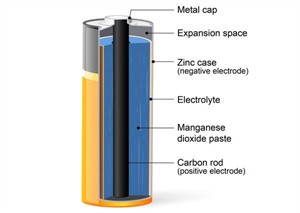
A dry cell consists of a zinc container that serves as the negative terminal. At the centre, there is a carbon rod fitted with a metal cap, which acts as the positive terminal. The carbon rod is surrounded by the paste-like electrolyte.
 
shutterstock471050654w600.jpg
Parts of a dry cell
 
Uses and limitations:
 
A dry cell is a single-use cell; once it is exhausted, it cannot be reused and must be discarded. For many modern applications, rechargeable batteries are now preferred because they can be used multiple times.
 
Rechargeable batteries:
 
Advantages:
 
Rechargeable batteries can be charged and used repeatedly. This reduces waste and helps save money over a long period of time.
 
Types and applications:
 
There are many types of rechargeable batteries designed for different purposes. Small rechargeable batteries are used in devices such as watches and mobile phones, while larger ones power laptops and tablets. Even bigger rechargeable batteries are used in inverters and electric vehicles.
 
Limitations of rechargeable batteries:
 
Although rechargeable batteries can be reused many times, they do not last forever. After repeated charging and discharging, their performance gradually decreases and they eventually wear out.