A force is a push or a pull that can change the shape, speed, direction, or position of an object. Some forces act only when objects are in contact with each other, while others can act even when objects are not touching.
 
Here, we will study non-contact forces, which act from a distance without direct physical contact. Magnetic force, electrostatic force, and gravitational force are important examples of non-contact forces that we experience in our daily life.
 
Non-contact forces: 
Non-contact forces are forces that act on objects without any physical contact between them.
Let us understand non-contact forces with an example.
 
Magnetic force: 
 
A magnet can attract objects made of magnetic materials like iron. When two magnets are brought close, like poles (North–North or South–South) push each other away, while unlike poles (North–South) pull each other towards each other.
 
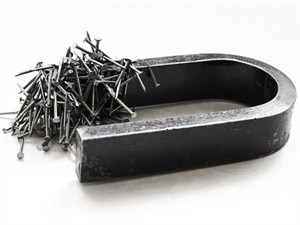
shutterstock99525080w600.jpg
A horseshoe magnet attracting iron nails
 
In an earlier chapter, we also learnt about electromagnets, which act like ordinary magnets. The attraction and repulsion between magnets are examples of push and pull, which means they are forces.
 
A magnet can exert force on another magnet or a magnetic object without touching it. This shows that magnetic force is a non-contact force.
Activity: To test magnetic force.
 
Step1: Take two ring magnets and a wooden stick and place the stick vertically on a table.
Step 2: Put one ring magnet on the stick.
Step 3: Place the second ring magnet above it with like poles facing each other.
Step 4: Observe the position of the upper magnet and gently push it down.
Step 5: Reverse the poles of the magnets and observe again.
 
Observation
 
  • When like poles of the two magnets face each other, the upper magnet floats above the lower magnet.
  • On pushing the upper magnet gently, a repelling force is felt.
  • When the poles are reversed, the upper magnet does not float and moves closer to the lower magnet. 
Conclusion:
 
A magnet can exert a force on another magnet without touching it. This shows that magnetic force is a non-contact force.
 Magnetic force:
Magnetic force is the force exerted by a magnet on another magnet or a magnetic material from a distance, without direct contact, and hence it is a non-contact force. 
Are there other forces that can act on objects from a distance without direct contact? 
Activity: To experiment on electrostatic force.
 
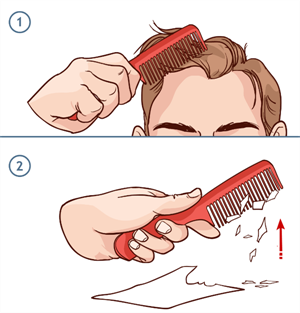
electrostaticw600.png
A comb and paper attracting each other
 
Step 1: Take a plastic comb or plastic straw, a piece of polythene, and small pieces of paper.
Step 2: Rub the plastic scale or comb vigorously with the polythene.
Step 3: Avoid touching the rubbed part with your hand or any metal object.
Step 4: Bring the rubbed plastic scale or comb close to the paper pieces placed on a table without touching them.
 
Observation:
 
The small pieces of paper are attracted towards the plastic scale or comb and stick to it.
 
Conclusion:
 
Rubbing the plastic scale or comb produces electrostatic force, which attracts the paper pieces without contact. This shows that electrostatic force is a non-contact force. 
Static electric charges:
 
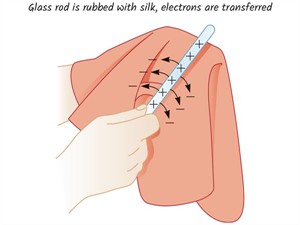
When two objects made of certain materials are rubbed together, electric charges develop on their surfaces. These charges remain at rest and are therefore called static charges. An object that gains such charges is known as a charged object.
 
Force exerted by a charged object:
 
A charged object can attract uncharged objects made of certain materials, such as small pieces of paper. This attraction means that the charged object exerts a force on them.
This force acts without direct contact between the objects. Hence, it is an example of a non-contact force.
 
Let us perform another activity using objects made of different materials to understand this force better.
Activity: To study attraction and repulsion due to electric charges.
 
Step 1: Take two balloons, a piece of thread, and a woollen cloth.
Step 2: Inflate the balloons and hang them using the thread so that they do not touch each other.
Step 3: Rub both balloons with the woollen cloth.
Step 4: Release the balloons carefully without touching them with your fingers.
Step 5: Bring the woollen cloth close to one of the rubbed balloons.
 
Observation:
 
  • After rubbing, the two balloons move away from each other, showing repulsion.
  • When the woollen cloth is brought near a rubbed balloon, the balloon moves towards the cloth, showing attraction.
 
Conclusion:
 
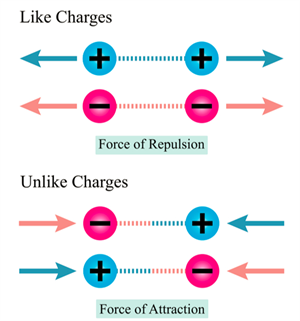
Objects that have the same kind of electric charge repel each other, while objects with different kinds of electric charges attract each other.
Types of static electric charges:
 
  • When both balloons are charged in the same manner, they acquire similar charges. Since the similarly charged balloons move away from each other, we can conclude that like charges repel each other.
  • During rubbing, both the rubbing object and the object being rubbed become charged, but they acquire opposite kinds of charges. Their attraction shows that unlike charges attract each other.
  • The two types of static electric charges are called positive and negative
Screenshot20211026100726.png
Like and unlike charges
 
Electrostatic force:
Electrostatic force is the force exerted by a charged object on another charged or uncharged object without direct contact, and hence it is a non-contact force. 
Electric current:
 
When electric charges start moving, they form an electric current in an electrical circuit. This current is responsible for making a lamp glow, producing heat, and creating magnetic effects.
 
shutterstock12782115162w600.jpg
Transfer of electrons 
Activity: To observe the effect of Earth’s gravitational force on objects.