

In our daily activities, we often apply force in different forms such as opening a drawer, stretching a rubber band, stopping a moving ball, kicking a football, applying brakes on a bicycle, rolling a chapati, or turning the steering handle of an autorickshaw. These actions involve either a push or a pull.
Force is a push or a pull that occurs when two objects interact. It plays an important role in our daily activities such as pushing, pulling, lifting, or moving objects. Forces can start motion, stop motion, change speed, direction, or even the shape of objects. Understanding force helps us explain many everyday actions around us.
Effect of force in everyday life:
Effects of applying force on objects:
The application of force on an object can produce the following effects.
Starting motion:
A force can make a stationary object move, such as pushing a door to open it.
Changing speed:
A force can increase or decrease the speed of a moving object, like applying brakes to slow down a bicycle.
Changing direction of motion:
A force can change the direction in which an object is moving, for example, hitting a moving ball with a bat.
Changing shape:
A force can change the shape of an object, such as stretching a rubber band, squeezing a lemon or rolling a chapati.
Producing multiple effects:
In some cases, a force may cause more than one effect at the same time.
Interaction between objects:
When you push a table, your hand applies a force on the table. In this situation, your hand and the table are two objects that interact with each other. This interaction results in the application of force.
Force:
A force is defined as a push or a pull on an object resulting from its interaction with another object.
Unit of force:
The SI unit of force is the newton, written with a small ‘n’, and its symbol is \(N\).
Forces acting on a stationary object:
If an object is at rest, it does not mean that no force is acting on it. Instead, it means that the forces acting on the object are balanced. When forces balance each other, there is no change in the state of rest or motion of the object.
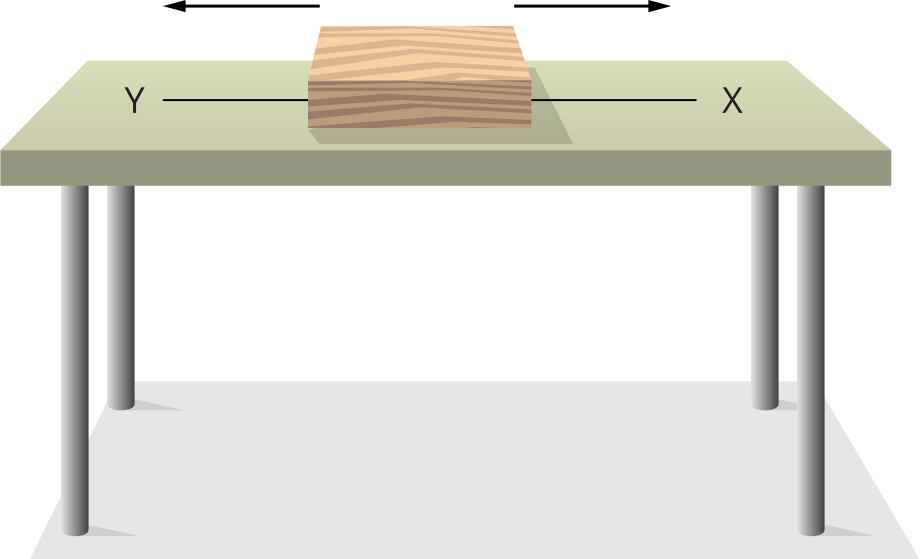
Balanced force acting on the wooden block
Forces act in pairs:
- When you push a table or car with your hand, you also feel a force acting on your hand.
- This force exists only as long as you are pushing the table or car.
- The moment you stop pushing, the force on your hand disappears.
- This shows that whenever two objects interact, each object experiences a force exerted by the other.
- When the interaction between the two objects stops, the forces acting on them also cease.
Contact forces:
Contact forces are forces that act only when two objects are in physical contact with each other.
These forces occur whenever we push, pull, or move objects by touching them. Contact can be direct, like using our hands or feet, or indirect, such as using tools like sticks, ropes, or levers. They are essential for performing tasks in both humans and animals.
Muscular force:
Muscular force is the force generated by the contraction and relaxation of muscles in the body during physical activity.
Muscular force allows us to perform actions such as walking, running, jumping, lifting, pushing, or stretching. Animals, birds, fish, and insects also depend on muscular force for movement and survival. In history, humans have relied on the muscular strength of animals, such as oxen or horses, to carry loads or pull carts. Muscular force is a fundamental example of a contact force in everyday life.
Role of muscular force in the body:
Muscular force is essential for many internal functions of our body. It helps us chew food and move it through the alimentary canal during digestion. The contraction and relaxation of heart muscles pump blood throughout the body, a process vital for survival.
Friction:
When a ball rolls on a flat surface, it eventually comes to a stop on its own. Similarly, if we stop pedaling a bicycle on a flat road, it slows down and halts after some time. On a rough road, the bicycle stops even sooner than on a smooth road.
Why objects slow down?
You might wonder what causes the change in speed in such situations. We know that a force is required to change the speed of an object. Even though it seems that no force is acting, the objects gradually slow down and stop. This happens because a force called friction is acting on them, opposing their motion.
Friction:
Friction is the force that comes into play when an object moves or tries to move over another surface. It always acts in a direction opposite to the motion or the attempted motion of the object.
Friction as a contact force:
Friction is a contact force because it arises due to the interaction between two surfaces in contact. It only exists when surfaces touch each other.
Cause of friction:
Friction occurs due to the irregularities on the surfaces in contact. Even surfaces that appear smooth have many tiny bumps and grooves. When two surfaces are placed together, these irregularities lock into each other, resisting any attempt to slide one surface over the other.
Friction in liquids and gases:
Does friction act only when objects move on solid surfaces? No.
Objects moving through liquids and gases also experience friction. Air, water, and other fluids exert a resistive force on objects passing through them. To reduce this friction, vehicles like aeroplanes, ships, boats, cars and high-speed trains are designed with streamlined shapes, allowing them to move more efficiently through air or water.
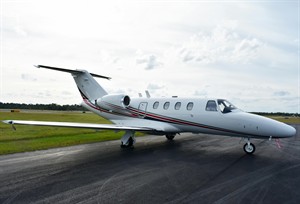
Streamlined shape of an aircraft
Reference:
https://www.pexels.com/photo/cessna-citation-aircraft-13528331/