When we observe the sky from Earth, the Sun seems to rise in the east, move across the sky, and set in the west every day, only to rise again the next morning. This repeating pattern is not because the Sun moves around us, but because the Earth rotates on its own axis. This daily movement of the Sun, as it appears to us, forms the basis of one “day,” which we use to measure time.
 
Mean solar day:
The Sun takes about 24 hours to return from its highest point in the sky on one day to the same highest point the next day. This average time interval is known as the mean solar day.
The Sun’s highest position during the day can be identified by checking the shadow of an object, it becomes the shortest at this moment.
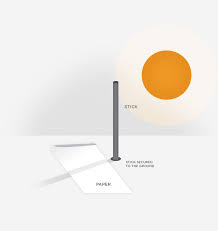
Activity: To find the duration of a solar day
 
download (4).jpg
A stick under the Sun
 
Step 1: Fix a 1 m stick vertically in a sunny flat area.
Step 2: From 11:00 a.m., mark the tip of the shadow every minute until 1:10 p.m. on a paper below.
Step 3: Identify the shortest shadow and note its time and repeat for a few days.
Step 4: Find the difference between the shortest-shadow times on two consecutive days to calculate the solar day.
Step 5: Calculate the average duration.
 
Observation:
 
The position of the shadow keeps shifting slowly as the Sun appears to move across the sky. The shortest shadow occurs when the Sun is at its highest point in the sky.The time of the shortest shadow is slightly different on different days.
 
Conclusion:
 
The time between two consecutive shortest-shadow points gives the duration of a solar day. The average duration calculated from several days is found to be almost equal to 24 hours, confirming that a day is based on the Earth’s rotation.
Solar year: 
 
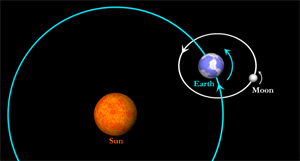
A solar year is the time the Earth takes to complete one full revolution around the Sun, which is nearly 365 and one-quarter days. During this period, the Earth passes through a complete cycle of seasons. This seasonal cycle is used to define a year, another major unit for measuring time.
 
Lunar month:
 
A lunar month is the natural time period based on the cycle of the Moon’s phases. The Moon takes about 29.5 days (almost one month) to move through all its phases, from new moon to full moon and back again. This repeating pattern of phases forms the basis of a month, which is used as a unit to measure time.
 
8927251_orig.png 
Earth and Moon's revolution
 
Lunar calendar:
A lunar calendar is a time-keeping system based on the phases of the Moon, in which the day is the smallest unit, each month lasts about 29.5 days, and a lunar year is made up of 12 lunar months, totalling roughly 354 days
In ancient times, people observed that almost 12 cycles of the Moon’s phases fit into one complete cycle of seasons. This led to the creation of lunar calendars, which used the day as the smallest unit, a month of about 29.5 days, and a lunar year made up of 12 lunar months. The repeating phases of the Moon provided a simple and reliable method to measure the passing of time.
 
2025_Lunar_Calendar.png
Lunar calendar

However, the seasons do not stay aligned with the same lunar months each year in a lunar calendar. This happens because the seasonal cycle takes about 365 days, while a lunar year has only 354 days, creating a mismatch.
 
Solar calendar:
 
It was necessary to know when different seasons would arrive, especially for farming. To match the year with the cycle of seasons, solar calendars were developed. The Gregorian calendar, which is commonly used today, is one such solar calendar.
A solar calendar is a calendar system designed to stay in step with the seasons, based on the time the Earth takes to complete one revolution around the Sun.
In such calendars, the months are adjusted to total 365 days, which is why different months have 30 or 31 days, and February has 28 days in a normal year.
 
Besides the 365 days, the Earth needs almost an extra quarter of a day to finish one full orbit around the Sun. Over four years, these extra hours add up to nearly one whole day. To correct this difference, solar calendars include an additional day every four years, which is known as a leap year.
 
Leap year corrections and calendar accuracy:
 
  • The Earth takes slightly less than 365¼ days to move from one spring equinox to the next.
  • Adding a day every four years helps align the calendar with the seasons, but this slightly overcompensates over time.
  • To correct it, leap years are skipped every 100 years, such as 1700, 1800, and 1900. However, skipping all of them would cause the calendar to fall behind, so every 400 years, a leap year is added back, as in 1600 and 2000.
  • These adjustments ensure the calendar stays closely aligned with the seasons over long periods.
 
Tropical year and Sidereal year:
 
  • Seasons occur due to the Earth’s revolution around the Sun, as it moves from the spring equinox to the winter equinox and back.
  • The time interval between two successive spring equinoxes is called the tropical year, and the Gregorian calendar is based on this.
  • The stars that appear at sunset also change throughout the year because of the Earth’s revolution.
  • The time taken for the same stars to appear again at sunset is called the sidereal year, which can also be used to define a solar calendar.
  • The sidereal year is slightly longer than the tropical year by about 20 minutes, so it takes a long time before the difference between the two becomes noticeable.
  • Today, astronomers use the sidereal year to track the Earth’s position in its orbit around the Sun.
Leap year:
A leap year is a special year in a solar calendar in which one extra day is added to adjust for the fact that the Earth takes about 365¼ days to orbit the Sun.
In the Gregorian calendar, a year divisible by four gets this extra day, making February 29 days long, and keeping the calendar aligned with the seasons.
 
Luni-Solar calendar:
 
Another type of calendar mainly uses the Moon’s phases to count days and months but also makes adjustments to stay aligned with the seasons. Twelve lunar months add up to about 354 days, which is nearly 11 days shorter than a solar year. Over 2–3 years, this difference accumulates to almost a full month. To correct this, an extra month, called Adhika Maasa or an intercalary month, is added every few years. This keeps the lunar months and the solar year in sync.
A luni-solar calendar is a calendar that counts days and months using the Moon’s phases but also adjusts to stay in sync with the seasons by adding an extra month when needed.
The Indian national calendar:
 
The Government of India uses a national calendar alongside the Gregorian calendar for official purposes. It is a solar calendar with 365 days in a year. The year begins on 22 March, the day after the spring equinox. Unlike the Gregorian calendar, the months in the Indian National Calendar have either 30 or 31 days, and their names are derived from traditional Indian calendars. In a regular year, the second to sixth months have 31 days, while the remaining months have 30 days. Leap years are synchronized with the Gregorian calendar by adding a day to Chaitra, the first month, so the new year in a leap year begins on 21 March.