

Lily wondered why festivals like Diwali and Holi fall on different dates every year, and her curiosity led her to learn that many Indian festivals are fixed according to the phases of the Moon rather than the usual calendar.
Festivals based on the Moon:
Many Indian festivals depend on the phases of the Moon. So, they follow lunar or luni-solar calendars instead of the Gregorian calendar.
Examples of the Moon based festivals:
- Diwali is celebrated on the new Moon day of the month of Kartika.
- Holi is celebrated on the full Moon day of Phalguna.
- Buddha Purnima falls on the full Moon day of Vaisakha.
- Eid-ul-Fitr is celebrated after the crescent Moon is seen at the end of Ramazan.
- Dussehra is celebrated on the tenth day of the month of Ashwina.
Why festival dates change every year?
Since these festivals are based on the Moon, their dates change every year in the Gregorian calendar.
Luni-solar calendars:
In luni-solar calendars, an extra month is added once in a few years. This helps match the Moon’s cycle with the Sun’s year. Because of this, festival dates usually shift by less than one month in the Gregorian calendar.
Pure lunar calendars:
Pure lunar calendars do not add an extra month. So, festivals based only on the Moon, like Eid-ul-Fitr, can fall in different seasons and months each year in the Gregorian calendar.
Festivals based on the solar (sidereal) calendar:
- Some Indian festivals such as Makar Sankranti, Pongal, Bihu, Vaisakhi, Poila Baisakh, and Puthandu follow a solar sidereal calendar.
- These festivals usually occur on almost the same date every year in the Gregorian calendar, which is based on the Sun.
- Long ago, these festivals were linked to important Sun positions like solstices or equinoxes.
- However, the length of the sidereal year is slightly different from the tropical year used in the Gregorian calendar.
- Because of this small difference and the slow wobbling of the Earth’s axis, the dates of these festivals slowly move away from the solstices and equinoxes.
- As a result, festivals based on the sidereal calendar slowly shift forward in the Gregorian calendar.
Example:
Makar Sankranti moves ahead by about one day every 71 years.
How festival dates are decided in India?
- Many Indian festivals depend on the exact position of the Moon at the time of sunrise.
- Since the Sun rises earlier in Eastern India and later in Western India, the same festival can sometimes fall on different dates in different parts of the country.
- To avoid this confusion and keep the dates uniform, the Positional Astronomy Centre of the Government of India prepares the Rashtriya Panchang every year.
- This panchang contains detailed calculations of the positions of the Sun, Moon, and other celestial bodies for a central location in India.
- Using these calculations, the Centre informs the Government in advance about festival dates, which helps in declaring holidays across the country.
Why do we launch artificial satellites into space?
- The Moon is the Earth’s natural satellite because it moves around our planet.
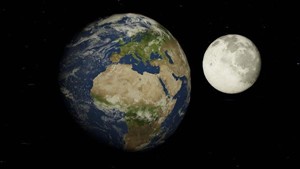
The Moon - Earth's natural satellite
- Apart from the Moon, humans have also sent artificial satellites into space.
- These are man-made objects launched by different countries to orbit the Earth.
- At night, they can sometimes be seen as tiny moving dots in the sky.
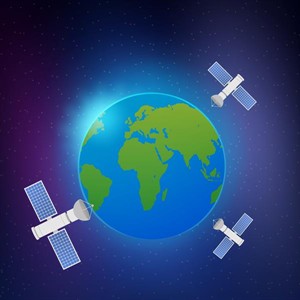
Artificial satellites
- Most artificial satellites travel at a height of about 800 km above the Earth.
- They move very fast and usually take about 100 minutes to complete one round around the Earth.
- Even though they are small, they play a very important role in our daily life.
- Artificial satellites are used for communication, navigation, weather forecasting, disaster management, and scientific research.
- In India, the Indian Space Research Organisation (ISRO) has launched many satellites to help in these fields and to improve life on Earth.
Logo of ISRO
Let us try observing an artificial satellite in the sky.
Activity: To observe and identify an artificial satellite in the night sky.
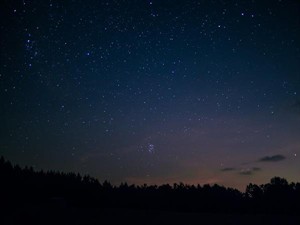
Night sky
Step 1: Choose a suitable time just after sunset or just before sunrise.
Step 2: Go to an open place with a clear view of the sky, accompanied by an adult.
Step 3: Look carefully at the sky for any moving point of light and observe the object as it moves very fast across the sky.
Step 4: Notice whether the light is steady or slightly flickering.
Step 5: Use binoculars if available, or a mobile app or website to confirm that the object is a satellite.
Observation:
A small, bright point of light was seen moving smoothly across the sky. The object did not blink like stars and moved much faster than aeroplanes. The movement was steady and lasted for a short time before it disappeared.
Conclusion:
The moving point of light observed in the sky was identified as an artificial satellite orbiting the Earth.
India’s space missions and satellites:
The Cartosat series of satellites launched by ISRO take clear pictures of the Earth. These images are used to make better maps, plan cities, and manage natural disasters in India. A mapping platform called Bhuvan uses these images to show details such as landforms, soil, land use, vegetation, and more. AstroSat is another ISRO mission that studies stars and other objects in space.
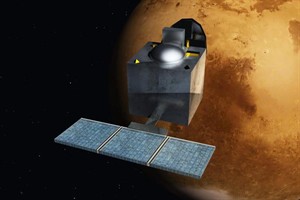
Mangalyaan
India has also sent missions like Chandrayaan-1, 2, and 3 to explore the Moon, Aditya-L1 to study the Sun, and Mangalyaan to explore Mars.
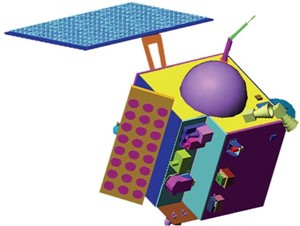
Chandrayaan-1
In addition, ISRO encourages students by helping them build and launch small satellites such as AzaadiSat, Kalamsat, InspireSat-1, and Jugnu.
Important!
The team led by Rifath Sharook built the world’s smallest satellite, Kalamsat. Rifath Sharook is an 18 year old high school student from Pallapatti near Karur, Tamil Nadu. Kalamsat, the lightweight satellite weighing only 64 − gram, was launched into space on June 22, 2017, by NASA.

Kalamsat
Space junk and its dangers:
- Many countries send a large number of artificial satellites into space. After these satellites stop working, the parts of rockets turn into space junk or space debris.
- This debris collects in space and can crash into working satellites, causing damage.
- Small pieces of space debris usually burn up when they enter the Earth’s atmosphere.
- However, bigger pieces may not burn completely and can fall on the Earth’s surface.
- Because of these dangers, countries around the world are now working together to reduce and remove space debris.
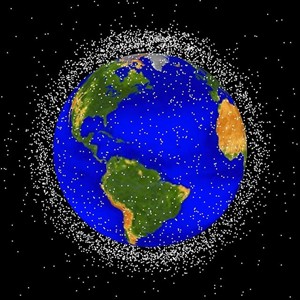
Space junks