

Darin loved watching the sky every night and was surprised to see the Moon looking different each day. Her grandmother told her that the Moon doesn’t change its shape, but we see different parts of it as it goes around the Earth. Excited, Tara decided to observe the Moon daily and discover all its changing shapes herself.
Let us perform an activity.
Activity:
To observe the Moon’s changes over a month
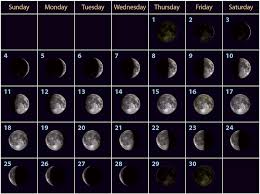
Moon phases
Step 1: Start the activity the day after a full Moon and look for the Moon at sunrise in the western sky.
Step 2: Record the date, time of observation (sunrise or sunset), and the Moon’s shape by shading the dark portion.
Step 3: From the second day onwards, note whether the bright part of the Moon is increasing or decreasing and its position relative to the Sun.
Step 4: After about 15 days, when the Moon is not visible at sunrise, continue observing it at sunset for the remaining days.
Step 5: Compare all your observations at the end to understand how the Moon’s appearance changes through its cycle.
Observation:
| Day | Moon seen at | Bright portion | Size change | Moon-Sun separation |
| 1 | Sunrise | Full | - | - |
| 2 | Sunrise | Slightly less | Decreased | Slightly farther |
| 3 | Sunrise | Half | Decreased | Farther |
| 10 | Sunrise | Crescent | Decreased | Farther |
| 16 | Sunset | Crescent | Increased | Closer |
| 30 | Sunset | Full | Increased | Closer |
Conclusion:
The Moon appears different each day due to the changing bright portion.The Moon is not visible at the same position every day, its position shifts relative to the Sun.Over about 15 days, the Moon goes from full to new (waning), and over the next 15 days, it goes from new to full again (waxing).The Moon’s apparent size of the bright portion decreases after the full Moon, reaches almost zero at new Moon, and then increases again.
Phase of the Moon:
The shape of the bright portion of the Moon that we see from Earth is called a phase. The Moon does not change shape, only the lit part we see changes.
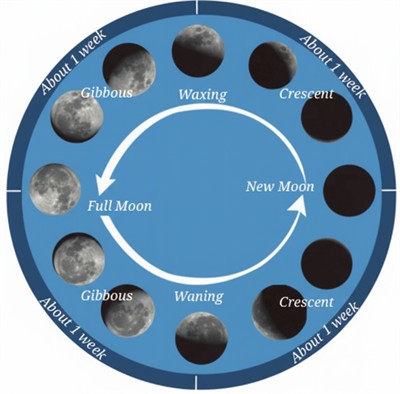
Waxing and waning period of the Moon
Full Moon:
The day when the Moon appears as a full bright circle in the sky is called the full Moon day or Purnima.
New Moon:
The day when the Moon is not visible in the sky is called the new Moon day or Amavasya.
Waning period:
The period of about two weeks after the full Moon, during which the bright portion of the Moon gradually shrinks until it is no longer visible, is called the waning period. It occurs after the Full Moon and goes until the New Moon. In India, this period is called Krishna Paksha.
Waxing period:
The period after the new Moon, during which the bright portion of the Moon gradually increases to a half circle in about a week and to a full circle in another week, is called the waxing period. It occurs after the New Moon and continues until the Full Moon. In India, this period is called Shukla Paksha.
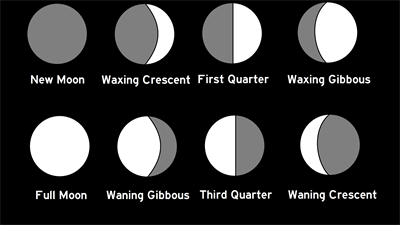
Moon phases:
Crescent Moon: When only a small part of the Moon is visible.
Waxing Crescent: Crescent during the waxing period.
Waning Crescent: Crescent during the waning period.
Gibbous Moon: When more than half of the Moon is visible but not full.
Waxing Gibbous: Gibbous during the waxing period.
Waning Gibbous: Gibbous during the waning period.
Moon cycle:
The Moon goes through a waning period followed by a waxing period in a cyclical manner. The complete cycle from one full Moon to the next takes about one month. This is called the Moon cycle.
Moon cycle