

One night, Darin noticed that only part of the Moon was bright while the rest looked dark and wondered why it appeared that way. Her grandma explained that the Moon always has one illuminated side facing the Sun and one non-illuminated side facing away. What we see from Earth depends on how much of that illuminated part is turned toward us. Curious to understand it better, Darin joined her grandma to explore this idea through a simple activity.
Locating the Moon in the Sky:
- When the Moon is observed at the same time on successive days, it appears in a different part of the sky.
- On a full Moon day, the Moon is nearly opposite the Sun, so when the Sun rises in the East, the Moon is setting in the West.
- On the following mornings at sunrise, as the bright portion of the Moon continues to decrease, it appears to move closer to the Sun in the sky.
- When the bright part reduces to a half circle, the Moon is overhead at sunrise.
- A few days later, the crescent Moon appears even closer to the Sun.
- Knowing whether the Moon is waxing or waning helps predict where and when it can be seen.
- A waxing Moon is easiest to spot at sunset, while a waning Moon is easiest to see at sunrise.
- Because of these changes, the Moon always rises and sets at times different from the Sun.
Understanding Moonrise times:
- Many people believe the Moon rises exactly when the Sun sets, but this is not always correct.
- Moonrise times published in newspapers or on the IMD’s Positional Astronomy Centre website show that the Moon rises about 50 minutes later each day.
- Sometimes, moonrise happens in the afternoon (around 2–4 p.m.), and the Moon can be seen in the eastern sky during daylight.
- It may take around 30 minutes after the listed moonrise time for the Moon to rise high enough to be visible.
- Both the time and the position of moonrise change from one day to the next.
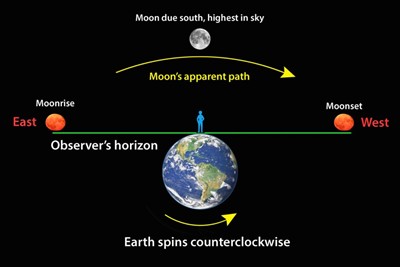
Moon rise and Earth's rotation
Making sense of Moon phases:
- The shape of the Moon never changes, only the part we see changes.
- The Moon does not emit its own light but shines by reflecting sunlight that falls on it.
- The half of the Moon facing the Sun is illuminated, while the half facing away remains dark.
- Although the Moon revolves around the Earth, only one side always faces the Earth.
- The part of the Moon that faces the Earth is not always the illuminated portion.
- We can see only the lit part of the Moon from Earth.
- Sometimes the entire illuminated portion faces the Earth, while at other times only part of it does.
- On New Moon day, the illuminated portion faces away from the Earth completely, so the Moon is not visible.
- Because the visible illuminated portion changes with the Moon’s position, the Moon appears different on different days.
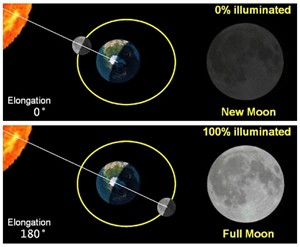
Illuminated and non-illuminated parts of Moon
Activity:
To understand the phases of Moon.
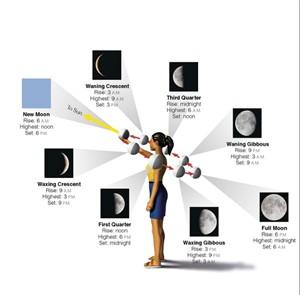
A student using a ball and torch
Step 1: Take a soft ball, insert a stick into it to represent the Moon, and go to a dark open place with a torch acting as the Sun.
Step 2: Stand facing the light source, hold the ball at arm’s length slightly above your head, and observe whether the part facing you appears illuminated.
Step 3: Slowly turn anti-clockwise while keeping your arm stretched out and keep looking at the ball to see how the illuminated portion changes.
Step 4: Notice whether the boundary between the bright and dark parts of the ball appears curved and whether the changing shapes match those shown in the Moon-phase diagram.
Step 5: Compare the different shapes you observe at various positions with the phases of the Moon, such as full Moon, new Moon, crescent, and gibbous, and relate them to how the Moon’s position changes around Earth.
Observations:
When the ball is opposite the lamp, the entire illuminated part faces you, it looks like a full Moon. When the ball is towards the lamp, the illuminated side faces away from you, you cannot see it, this is like a New Moon. At other positions, you observe crescent, half, or gibbous shapes. The boundary between light and dark on the ball is curved, similar to what we observe on the real Moon.
Conclusion:
The ball shows different illuminated shapes depending on its position relative to the torch and your eyes. Similarly, the Moon shows different phases because only the portion facing the Sun is illuminated, and the fraction of that illuminated part visible from Earth keeps changing as the Moon revolves around Earth. When the Moon appears closer to the Sun in the sky (as during New Moon), we see less of its illuminated side. When it appears opposite the Sun (Full Moon), we see the entire illuminated face.
Phases of the Moon:
The phases of the Moon are the different shapes formed by the illuminated and non-illuminated portions that we see from Earth as the Moon revolves around us.
Main Moon phases:
New Moon: The illuminated side faces away from Earth and we see only the non-illuminated side.
Full Moon: The illuminated side fully faces Earth and the non-illuminated side is hidden.
Crescent Phase: Only a small part of the illuminated portion is visible while most of the rest is non-illuminated.
Gibbous Phase: A large part of the illuminated portion is visible and only a small part is non-illuminated.
Full Moon: The illuminated side fully faces Earth and the non-illuminated side is hidden.
Crescent Phase: Only a small part of the illuminated portion is visible while most of the rest is non-illuminated.
Gibbous Phase: A large part of the illuminated portion is visible and only a small part is non-illuminated.
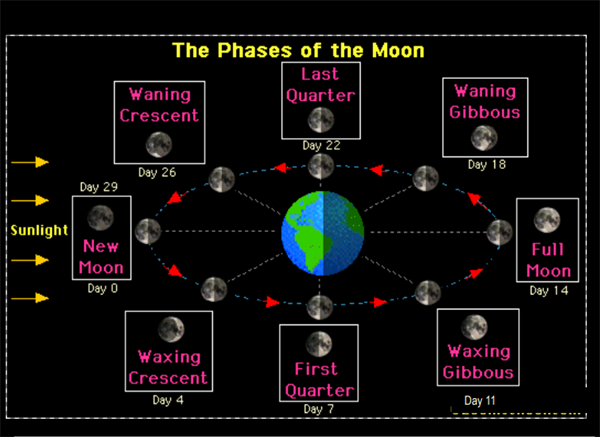
The Moon at different positions around the Earth
Changing brightness:
Waxing: The illuminated portion visible from Earth increases while the non-illuminated part decreases.
Waning: The illuminated portion decreases while the non-illuminated part increases.
Waning: The illuminated portion decreases while the non-illuminated part increases.
Reason for decrease in illumination:
The illuminated portion appears smaller when the Moon is closer to the Sun in the sky because the illuminated side faces away from Earth and the non-illuminated side faces toward us.
Why the Moon’s position shifts each day?
The Moon appears in a slightly shifted position at sunrise or sunset on successive days because the Moon moves ahead in its orbit while the Earth completes one rotation in 24 hours, and the Earth must rotate a little more for the Moon to appear in nearly the same spot in the sky.
Why Moon phases are not caused by Earth’s shadow?
Moon phases do not happen because of Earth’s shadow, instead, they occur due to the changing orientation of the Sun, Moon, and Earth as the Moon revolves around Earth, which changes how much of the illuminated and non-illuminated portions we can see. Earth’s shadow falling on the Moon causes a lunar eclipse, not the regular phases.
Why eclipses do not occur every month?
Lunar eclipses can happen only on a full Moon day, and solar eclipses only on a new Moon day, but they do not occur every month because the Moon’s orbit is slightly tilted compared to Earth’s orbit around the Sun, so the Sun, Earth, and Moon do not line up perfectly each time.
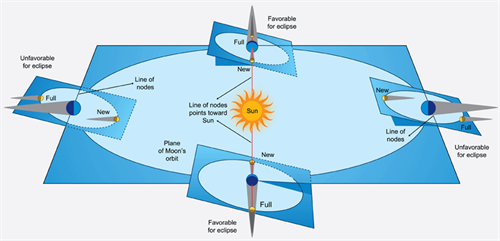
Positions favourable and unfavourable for eclipses
Reference:
https://encrypted-tbn0.gstatic.com/images?q=tbn:ANd9GcQrfmrw55egn6n2RRgtyJhAI3fb0Zx1UUMrysw5m6kxplY7ug7HVxPSTBgZNkTNRuVYtLo&usqp=CAU