

Types of calendars:
Lunar calendar:
A lunar calendar is based on Moon phases.
- One month \(=\ 29.5\) days
-
\(12\) months \(=\ 354\) days
- Seasons shift because it is shorter than solar year.
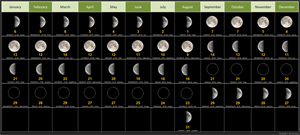
Lunar calendar
Luni-Solar calendar:
This calendar uses Moon phases but adjusts to match seasons.
- An extra month (Adhika Maasa) is added every few years.
- Keeps lunar months aligned with the solar year.
Solar calendar:
Based on Earth’s revolution around the Sun.
- Gregorian calendar is an example.
- \(365\ \text{days}\) in a year
- Months adjusted to total \(365\ \text{days}\)
- Includes leap year correction
Indian national calendar:
- A solar calendar used for official purposes.
- Year begins on \(22\ \text{March}\) (\(21\ \text{March}\) in leap year).
- Months have \(30\) or \(31\ \text{days}\).
- Leap year synchronized with Gregorian calendar.
Festivals and calendars
Festivals based on Moon:
Many Indian festivals follow lunar or luni-solar calendars:
- Diwali – New Moon of Kartika
- Holi – Full Moon of Phalguna
- Buddha Purnima – Full Moon of Vaisakha
- Eid-ul-Fitr – After sighting crescent Moon
- Dussehra – Tenth day of Ashwina
Since lunar year is shorter, these festivals change dates in the Gregorian calendar.
Festivals based on solar (Sidereal) calendar:
- Makar Sankranti
- Pongal
- Bihu
- Vaisakhi
- Poila Baisakh
- Puthandu
These occur nearly on the same Gregorian dates. However, due to difference between sidereal and tropical year and Earth’s slow wobble (precession), they slowly shift over centuries.
Example:
Makar Sankranti shifts by about one day every \(71\) years.
Rashtriya Panchang:
The Positional Astronomy Centre prepares the Rashtriya Panchang to standardize festival dates across India. It calculates precise positions of the Sun and Moon.
Artificial satellites:
Natural and Artificial Satellites:
- The Moon is Earth’s natural satellite.
- Artificial satellites are man-made objects sent into space.
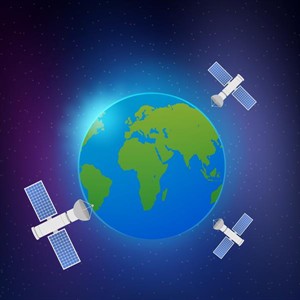
Artificial satellites
Why we launch artificial satellites:
They are used for:
- Communication
- Weather forecasting
- Navigation
- Disaster management
- Scientific research
Most artificial satellites orbit at about \(800\ \text{km}\) height and take about \(100\ \text{minutes}\) to complete one orbit.
India’s space missions (ISRO):
Cartosat series: Earth imaging and mapping
Bhuvan platform: Displays mapping data
AstroSat: Studies stars and space objects
Chandrayaan 1, 2, 3: Moon missions
Aditya-L1: Studies the Sun
Mangalyaan: Mars mission
Student satellites: AzaadiSat, Kalamsat, InspireSat-1, Jugnu
Space junk:
- Old satellites and rocket parts form space debris.
- Can damage working satellites.
- Small pieces burn in atmosphere.
- Larger pieces may fall to Earth.
- Countries are working to reduce space debris.
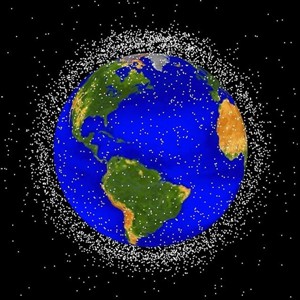
Space junks