

As the car moved on further, Aaron looked through the window and noticed the view outside looked different when he changed his angle.
“Dad,” he asked, “why does the glass make things look strange?”
His father smiled and said, “Because glass lets light pass through and bends it. That’s what a lens does, it changes how we see things by bending light.”
Aaron understood that while mirrors reflect light, lenses bend it to form images.
 
look-out-of-the-window-2121134_1280.jpg
View outside a car window
 
Now let us perform an activity to understand this.
Activity:
To observe how a transparent glass marble bends light
 
glass-sphere-1547291_1280.jpg
Glass marble
 
Procedure:
Step 1: Place the glass marble on a flat surface such that you can look through it at an object.
Step 2: Look carefully through the marble from different angles.
Step 3: Move your eye closer or farther away from the marble and notice how the image of the object changes.
Step 4: Try focusing on the image inside the marble and observe its orientation.
 
Observation:
You will notice that the image of the object seen through the marble appears inverted (upside down) and smaller or larger depending on your viewing distance.

Conclusion:
A transparent glass marble behaves like a convex lens. It converges light rays and can form an inverted image of distant objects, just like the image seen inside the marble in the picture.
Lens:
A lens is a transparent piece of glass or plastic that bends (refracts) light rays passing through it. Lenses are thicker or thinner at the center or edges, which changes how light rays travel through them.
Convex lens:
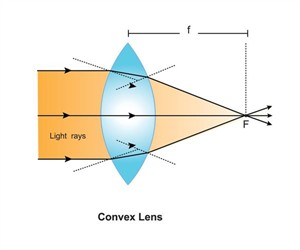
A convex lens is a lens that is thicker in the middle and thinner at the edges. It converges the light rays passing through it at a point called the focus. Hence, it is also known as a converging lens.
shutterstock1679185867w600.jpg
Example:
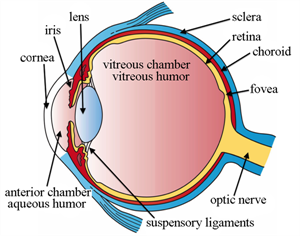
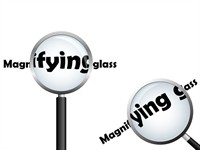
Magnifying glass, camera lens, human eye lens.
shutterstock424993786w600.jpg
Magnifying glass
 
Concave lens:
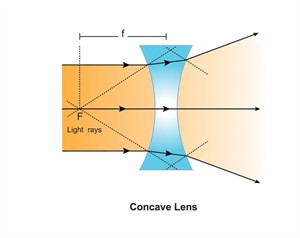
A concave lens is a lens that is thinner in the middle and thicker at the edges. It diverges the light rays passing through it. Hence, it is also called a diverging lens.
shutterstock16791858671w600.jpg
Example:
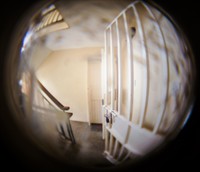
Lenses used in spectacles for short-sightedness, door peepholes.
door-2108771_1280.jpg
Door peepholes
 
Let us undertstand how the images are formed by these lenses with the help of an activity. 
Activity:
To observe images formed by convex and concave lenses
 
concavecandle4.svg
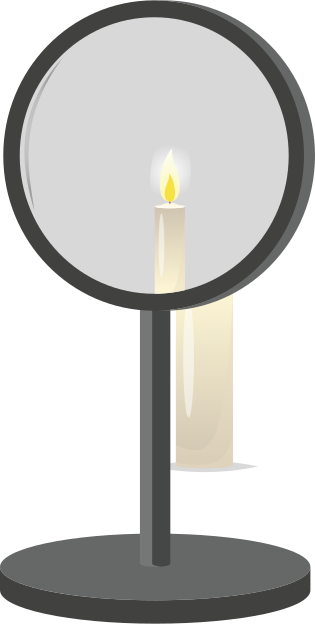
Concave lens 
 
Procedure:
Step 1: Fix a convex lens upright.
Step 2: Place an object behind the convex lens.
Step 3: Adjust its height so that it is at the same level as the lens.
Step 4: Look at the object through the convex lens from the opposite side and note your observation.
Step 5: Gradually move the object farther from the convex lens.
Step 6: Each time, observe the change in the appearance of the image.
Step 7: Repeat the same steps using the concave lens.
 
convexcandle12.svg
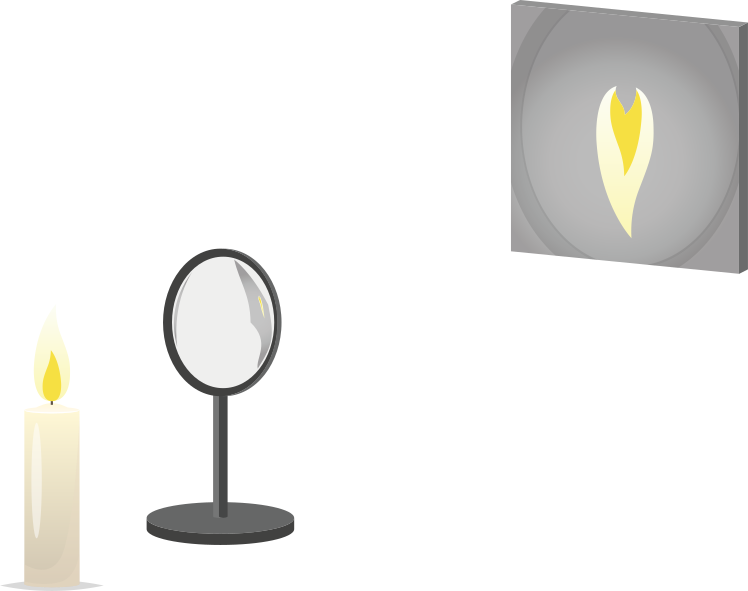
Convex lens when object is farther
 
convexcandle23.svg
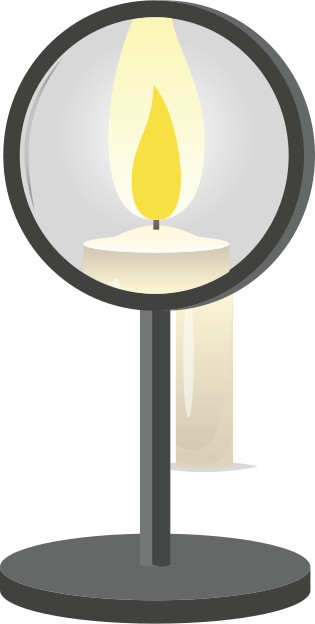
Convex lens when object is closer
 
Observations:
  • Convex lens: When the object is placed close to the lens, the image appears erect and enlarged. As the object is moved farther, the image becomes inverted. The image is initially enlarged, and then becomes smaller as the distance increases.
  • Concave lens: The image is always erect and diminished in size. As the distance between the object and lens increases, the image size slightly decreases.
Conclusion:
  • A convex lens can form both erect and inverted images depending on the distance of the object.
  • A concave lens always forms an erect, and diminished image irrespective of the distance.
Do lenses also diverge and converge light rays as convex and concave mirrors?
 
Yes, lenses also diverge and converge light rays just like concave and convex mirrors.
 
Let us find it with the help of an activity.
Activity:
To observe the effect of different lenses on a beam of light
 
divergeshutterstock7210741002.svg
Concave lens
 
Procedure:
Step 1: Place a thin glass plate, convex lens and a concave lens upright on a table.
Step 2: Use a torch and a stencil  to get parallel beams of light.
Step 3: Direct the light beams onto the lenses and observe how they pass through.
Step 4: Note whether the rays meet at a point or spread out.

 
convergeshutterstock7210741001.svg
Convex lens
 
Observations:
  • When light passes through the thin glass plate, the beams continue in the same direction.
  • When light passes through the convex lens, the beams converge (come together at a point).
  • When light passes through the concave lens, the beams diverge (spread out from a point).
Conclusion:
  • The convex lens brings parallel beams of light together, so it is called a converging lens.
  • The concave lens spreads parallel beams of light apart, so it is called a diverging lens.
  • The thin glass plate does not change the direction of the light beams.
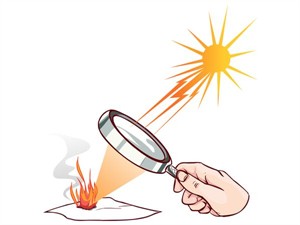
Since a convex lens converges a beam of light, can it also be used to burn a piece of paper?
 
Yes, a convex lens,  like a concave mirror is a converging lens. It bends the parallel rays of sunlight so that they meet at a single point called the focus. When the paper is placed at this focal point, the concentrated sunlight produces enough heat energy to burn the paper after a short time.
 
sunensshutterstock1182465124w600.jpg
Convex lens focusing sunlight on a paper
 
Uses of lens:
 
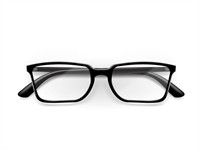
1. Lenses in eyeglasses:
  • Many people wear eyeglasses to correct their vision.
  • Eyeglass lenses help focus light properly on the retina so we can see sharp, clear images.
specshutterstock1571213041w600.jpg
Eyeglasses
 
2. Lenses in optical instruments:
  • Lenses are the key parts of many scientific and optical instruments.
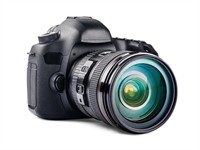
  • Cameras use lenses to focus light and form clear pictures on a film or sensor.
 
camerashutterstock610909205w600.jpg
Camera
 
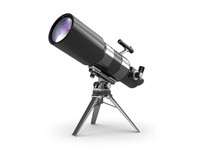
  • Telescopes use combinations of lenses to make distant celestial objects appear closer.
 
telescopehutterstock120272353w600.jpg
Telescope
 
  • Microscopes use lenses to magnify tiny objects that cannot be seen with the naked eye.
 
microshutterstock1379301638w600.jpg
Microscope
 
3. The lens in the human eye:
  • Even our eye contains a convex lens inside it.
  • This natural lens focuses light on the retina, forming images that our brain interprets.
  • Unlike glass lenses, the eye’s lens is flexible, it can change its shape to adjust focus.
ThreeMainLayersoftheEyew600.png
Human eye