

On a holiday, Aaron and his brother Andy went to a funfair in their town. Among all the colourful stalls, Aaron saw a shiny sign that said, “The Hall of Mirrors”
They went inside that stall. The first mirror made Aaron’s head look big and round like a balloon! Another mirror made him short and tiny, while Andy looked tall and thin like a stick. They laughed as their reflections kept changing.
Then Andy puzzled and said, “That’s strange! How can the mirrors make us look so different?” Aaron wondered too.
Let us explore through an activity what made them puzzle.
Activity:
To observe images in a spoon


Spoon's inner and outer side
Step 1: Take a shiny metallic spoon.
Step 2: Hold the inner curved side of the spoon close to your face and look at your image.
Step 3: Slowly move the spoon away from your face and watch how the image changes.
Step 4: Now flip the spoon and look at your image on the outer curved side.
Step 5: Again, move the spoon closer and farther from your face and observe the changes.
Observations:
On the inner side of the spoon, your image appears upside down (inverted) when the spoon is moved away.
On the outer side, your image appears upright (erect) but smaller than your actual face.
Conclusion:
A shiny spoon acts like a mirror with a curved surface.
Spherical Mirror:
A spherical mirror is a mirror with a curved surface that can reflect light and are shaped like a part of an imaginary hollow glass sphere. It forms different kinds of images like larger, smaller, erect, or inverted depending on its shape. The reflecting surface of the spherical mirror may be curved inwards or outwards.

Spherical Mirror
Reflecting surface:
- The reflecting surface of a mirror is the shiny, polished side that bounces back light.
- When light rays fall on this surface, they are reflected, allowing us to see images.
Non-reflecting surface:
- The non-reflecting surface is the back or coated side of the mirror.
- It does not reflect light because it is usually painted or covered to protect the reflecting layer.
Concave mirror:
A concave mirror is a spherical mirror whose reflecting surface curves inward, like the inside of a bowl or spoon. The inner curved side is the reflecting surface and the non-reflecting surface of the mirror is the shaded part. It mostly forms enlarged and inverted images.
Convex mirror:
A convex mirror is a spherical mirror whose reflecting surface curves outward, like the back of a spoon. The outer curved side is the reflecting surface and the non-reflecting surface of the mirror is the shaded part. It forms erect and smaller images.

Think of a spherical mirror as a small part of a tennis ball. Imagine cutting a small piece from the round surface of the ball, that curved piece is like the shape of a spherical mirror.
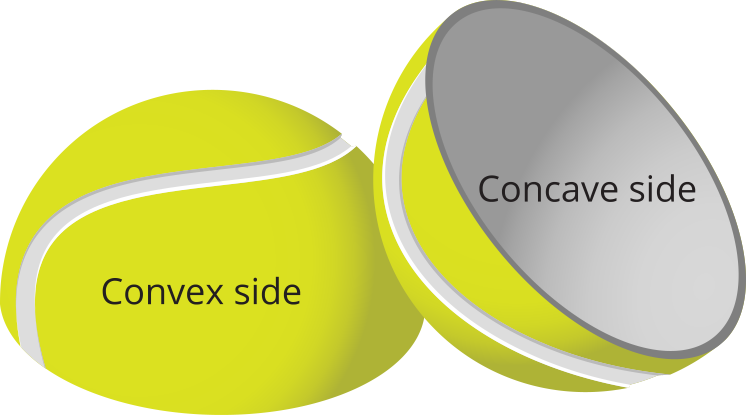
Two halves of a tennis ball
However, real mirrors are not actually made by cutting a ball. Instead, they are made by grinding and polishing a flat glass sheet into a curved shape.
If a shiny coating (like aluminium) is applied on the outside of the curved surface (like the outer side of the tennis ball), it becomes a concave mirror.
If the coating is applied on the inside of the curved surface (like the inner side of the tennis ball), it becomes a convex mirror.
If the coating is applied on the inside of the curved surface (like the inner side of the tennis ball), it becomes a convex mirror.
Activity:
To distinguish between concave and convex mirrors
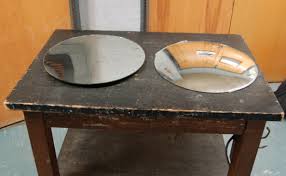
Concave and convex mirrors on the table
Step 1: Place a concave mirror and a convex mirror on a table with their reflecting surfaces facing upward.
Step 2: Sit or bend down so that your eyes are at the same level as the mirrors.
Step 3: Look carefully at each mirror from the side view.
Step 4: Observe whether the reflecting surface of each mirror is curved inward or curved outward.
Observations:
-
In one mirror, the reflecting surface curves inward like the inside of a bowl — this is the concave mirror.
-
In the other mirror, the reflecting surface bulges outward like the back of a spoon — this is the convex mirror.
Conclusion:
-
A concave mirror has a reflecting surface that curves inward.
-
A convex mirror has a reflecting surface that curves outward.
-
Therefore, by observing the direction of the curve, we can easily distinguish between concave and convex mirrors.