

Velocity–Time Graph:
A velocity–time (v–t) graph shows how the velocity of an object changes with time.
- Time is plotted on the x-axis.
- Velocity is plotted on the y-axis.
The shape of the graph tells us about the motion of the object.
Constant velocity:
If velocity does not change with time, the graph is a horizontal straight line.
- \(Velocity = constant\)
- \(Acceleration = 0\)
- \(Slope\ of\ the\ graph\ = 0\)
So,
Horizontal v–t graph \(\to\) constant velocity \(\to\) zero acceleration
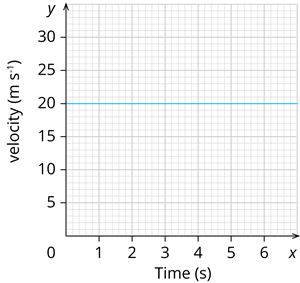
Velocity-time graph for object moving with constant velocity
Increasing velocity:
If velocity increases by equal amounts in equal intervals of time, the graph is a straight line sloping upwards.
- Velocity is increasing.
- Acceleration is constant.
- Acceleration is in the direction of velocity.
Upward straight-line v–t graph \(\to\) constant positive acceleration
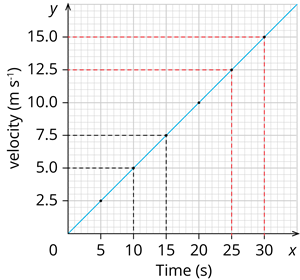
Increasing velocity with constant acceleration
Decreasing velocity:
If velocity decreases by equal amounts in equal intervals of time, the graph is a straight line sloping downwards.
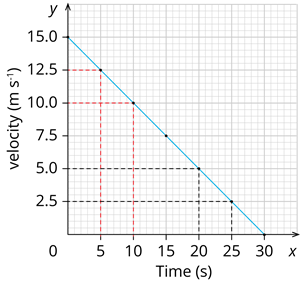
- Velocity is decreasing.
- Acceleration is constant.
- The acceleration is opposite to the direction of velocity.
Downward straight-line v–t graph \(\to\) constant negative acceleration
Decreasing velocity with constant acceleration
Slope of a Velocity–Time Graph gives Acceleration
The acceleration of an object is the rate of change of velocity with time.
Therefore,
\(a=\frac{Change\ in\ velocity}{Change\ in\ time}\)
If the initial velocity is \(u\), the final velocity is \(v\), and the time interval is \(t\),
\(a=\frac{v-u}{t}\)
Therefore,
\(Slope\ of\ v–t\ graph=acceleration\)
- Positive slope \(\to\) positive acceleration
- Zero slope \(\to\) zero acceleration
- Negative slope \(\to\) negative acceleration
Area Under a Velocity–Time Graph gives Displacement
Another important idea is:
\(Area\ under\ v–t graph=displacement\)
This is extremely useful because the area can have different shapes.
The Three Kinematic Equations:
For motion in a straight line with constant acceleration, three equations are especially important.
| Equation | Purpose | Variables in equation |
| \(v=u+at\) | Finding final velocity |
Use this when you know:
and need to find final velocity \(v\).
|
| \(s=ut+\frac{1}{2}at^{2}\) | Finding displacement |
Use this when you know:
and need to find displacement \(s\).
|
| \(v^{2}=u^{2}+2as\) | When time is not given | This equation is particularly useful when time is not given. |