

Kinematic Equations for Motion in a Straight Line with Constant Acceleration:
When an object moves with constant acceleration, its velocity changes by equal amounts in equal intervals of time. The relationship between initial velocity (\(u\)), final velocity (\(v\)), acceleration (\(a\)), time (\(t\)), and displacement (\(s\)) is given by the three equations of motion.
| Equation of motion | Uses |
| \(v=u+at\) | Used to calculate the final velocity when time is known. |
| \(s=ut+\frac{1}{2}at^{2}\) | Used to calculate the displacement when time is known. |
| \(v^{2}=u^{2}+2as\) | Used when time is not given. |
How to Choose the Correct Equation:
| Given | Use |
|---|---|
| \(u\), \(a\), \(t\) \(\to\) Find \(v\) | \(v=u+at\) |
| \(u\), \(a\), \(t\) \(\to\) Find \(s\) | \(s=ut+\frac{1}{2}at^{2}\) |
| \(u\), \(v\), \(s\) \(\to\) Find \(a\) | \(v^{2}=u^{2}+2as\) |
| \(u\), \(v\), \(a\) \(\to\) Find \(s\) | \(s\ = \frac{v^{2}-u^{2}}{2a}\) |
Safe Distance Between Two Moving Vehicles:
Maintaining a safe distance between two moving vehicles helps prevent accidents. If the vehicle in front stops suddenly, the driver behind needs time to notice the danger, react, and apply the brakes.
The total stopping distance consists of two parts:
Reaction Distance
- The distance travelled before the brakes are applied.
- Depends on the driver's reaction time and the speed of the vehicle.
Braking Distance
- The distance travelled after the brakes are applied until the vehicle comes to rest.
- Depends on the speed of the vehicle and the braking force (deceleration).
Stopping Distance
\(Stopping Distance=Reaction Distance+Braking Distance\)
Factors Affecting Safe Distance
- Speed of the vehicle
- Driver's reaction time
- Road conditions (wet or dry)
- Efficiency of the brakes
- Weather conditions
The faster a vehicle moves, the greater the stopping distance. This is why speed limits are enforced near schools, hospitals, and sharp bends.
Motion in a Plane:
An object is said to be in motion in a plane when it moves in two dimensions.
In this type of motion:
- The object changes its position in more than one direction.
- Two coordinates are required to describe its position.
- Both distance and displacement can be determined.
Example:
A football kicked across a playground.
A bird flying in the sky.
A drone moving east and then north.
A car taking turns on a road
Difference Between Straight-Line Motion and Motion in a Plane:
| Straight-Line Motion | Motion in a Plane |
|---|---|
| One-dimensional motion | Two-dimensional motion |
| Moves along a single straight path | Moves in two directions |
| One coordinate describes the position | Two coordinates describe the position |
Uniform Circular Motion:
When an object moves along a circular path with constant speed, it is said to be in uniform circular motion.
Although the speed remains constant, the direction of motion changes continuously.
Since velocity depends on both speed and direction, the changing direction causes the velocity to change continuously.
Therefore, uniform circular motion is an accelerated motion.
A Marble Moving Inside a Ring:
Imagine a marble rolling inside a circular ring.
As the marble moves around the ring:
- Its speed may remain constant.
- Its direction changes continuously.
- Therefore, its velocity changes continuously.
- The marble experiences centripetal acceleration directed towards the centre of the ring.
This activity helps us understand why uniform circular motion is an accelerated motion.
When an object moving in a circular path suddenly loses the force that keeps it moving in the circle, it moves along the tangent to the circular path at that point.
Examples
- A vehicle skids on a curved road and moves tangentially.
- A stone released while being whirled on a string flies off in a straight-line path.
- A marble leaving a circular track moves along the tangent.
Centripetal Acceleration:
The acceleration acting on an object moving in a circular path is called centripetal acceleration.
Characteristics:
- Acts towards the centre of the circular path.
- Keeps the object moving in a circle.
- Changes the direction of velocity, not its speed.
Example:
A satellite revolving around the Earth.
A car moving around a roundabout.
A stone tied to a string and whirled in a circle.
A Ferris wheel.
The hands of a clock
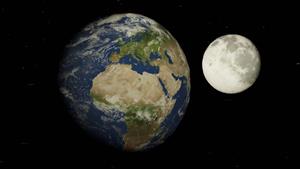
Motion of the moon and the earth
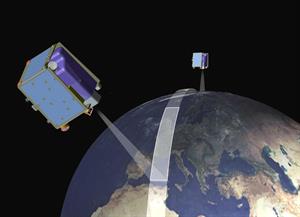
A satellite in a circular orbit around the earth
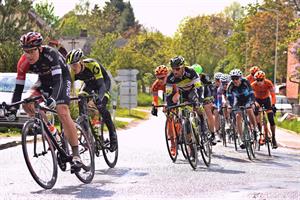
A cyclist at a circular track moving at a constant speed