

Every movement around us involves forces. A football moves when kicked, a bicycle stops when brakes are applied, and we are able to walk because our feet grip the ground. One important force involved in all these situations is friction. Friction affects how objects move and is closely related to acceleration, which is the change in velocity caused by force.
What is Friction?
Friction is a force that acts between two surfaces in contact and opposes motion.
Whenever two surfaces rub against each other, friction is produced.
Examples:
- Shoes rubbing against the ground
- Tyres moving on roads
- A book sliding on a table
- Pencil writing on paper
- Ball rolling on the ground
Important Characteristics of Friction:
- Friction is a contact force.
- It always acts opposite to motion.
- It slows moving objects.
- It depends on the nature of surfaces.
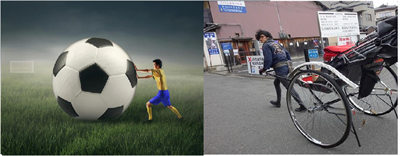
Examples of friction
Why Does Friction Occur?
Even surfaces that look smooth contain tiny irregularities or bumps.
When two surfaces touch:
- These irregularities lock together.
- This creates resistance to motion.
- The resisting force is friction.
Example:
Dragging a box on rough ground is harder than dragging it on smooth tiles because rough surfaces have more irregularities.
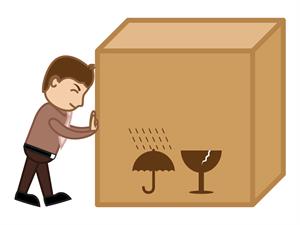
Dragging a box in a rough ground
Types of Surfaces and Friction
Rough Surfaces
- Produce more friction
- Resist motion strongly
Examples:
- Sandpaper
- Gravel road
- Carpet
Smooth Surfaces
- Produce less friction
- Allow easier motion
Examples:
- Ice
- Polished marble
- Glass
Role of Friction in Daily Life
Friction is both useful and harmful.
Useful Effects of Friction
(a) Helps Us Walk
Friction between shoes and the ground provides grip.
Without friction:
- Our feet would slide backward.
- Walking would become impossible.
(b) Helps Vehicles Move Safely
Tyres grip the road because of friction.
Tyre Grooves:
Vehicle tyres contain grooves or treads to increase friction, especially on wet roads.
(c) Helps in Writing
Friction between pencil and paper allows graphite to rub onto paper.
Without friction, writing would not be possible.
(d) Helps Brakes Work
Brakes create friction with wheels to slow vehicles.
(e) Helps Objects Stay in Place
A book remains on a table because friction prevents it from sliding easily.
What is Velocity?
Velocity means the speed of an object in a particular direction.
Example:
- A car moving at \(20\) \(m/s\) east
- A football moving towards the goal
If either the speed or the direction changes, the velocity changes.
What is Acceleration?
Acceleration is the change in velocity caused by a force.
Acceleration can happen when:
- Speed increases
- Speed decreases
- Direction changes
How Force Causes Acceleration
A force is needed to change the velocity of an object.
(a) Increasing Speed
When more force is applied, objects move faster.
Example:
A cyclist pedals harder and the bicycle speeds up.
The extra force increases the velocity, causing acceleration.
(b) Decreasing Speed
A force can also reduce speed.
Example:
When brakes are applied to a bicycle, friction acts opposite to motion and slows it down.
This decrease in velocity is also acceleration, called deceleration.
(c) Changing Direction
Even if speed remains the same, changing direction means velocity changes.
Example:
A bat changes the direction of a moving cricket ball.
The force from the bat causes acceleration because the direction changes.
(d) Starting Motion
Force can make a stationary object start moving.
Example:
A football at rest moves when kicked.
The applied force changes the ball from rest to motion.
Important Point
If velocity changes in any way:
- Speed increases
- Speed decreases
- Direction changes
then a force must be acting on the object.