

Every day we observe objects moving, stopping, speeding up, or slowing down. For example:
- A football moves when kicked.
- A bus stops when brakes are applied.
- A cyclist speeds up when pedaling harder.
These changes in motion occur because of force.
A force is simply a push or a pull acting on an object.
Newton’s First Law of Motion:
Isaac Newton stated that:
An object remains at rest or continues to move with uniform velocity in a straight line unless acted upon by an unbalanced external force.
This law is also called the Law of Inertia.
Explanation
- A stationary object remains stationary unless force acts on it.
- A moving object continues moving with the same speed and direction unless an external force stops it.
Inertia:
The body's tendency to oppose the change in its state of rest or uniform motion in a straight line is called inertia.
Mass:
The inertia of a body depends upon mass. We know it is not easy to move a heavier object than the lighter one. Similarly, it is not easy to stop a moving heavier body than the moving lighter one. Thus, we can conclude that the mass of body is the measure of inertia; more the mass of a body, more the inertia.
Real-Life Examples
- A football does not move until kicked.
- A moving bicycle slows down because friction acts on it.
- Passengers fall backward when a bus starts suddenly.
Types of inertia:
- Inertia of rest
- Inertia of motion
- Inertia of direction
Inertia of rest:
The body's tendency to oppose the change in its state of rest when unbalanced force is applied to it is called the inertia of rest.
The body's tendency to oppose the change in its state of rest when unbalanced force is applied to it is called the inertia of rest.
For example, a person in a bus falls backwards when the bus starts suddenly. This is because the lower part of his body begins to move along with the bus, but the upper part of the body tends to remains at rest due to the inertia of rest.

Inertia of rest
Inertia of Motion:
The body's tendency to oppose the change in its state of motion when unbalanced force is applied to it is called the inertia of motion.
The body's tendency to oppose the change in its state of motion when unbalanced force is applied to it is called the inertia of motion.
For example, a man travelling in a bus falls forward when the driver applies the brake, it is because his feet comes to rest suddenly, whereas the upper part of his body retains the forward motion.
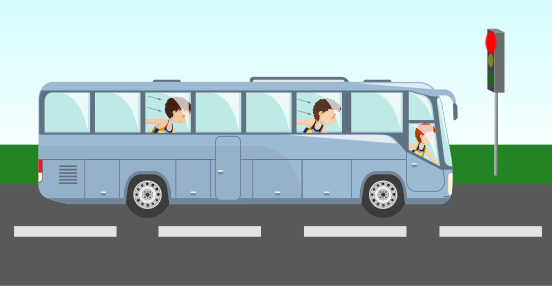
Inertia of motion
Inertia of Direction:
The tendency of the body to oppose the change in its direction of motion is called the inertia of direction.
The tendency of the body to oppose the change in its direction of motion is called the inertia of direction.
For example: Tie a stone to one end of a string, by holding the other end of the string in hand, rotate the stone in a horizontal circle. During rotation, if the string breaks at a certain stage, the stone is found to fly off tangentially.
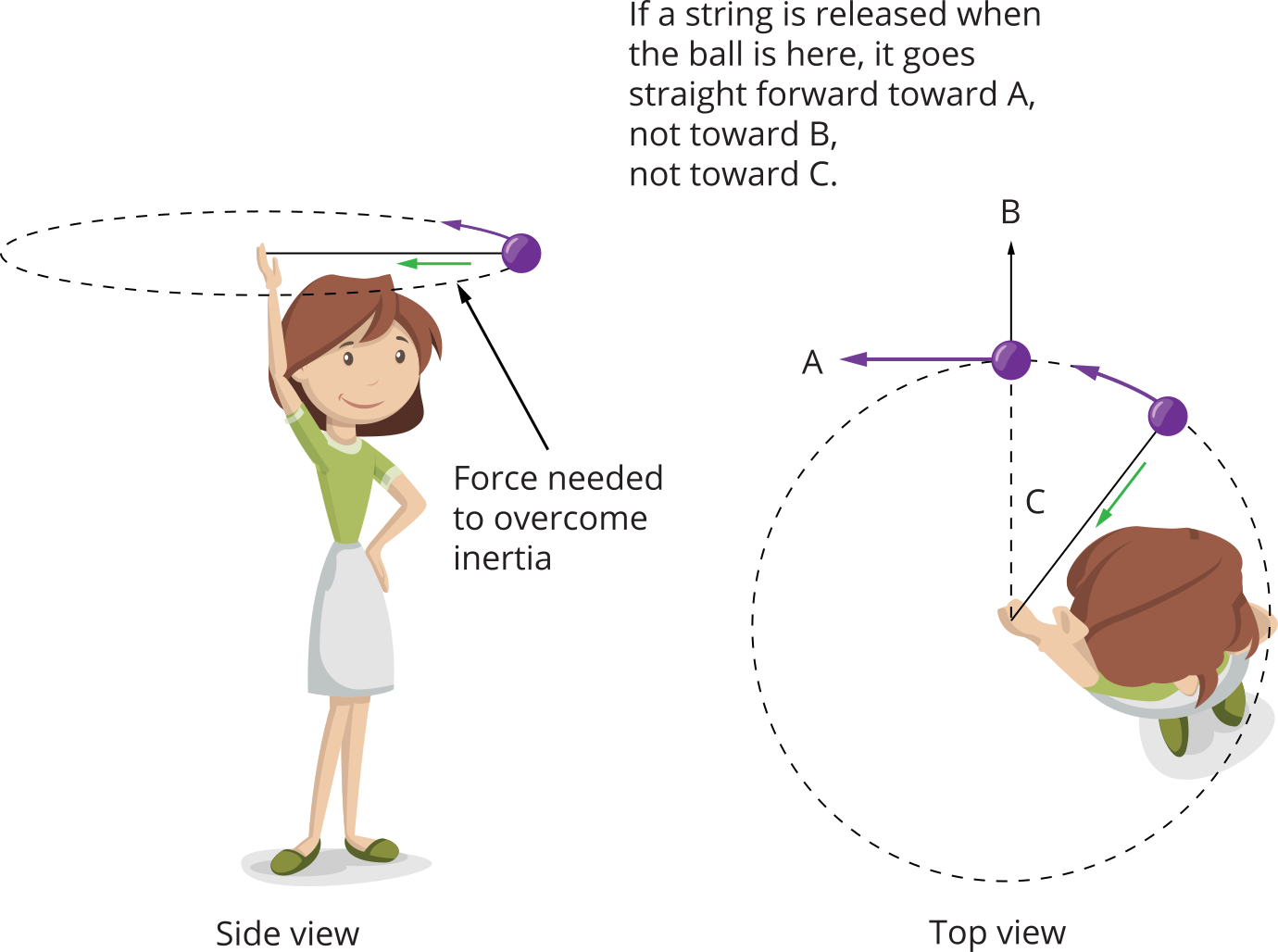
Inertia of direction
Newton’s second law explains how force affects motion.
It states:
The acceleration produced in an object is directly proportional to the applied force and inversely proportional to its mass.
This means:
- Greater force → Greater acceleration
- Greater mass → Smaller acceleration
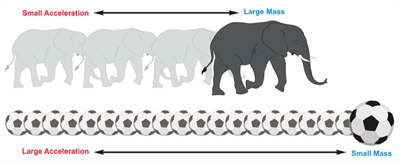
Relationship between mass and accelertion
Mathematical Expression:
Use:
\(F=ma\)
Where:
- \(F\) \(=\) Force
- \(m\) \(=\) Mass
- \(a\) \(=\) Acceleration
SI Unit of Force:
The SI unit of force is newton (\(N\)).
One newton is defined as the force required to produce an acceleration of \(1\) \(m/s^{2}\) in an object of mass \(1\) \(kg\).
Use:
\( 1N = 1kgm/s^{2}\)
\( 1N = 1kgm/s^{2}\)