

Introduction to Motion:
Motion is defined as the change in position of an object with respect to time and a reference point. For example, a moving car, a flying bird, or a man riding a bicycle are all in motion. If an object does not change its position, it is said to be at rest.
A force can cause or change the motion of an object. It can:
-
Start motion (a stationary ball begins to move when kicked)
-
Stop motion (a moving bicycle stops when brakes are applied)
-
Change speed (a car accelerates when the driver presses the accelerator)
-
Change direction (a ball changes direction when hit with a bat)

Flying Birds

A man riding a bicycle
Distance:
Distance is the total length of the path travelled by an object. It depends on the actual path followed and is always positive. It is a scalar quantity and its SI unit is metre (\(m\)).
Displacement:
Displacement is the shortest distance between the initial and final positions, along with direction. It does not depend on the path taken and can be positive, negative, or zero. It is a vector quantity and its SI unit is metre (\(m\))
| Distance | Displacement |
| Total path travelled | Shortest distance between two points |
| Scalar quantity | Vector quantity |
| No direction | Has direction |
| Always positive | Can be zero or positive/negative |
Speed:
Speed is defined as the distance travelled per unit time. It tells us how fast an object is moving and is a scalar quantity.
\( Speed= \frac{Distance}{Time}\)
SI Unit: metre per second (\(m/s\))
Velocity:
Velocity is the displacement per unit time and includes both magnitude and direction. Hence, it is a vector quantity.
\(Velocity= \frac{Displacement}{Time}\)
SI Unit: \(metre\ per\ second\) (\(m/s\))
| Speed | Velocity |
| Distance per unit time | Displacement per unit time |
| Scalar quantity | Vector quantity |
| No direction | Has direction |
| Always positive | Can be zero, positive, or negative |
If an object moves in a straight line without changing direction, speed and velocity may have the same value.
Acceleration:
Acceleration is defined as the rate of change of velocity with respect to time.
It can occur due to change in speed, direction, or both.
It can occur due to change in speed, direction, or both.
\(Acceleration= \frac{Change \ in \ Velocity}{Time}\)
\(a= \frac{v-u}{t}\)
where:
-
= initial velocity
-
= final velocity
-
= time
SI Unit: \(metre\ per\ second\ squared\) (\(m/s^{2}\))
Acceleration is a vector quantity.
Uniform Circular Motion:
Uniform circular motion is the motion of an object along a circular path with constant speed.
At first glance, it may seem that if speed is constant, there is no acceleration. However, this is not true. In circular motion, even though the speed remains constant, the direction of motion changes continuously at every point of the circle.
Since velocity depends on both speed and direction, a change in direction means velocity is changing. And whenever velocity changes, acceleration is present.
This acceleration is called centripetal acceleration, and it always acts towards the center of the circular path.
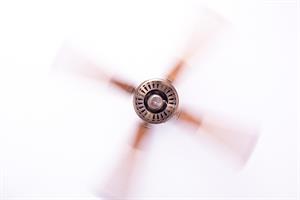
Example of uniform circular motion
Variables in Motion:
The main variables used to describe motion are:
-
Time (\(t\)) → measured in \(seconds\) (\(s\))
-
Displacement (\(s\)) → \(measured\ in\ metres\) (\(m\))
-
Velocity (\(v\)) → measured in \(meter\ per\ second\) (\(m/s\))
-
Acceleration (\(a\)) → measured in (\(m/s^{2}\))