

Imagine you are watching a car move on a road. Without seeing it directly, can you still understand:
- How fast it is moving?
- Whether it is speeding up or slowing down?
Yes! We can do this using graphs.
Graphs help us represent motion in a simple visual way.
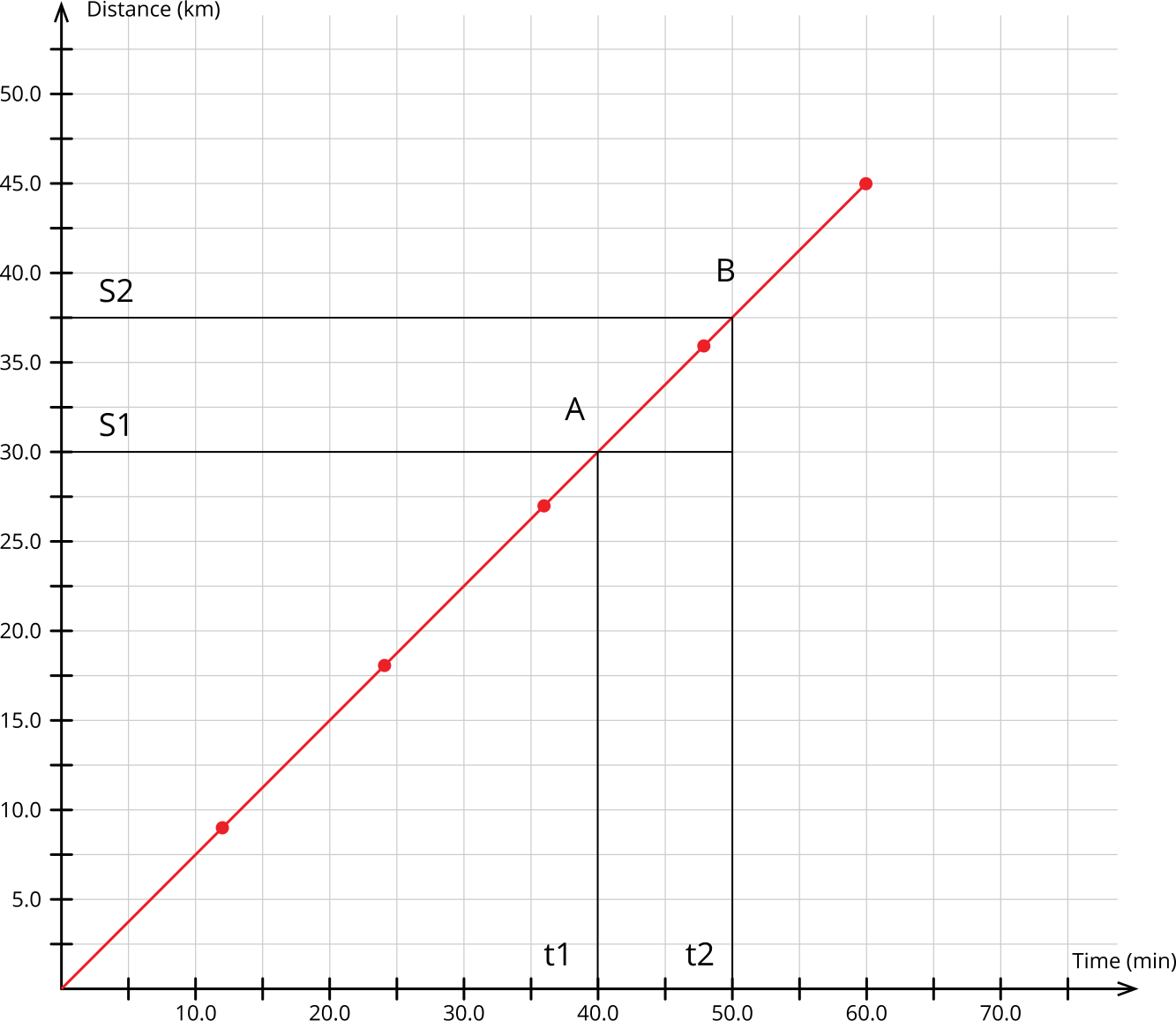
Position-time graph (Object with constant velocity):
In a position–time graph:
- X-axis represents time
- Y-axis represents position (distance)
When an object moves with constant velocity, it covers equal distances in equal time intervals.
Object moving with constant velocity
How does the graph look?
- A straight slanted line
What does it mean?
- The object is moving at a uniform speed in a straight line
Important Concept:
\(Slope\ of\ the\ graph\ =\ Velocity\)
- Steeper line → higher velocity
- Less steep line → lower velocity
- Horizontal line → zero velocity (object at rest)
Calculating average velocity from graph:
To find average velocity:
The slope of a position-time graph of a body can be used to calculate the velocity of the body.
\(Velocity=\frac{Dispalcement}{Time}\)
From the graph:
- Choose any two points
- Calculate slope
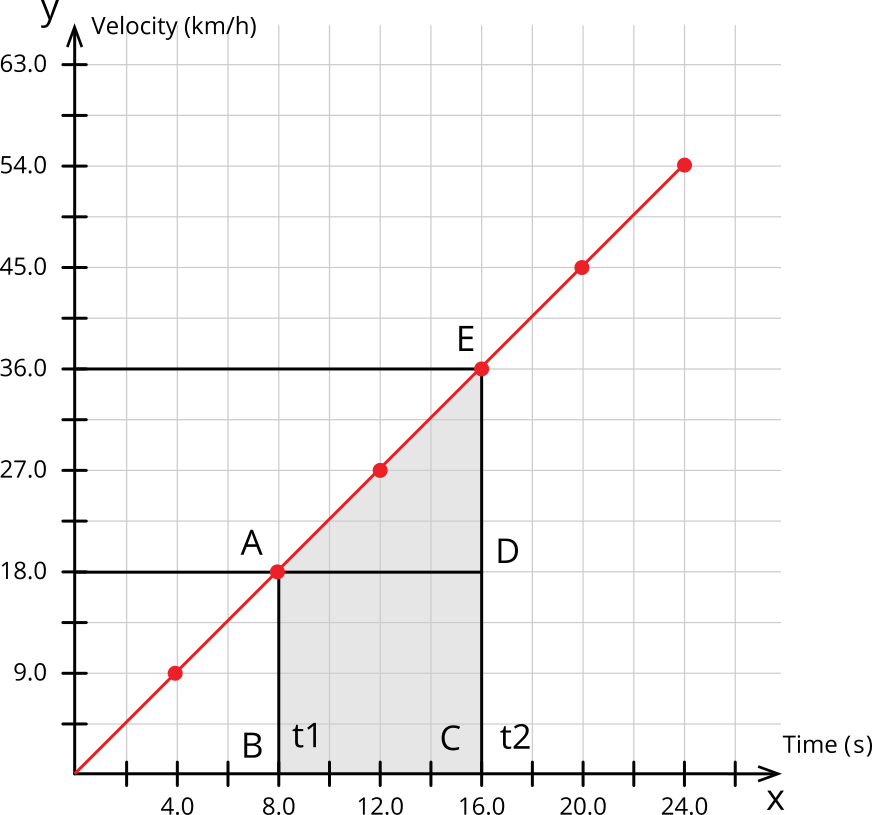
Velocity-time graph (Object with constant acceleration):
In a velocity–time graph:
- X-axis → time
- Y-axis → velocity
If the object is accelerating uniformly (speed increasing steadily)
Velocity-time graph
How does the graph look?
- A straight slanted line
What does it mean?
- Velocity is changing at a constant rate
Understanding acceleration:
\(Slope \ of \ velocity \ – \ time \ graph \ = \ Acceleration\)
- Steeper slope → greater acceleration
- Horizontal line → zero acceleration (constant velocity)
- Downward slope → deceleration (slowing down)
Displacement from velocity-time graph:
The velocity-time graph, the area enclosed by the velocity-time graph and the time axis gives us the distance travelled by the body in a given time.
\(Area \ under \ the \ velocity \ –\ time \ graph \ = \ Displacement\)
Different Shapes:
- Rectangle → constant velocity
- Triangle → increasing velocity
- Trapezium → mixed motion
Example Idea
If the graph forms a triangle:
\(Displacement = \frac{1}{2}\times base\times height\)
Calculating average acceleration:
The slope of the velocity-time graph of a moving body gives its acceleration. The straight line graph sloping upwards shows uniform acceleration.
\(Acceleration=\frac{Change \ in \ velocity}{Time}\)
From graph:
- Take two points
- Find slope
This tells how quickly the velocity is changing.
Connecting all concepts:
| Graph | What we calculate |
| Position–Time | Velocity (from slope) |
| Velocity–Time | Acceleration (from slope) |
| Velocity–Time | Displacement (from area) |