

When an object moves in a straight line and its acceleration is constant (uniform), we can describe its motion using three equations of motion.
These equations help us find velocity, distance, time, and acceleration.
These equations help us find velocity, distance, time, and acceleration.
Graphical derivation:
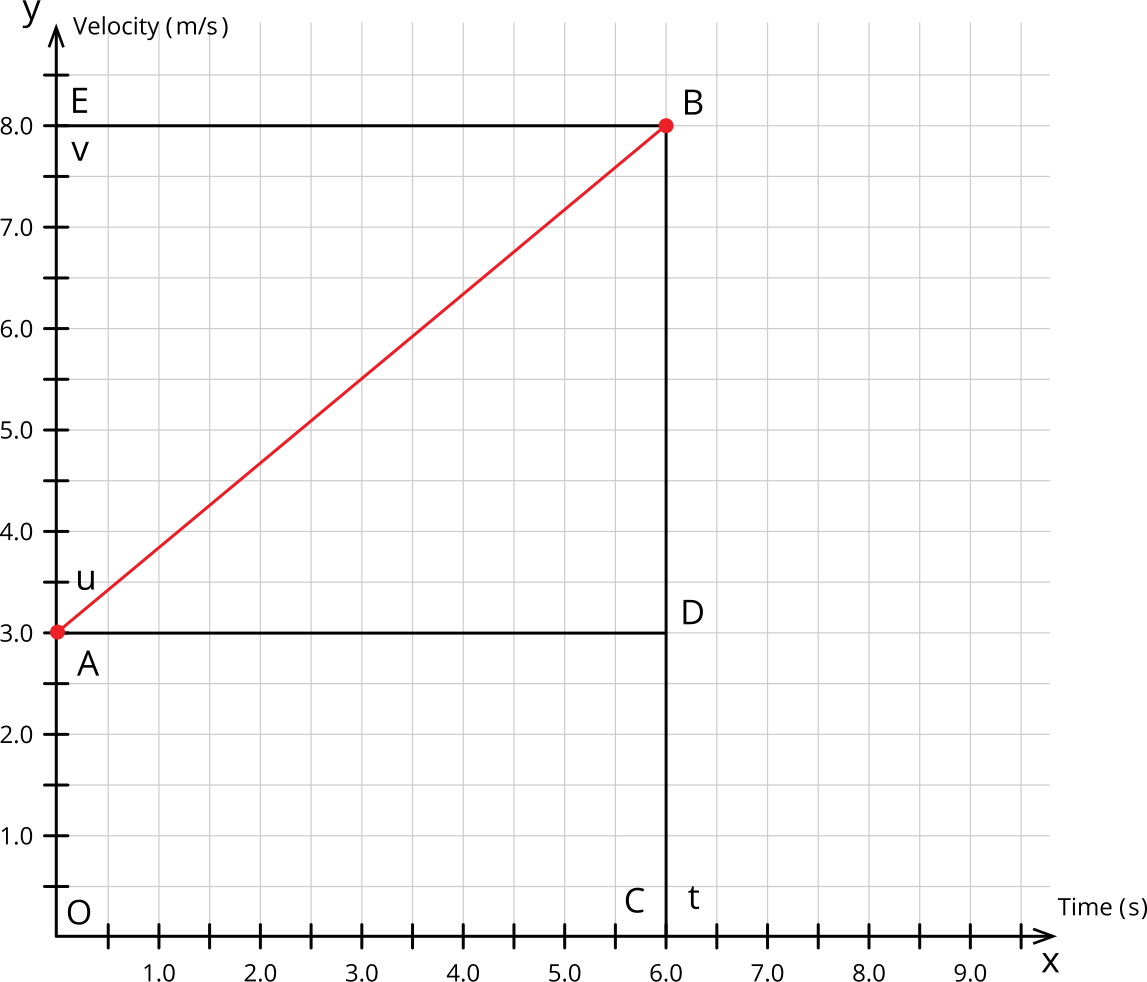
Velocity-time graph
Understanding the graph:
- The graph is a straight line \(\rightarrow\) motion has uniform acceleration
- Initial velocity = \(u\) (starting point)
- Final velocity = \(v\) (ending point)
- Time taken = \(t\)
1. First equation of motion:
The slope of the velocity–time graph gives acceleration:
\(a=\frac{v-u}{t}\)
Rearranging,
\(v=u+at\)
This shows how velocity changes with time.
2. Second equation of motion:
\(Distance \ travelled \ = \ area \ under \ the \ velocity-time \ graph\)
\(Area= rectangle (AOCD) +triangle (ABD) \)
Rectangle area (\(AOCD\)),
\(base\times height=t\times u=ut\)
Triangle area (\(ABD\)),
\(=\frac{1}{2}\times base\times height\)
\(\frac{1}{2}\times t\times (v-u)\)
Total distance:
\(s=ut+\frac{1}{2}(v-u)t\)
From first equation, \(v-u=at\), substitute
\(s=ut+\frac{1}{2}at^{2}\)
This gives the distance travelled in time \(t\)
3. Third equation of motion:
We eliminate time \(t\)
From first equation:
\(v-u=at\Rightarrow t=\frac{v-u}{a}\)
Substitute in second equation:
\(s=ut+\frac{1}{2}at^{2}\)
After simplification, we get:
\(v^{2}=u^{2}+2as\)
This equation relates velocity and distance and is useful when time is not given.
Selecting the correct equation:
- Use \(v=u+at\rightarrow\) when distance is not required
- Use \(s=ut+\frac{1}{2}at^{2}\rightarrow\) when distance is needed
- Use \(v^{2}=u^{2}+2as \rightarrow\) when time is not given
Solving numerical problems:
Steps:
- Write the given values (\(u\), \(v\), \(a\), \(t\), \(s\))
- Identify what is required
- Choose the correct equation
- Substitute values and solve