

Energy of Sound waves:
A sound wave carries energy from one place to another through a medium. The particles of the medium only vibrate about their mean positions; they do not travel along with the sound wave.
When grains placed on a stretched sheet move as the sheet vibrates, it shows that the vibrating sheet transfers energy to the grains. Similarly, a sound wave transfers energy through the medium.
- Microphone: Sound energy \(\to\) Electrical energy
- Speaker: Electrical energy \(\to\) Sound energy
Graphical representation of Sound:
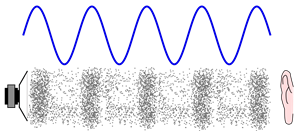
Regions of high density and low density
Sound travelling through a medium produces alternating regions of:
- Compression: particles are closer together \(\to\) high density
- Rarefaction: particles are farther apart \(\to\) low density
In a Density-versus-Distance graph:
- Maximum density \(\to\) compression/crest
- Minimum density \(\to\) rarefaction/trough
- Distance between two successive compressions or rarefactions → wavelength
- \(\lambda\ =\ distance\ between\ successive\ compressions\)
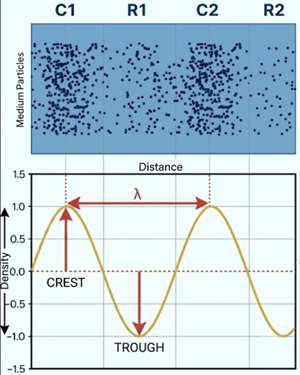
Distance vs density graph
Wavelength, Frequency and Time Period:
Wavelength
Wavelength is the distance between two successive points in the same phase, such as two successive compressions or rarefactions.
SI unit: \(metre\) (\(m\))
Frequency
Frequency is the number of complete vibrations produced by the source in one second.
SI unit: \(hertz\) (Hz).
For example:
\(500\ Hz\ =\ 500\ vibrations\ per\ second\)Time period is the time taken by the source to complete one vibration.
SI unit: \(second\) (\(s\)).
Different musical notes have different frequencies, which helps us distinguish one note from another.
Amplitude and Intensity:
Amplitude:
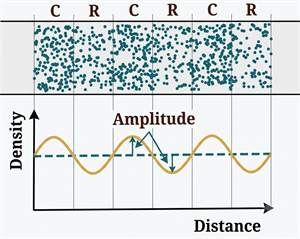
In a sound wave, amplitude represents the maximum change in density from the average density.
A larger amplitude means a greater variation in density.
Amplitude is related to the energy carried by the sound wave:
For sound travelling through air, the speed is also affected by:
- Temperature
- Humidity
In general, the speed of sound in air increases with increase in temperature.
When Sound enters another medium:
The frequency is determined by the vibrating source. Therefore, when sound enters another medium, its frequency remains the same.
However, the speed of sound can change because the medium has changed. Since:
if \(v\) changes while \(\nu\) remains constant, the wavelength also changes.