

Production of Sound:
Have you ever noticed what happens when you pluck a rubber band? The rubber band moves rapidly to and fro. This rapid to-and-fro motion is called vibration. At the same time, we hear a sound.
This shows that sound is produced by vibrating objects. Whenever an object vibrates, it can produce sound. Different objects may vibrate in different ways, but vibration is the common cause of sound production.
Examples of vibrating sources:
- In a guitar, the stretched strings vibrate.
- In a drum, the stretched membrane vibrates.
- In a tuning fork, the prongs vibrate.
- In a flute, the air column inside the instrument vibrates.
- In humans, the vocal cords vibrate to produce sound.
Therefore, whenever we hear a sound, we can ask:
“What part of the source is vibrating?”
Tuning Fork – A Simple Source of Sound:
A tuning fork is an instrument used to produce a particular sound. It has two prongs joined to a stem.
When a tuning fork is struck against a suitable surface, its prongs begin to vibrate. These vibrations produce sound.
The vibrations of the tuning fork may not always be clearly visible to our eyes. However, their effect can be observed through an activity. If a vibrating tuning fork is brought close to the surface of water, it can produce ripples on the water surface.
This gives us evidence that the tuning fork is vibrating.
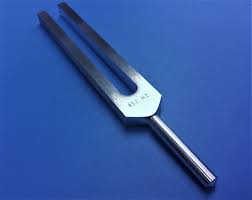
Tuning fork
Sound Production in Humans and Animals:
Sound is not produced only by musical instruments. Humans and many animals also produce sounds using vibrating parts of their bodies.
In humans, air from the lungs passes through the voice box. The vocal cords vibrate as air passes through them, producing sound. We can then use our mouth, tongue and other parts to produce different sounds.
Animals also produce sounds using different body parts. For example, birds may produce sounds using their vocal organs, while some animals use other vibrating body structures.
Thus, the basic idea remains the same:
A vibrating part acts as the source of sound.
Propagation of Sound:
Producing sound is only the first step. The sound must also travel from the source to the listener.
For example, when your friend speaks to you, the vocal cords produce the sound, but you hear the sound because the disturbance travels from your friend to your ears through the surrounding air.
Sound can travel through different materials. It can propagate through:
- Solids – such as a wooden desk
- Liquids – such as water
- Gases – such as air
Therefore, sound does not travel only through air.
Activity: Sound through a Solid:
If one student taps one end of a wooden desk while another student listens at the other end, the sound can be heard through the desk.
This demonstrates that sound can propagate through solids.
Similarly, when two objects are struck while submerged in water, the sound can be heard, showing that sound can also propagate through liquids.
Sound Needs a Medium:
An important question is: Can sound travel if there is no material around it? The answer is no.
Sound is a mechanical wave, which means it requires a material medium for its propagation. A medium contains particles that can vibrate and transfer the disturbance from one place to another.
The medium may be a solid, liquid or gas.
However, a vacuum does not contain a material medium through which sound can propagate.
Therefore:
Sound cannot travel through vacuum.
Bell Jar Experiment:
The requirement of a medium can be understood using the bell jar experiment.
A sound-producing source is placed inside a bell jar containing air. Initially, the sound can be heard. When air is gradually removed from the bell jar, the sound becomes weaker.
The important point is that the source can continue vibrating, even when the sound becomes very weak.
This shows that the vibration of the source alone is not enough. The surrounding medium is required to carry the disturbance to the listener.
Thus, the experiment demonstrates:
Sound requires a material medium for propagation.
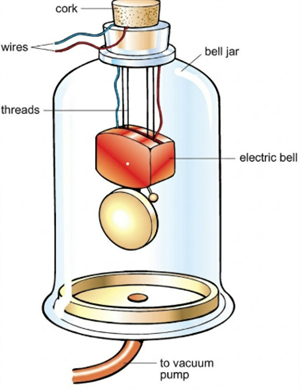
Illustration ofa vacuum bell jar
How Do Astronauts Communicate in Space?
Astronauts often work outside their spacecraft, where there is essentially a vacuum. If one astronaut simply shouts, another astronaut nearby cannot hear the sound directly through space.
This is because there is no material medium in the surrounding vacuum to carry the sound disturbance.
Astronauts therefore use communication systems built into their spacesuits. Their voices are converted into signals and transmitted through the communication system.
This is a real-life application of the principle:
Sound cannot propagate through vacuum.
Sound Waves:
When a vibrating source produces sound, it creates a disturbance in the surrounding medium. This disturbance travels from one region of the medium to another.
This travelling disturbance is called a sound wave.
Consider a vibrating source moving forward and backward in air. When it moves forward, it pushes nearby air particles closer together. This produces a region where particles are closely packed.
When the source moves backward, the nearby particles become more spread out.
As the vibration continues, alternate regions of closely packed and widely spaced particles are produced.
Compressions and Rarefactions:
The closely packed regions in a sound wave are called compressions.
The regions where the particles are spread farther apart are called rarefactions.
So, a sound wave travelling through air contains alternate:
Compression \(\to\) Rarefaction \(\to\) Compression \(\to\) Rarefaction
Compression:
A region of a sound wave where the particles of the medium are closer together.
Rarefaction:
A region of a sound wave where the particles of the medium are farther apart.
The particles themselves do not travel continuously from the source to the listener. They vibrate about their mean positions, transferring the disturbance through the medium.
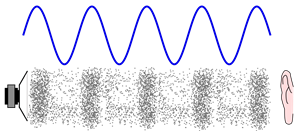
Compression and Rarefaction
Slinky Model of a Sound Wave:
A slinky can be used to understand how a sound wave travels.
If one end of a slinky is pushed and pulled along its length, some regions of the coils become closely packed, while other regions become spread out.
The crowded regions represent compressions, while the spread-out regions represent rarefactions.
This model helps us understand that in a sound wave, the particles of the medium vibrate parallel to the direction in which the wave travels.
Therefore, sound travelling through air is a longitudinal wave.
Longitudinal Waves:
A longitudinal wave is a wave in which the particles of the medium vibrate parallel to the direction of propagation of the wave.
Sound waves travelling through air are longitudinal waves.
For example, if a sound wave is travelling from left to right, the air particles vibrate back and forth along the same left-right direction.
The important features of a longitudinal sound wave are:
- It consists of compressions and rarefactions.
- Particles vibrate parallel to the direction of wave propagation.
- Sound requires a material medium for propagation.
Transverse Waves:
In a transverse wave, the particles of the medium vibrate perpendicular to the direction in which the wave travels.
For example, imagine moving one end of a stretched rope up and down. The disturbance travels along the rope, while the particles move up and down.
This is different from a longitudinal wave.
Quick comparison:
| Longitudinal Wave | Transverse Wave |
|---|---|
| Particles vibrate parallel to wave direction | Particles vibrate perpendicular to wave direction |
| Has compressions and rarefactions | Can be represented by crests and troughs |
| Sound in air is longitudinal | Light is a transverse electromagnetic wave |
Sound and Light – An important difference:
Sound and light are both waves, but they do not have the same requirement for propagation.
Sound is a mechanical wave. It requires a material medium such as air, water or a solid.
Light does not require a material medium for propagation. Light can travel through the vacuum of space.
This is why sunlight can reach Earth through space, while sound from an object in space cannot travel directly to us through the vacuum.
Sudden Loud Sounds:
Some sounds are produced by rapid expansion of gases.
For example, when a firecracker explodes, gases are produced and expand rapidly. This produces a sudden and strong disturbance in the surrounding air. The disturbance travels through the air and reaches our ears as a loud sound.
Thunder is another example of a sudden loud sound associated with a strong disturbance in the atmosphere.
Thus, sudden changes or rapid expansion can produce strong sound disturbances.
Sonic Boom:
A sonic boom is a sudden loud sound associated with an object travelling at a speed greater than the speed of sound.
When a supersonic aircraft travels through the atmosphere, it produces strong pressure disturbances in the surrounding air. These disturbances can reach people on the ground and are heard as a sudden loud sound called a sonic boom.
The important point is that the aircraft is travelling through the atmosphere, so the disturbance is propagated through a material medium.
Sound from a Point source:
A sound source can sometimes be treated as a point source when its size is very small compared with the distance over which the sound spreads.
Sound produced by such a source spreads outward in different directions. The wavefronts can be represented approximately as spherical surfaces expanding away from the source.
This helps explain why a sound produced at one location can be heard by people standing in different directions around the source.