

Reflection of Sound:
Sound waves can bounce back when they strike a surface or an obstacle. This phenomenon is called reflection of sound.
You may have noticed that when you shout near a mountain or a large wall, you may hear your voice again after a short time. The sound that reaches the surface travels back towards you after being reflected. This is an example of reflection of sound.
Sound follows the same laws of reflection as light. When a sound wave strikes a reflecting surface, the direction in which the sound approaches the surface is called the direction of the incident sound, and the direction in which it travels after reflection is called the direction of the reflected sound.
At the point where the sound strikes the surface, a normal can be drawn perpendicular to the reflecting surface. The angle of incidence is equal to the angle of reflection. The incident sound, the reflected sound, and the normal at the point of incidence all lie in the same plane.
One important result of reflection of sound is the formation of an echo.
Echo:
An echo is the sound heard again after the original sound has been reflected from a distant surface.
For example, if you shout while standing near a mountain, cliff, or in a long corridor, the sound travels towards the distant surface, gets reflected, and returns to you. You hear the reflected sound as a separate sound after the original sound.
Why do we not hear echoes everywhere?
For an echo to be heard clearly, the reflected sound must reach our ears after a sufficient time gap from the original sound.
Our brain needs a minimum time interval to distinguish two sounds as separate sounds. If the time gap between the original sound and the reflected sound is at least \(0.1\ s\), the two sounds can generally be heard separately.
If the reflected sound reaches the ear in less than \(0.1\ s\), the brain cannot clearly distinguish it from the original sound. In that situation, we do not hear a distinct echo.
Minimum distance required for an echo:
The sound travels from the source to the reflecting surface and then returns to the listener. Therefore, the distance travelled by sound is twice the distance between the source and the reflecting surface.
For example, if the speed of sound is \(340\ m/s\) and the minimum time required to hear a separate echo is \(0.1\ s\):
\(Distance\ travelled\ by\ sound\ = speed \times time\)
\(Distance = 340 \times 0.1\)
\(Distance = 34\ m\)
This \(34\ m\) is the total distance travelled by the sound to the reflecting surface and back.
Therefore, the minimum distance of the reflecting surface is:
\(34\div 2=17\ m\)
Thus, a reflecting surface should be approximately \(17\ m\) or more away for a distinct echo to be heard under these conditions.
Why is the distance divided by \(2\)?
This is an important point when solving echo problems.
The sound does not travel only from the source to the reflecting surface. It travels:
Source \(\to\) reflecting surface \(\to\) source/listener
Therefore, the distance calculated using \(speed \times time\) represents the round-trip distance. The actual distance to the reflecting surface is half of this value.
Nature of the reflecting surface:
The type of surface also affects the strength and clarity of an echo.
Hard and smooth surfaces reflect sound strongly. Examples include walls, cliffs, and other hard surfaces.
On the other hand, soft surfaces such as curtains absorb sound. Rough surfaces can scatter sound in different directions. As a result, the reflected sound may not return strongly enough in one direction to produce a clearly heard echo.
Reverberation:
Sometimes sound does not produce a clearly separated echo. Instead, the sound may undergo multiple reflections from the walls and other surfaces of a large room, hall, or auditorium.
These multiple reflections can make the sound continue to be heard for a short time even after the source has stopped producing sound. This phenomenon is called reverberation.
For example, imagine speaking inside a large, empty hall. Your voice may continue to be heard briefly because sound repeatedly reflects from the walls, ceiling, and other surfaces.
Reverberation and the time gap between sounds:
When the reflections arrive with a time difference of less than \(0.05\ s\), they are not heard as separate sounds. Instead, they combine with the original sound and contribute to reverberation.
A small amount of reverberation can be useful because it can make speech, music, and other sounds continue naturally in a large space. However, excessive reverberation is undesirable because it can make sounds overlap and become unclear or distorted.
How is reverberation controlled?
Auditoriums and concert halls are carefully designed so that the audience can hear speech, music, and other sounds clearly.
Materials that absorb sound are used to reduce unwanted reflections. These include:
- Sound-absorbing panels
- Upholstered or cushioned seats
- Curtains
- Other soft and porous materials
These materials absorb some of the sound energy instead of reflecting all of it back into the hall. This helps reduce excessive reverberation and prevents speech or music from becoming garbled or unclear.
Therefore, the design of an auditorium is not only about its appearance. The shape, surfaces, seating, curtains, and sound-absorbing materials are important for controlling how sound behaves inside it.
Whispering Gallery of Gol Gumbaz:
The Whispering Gallery of the Gol Gumbaz in Bijapur, Karnataka, is a remarkable example of the architectural use of sound reflection.
The structure has a large dome with a special design. Because of the way sound reflects from its surfaces, even a faint whisper can be heard multiple times across the large dome.
This example shows that reflection of sound is not merely a classroom phenomenon. The principles of sound reflection can also be observed in historical buildings and architectural structures.
Ultrasonic and Infrasonic Waves and Their Applications:
Humans cannot hear every sound wave. The human ear can hear sound waves only within a particular range of frequencies.
The human audible range is approximately \(20\ Hz\) to \(20\ kHz\).
Sound waves with frequencies outside this range are not normally heard by humans. However, such waves can still be detected and can have important applications in science, medicine, and technology.
There are two important categories of sound waves outside the human audible range:
- Infrasonic waves
- Ultrasonic waves
Infrasonic Waves
Sound waves with frequencies less than \(20\ Hz\) are called infrasonic waves. Humans cannot hear them, but they can be used to detect earthquakes, volcanic eruptions, and severe storms.
Ultrasonic Waves:
Sound waves with frequencies greater than \(20\ kHz\) are called ultrasonic waves. Humans cannot hear them, but they have many applications.
Applications:
- Ultrasonography: Used to produce images of internal organs without surgery.
- Kidney-stone treatment: Used to break kidney stones into smaller pieces.
- Industrial cleaning and welding: Used to clean delicate parts and join materials.
- Detecting metal defects: Used to find hidden cracks or defects inside metals.
- Locating objects: Reflected ultrasonic waves can help locate objects.
Echolocation:
Echolocation is the use of reflected sound waves to locate objects.
Bats produce short bursts of ultrasonic waves. When these waves reflect from obstacles or prey, the bats detect the echoes and determine their position.
Dolphins, whales, and some birds also use echolocation for navigation and hunting.
SONAR:
SONAR stands for Sound Navigation and Ranging. It uses ultrasonic waves to locate underwater objects.
A SONAR device sends ultrasonic waves into the water. The waves reflect from an underwater object and return to the device. By measuring the time taken for the waves to return, the distance of the object can be calculated.
Since the sound travels to the object and back, the distance is calculated using:
\(Distance = speed \times time \div 2\)
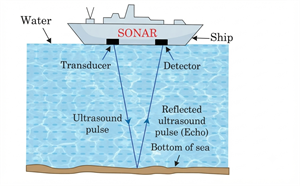
Functioning of SONAR
Audio Surveillance Using Sound Signatures:
Drones and aircraft produce characteristic sounds from their motors and engines. These sounds can be detected using sensitive sound sensors.
The characteristic sound of an object is called its sound signature. Audio surveillance uses sound signatures to monitor airspace for safety and security.