

Many everyday tasks involve doing work. Carrying a school bag upstairs, lifting a bucket of water from a well, pushing a loaded trolley up a ramp, and hoisting a flag are all examples of doing work.
Sometimes, two people may do the same amount of work, but one completes it much faster than the other. This difference introduces the concept of Power.
Similarly, lifting or moving heavy objects directly often requires a large effort. To make such tasks easier, we use simple machines such as levers, pulleys, and inclined planes.
Power:
Power is the rate of doing work. It tells us how quickly or slowly a given amount of work is done.
If the same amount of work is completed in a shorter time, more power is developed. Conversely, if more time is taken to complete the same work, less power is developed. Thus, power measures the speed at which work is performed rather than the amount of work done.
Formula:
\(P=\frac{Work\ done}{Time\ taken}\) or
\(P=\frac{W}{t}\)
SI Unit of Power:
The SI unit of power is the \(watt\ (W)\).
One watt is the power of an agent which does work at the rate of one joule per second.
\(1\ W=1\ J/s\)
Since one watt is a small unit, \(1\ kW\ =\ 1000\ W\)
Simple Machines:
A simple machine is a device that makes work easier.
Simple machines do not reduce the amount of work done.
They make work easier by:
- reducing the effort required,
- changing the direction of the effort,
- or both.
The simple machines discussed in this chapter are,
- Lever
- Pulley
- Inclined Plane
Lever:
A lever is a rigid bar that rotates about a fixed point called the fulcrum.
A lever has three parts:
- Fulcrum
- Effort
- Load
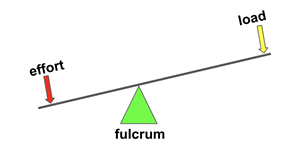
Parts of a lever
Principle of a Lever:
A lever works on the principle
\(F_{1}\times d_{1}=F_{2}\times d_{2}\)
where,
\(F_1\ =\ Effort\)
\(d_1\ =\ Effort\ arm\)
\(F_2\ =\ Load\)
\(d_2\ =\ Load\ arm\)
On a seesaw, a lighter child can balance a heavier child by sitting farther from the fulcrum.
This is because
\(Effort\times Effort\ arm=Load\times Load\ arm\)
Everyday Applications of Levers:
| Device | How it helps |
|---|---|
| Crowbar | Lifts heavy stones |
| Bottle opener | Opens bottle caps easily |
| Nutcracker | Cracks hard shells |
| Hammer | Pulls out nails |
| Seesaw | Demonstrates balance |
Pulley:
A pulley is a simple machine consisting of a wheel with a groove over which a rope passes.
Fixed Pulley:
A fixed pulley
- changes the direction of the effort,
- does not reduce the effort required (ideal case).
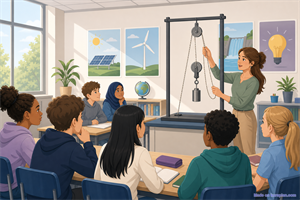
Pulley
Applications of Fixed Pulleys:
- Flag hoisting
- Drawing water from wells
- Construction sites
- Window blinds
Inclined Plane:
An inclined plane is a sloping surface that helps raise or lower objects.
Why Does an Inclined Plane Make Work Easier?
An inclined plane
- increases the distance travelled,
- reduces the effort required.
It follows,
\(W=F\times d\)
The work done remains approximately the same. If the distance increases, the required force decreases.
Example:
Instead of lifting a heavy box directly into a truck, workers push it up a ramp. The ramp is longer, but less effort is needed.
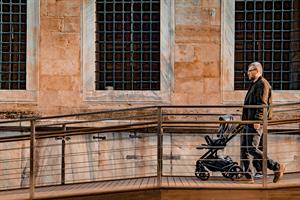
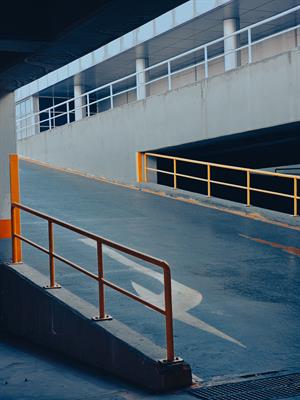
Ramps(Inclined Planes)
Applications of Inclined Planes:
- Staircases
- Hill roads
- Wheelchair ramps
- Airport luggage ramps
- Loading ramps
- Slides
Mechanical Advantage:
Mechanical Advantage tells us how effective a machine is.
It compares
- the load lifted
- with the effort applied.
\(MA=\frac{Load}{Effort}\)
Interpretation of Mechanical Advantage:
| \(MA=1\) | \(MA>1\) |
\(MA<1\)
|
|
|
|
Mechanical Advantage of an Inclined Plane:
For an ideal inclined plane,
\(MA=\frac{Length}{Height}\)
This formula shows that,
- increasing the length increases MA.
- increasing the height decreases MA.