

What are Simple Machines?
A simple machine is a device that makes work easier by changing the magnitude or direction of the applied force. It does not reduce the total work done or create energy. Instead, it helps us use our effort more effectively.
Example:
Lever
Inclined Plane
Pulley
Wheel and Axle
Screw
Wedge
Important terms in simple machines:
Load:
The load is the object or resistance that is lifted or moved by the machine.
Example: A heavy rock lifted using a crowbar.
Effort:
The effort is the force applied to the machine to move the load.
Example: Pulling the rope of a pulley.
Fulcrum:
The fulcrum is the fixed point about which a lever rotates.
Example: The support of a seesaw.
Mechanical Advantage:
Mechanical Advantage tells us how effectively a machine multiplies the applied force.
\(Mechanical\ Advantage = \frac{Load}{Effort}\)
Inclined Plane:
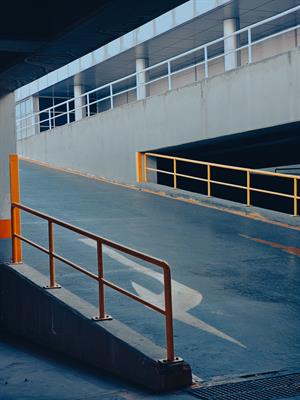
An inclined plane is a sloping surface that helps move heavy objects to a higher or lower level with less effort.
- A longer inclined plane requires less effort, but the object travels a greater distance.
- It does not reduce the total work done.
- It is useful for moving heavy objects safely.
Inclined plane
Pulley:
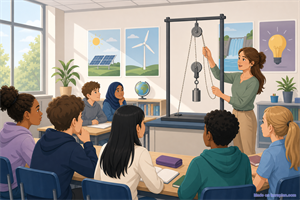
A pulley is a simple machine made of a grooved wheel and a rope used to lift heavy loads.
Fixed Pulley:
- The pulley is attached to a fixed support.
- It changes the direction of the applied force.
- \(Mechanical\ Advantage\ =\ 1\)
Example: Drawing water from a well.
Movable Pulley:
- The pulley moves along with the load.
- It reduces the effort required to lift the load.
- It provides a mechanical advantage greater than \(1\).
Example: Construction cranes.
Pulley
Levers:
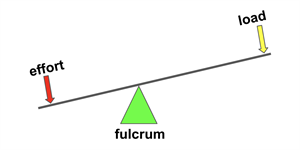
A lever is a rigid bar that rotates about a fixed point called the fulcrum.
Every lever has three parts:
- Fulcrum (F) – Fixed point
- Load (L) – Object to be lifted
- Effort (E) – Force applied
Classes of levers:
| Class I | Class II | Class III |
|
Arrangement:
Effort — Fulcrum — Load
|
Arrangement:
Fulcrum — Load — Effort
|
Arrangement:
Fulcrum — Effort — Load
|
|
Examples
|
Examples
|
Examples
|
| Changes the direction of force and may increase force or speed depending on the fulcrum position. |
Always provides a mechanical advantage greater than \(1\), so less effort is needed to lift heavy loads.
|
Does not multiply force but increases the speed or distance of movement. |
Parts of lever
Electricity Production from a Watermill:
A watermill uses the energy of flowing water to perform useful work. Water stored at a higher level has gravitational potential energy. As it flows downward, this energy changes into kinetic energy. The moving water strikes a water wheel, causing it to rotate. The rotating wheel is connected to machines such as grinding stones, which are used to grind grains.
The same principle is used in hydroelectric power plants. Water stored behind a dam flows through pipes and rotates turbines. These turbines are connected to generators, which convert mechanical energy into electrical energy. Since water is continuously renewed through the water cycle, hydroelectric power is a renewable source of energy and helps reduce the use of fossil fuels.