

Isaac Newton found this phenomenon when he sat under the apple tree. He called the force which is responsible for the motion of planets is the gravitational force. In this part, we shall learn about the universal law of gravitation and objects' movement under the influence of gravitational pull on the earth.
When we throw an object upwards, it reaches a maximum height and then falls downwards. The reason is earths gravity pulls the object towards it's centre.
Circular motion:
If an object moves with constant speed in a circular path, then the motion is called uniform circular motion.
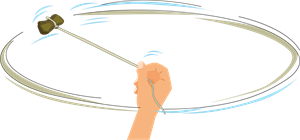
Circular motion
The force which makes an object in a circular path is known as centripetal force. The movement of the moon around the earth is due to the centripetal force.
According to the second law of motion, acceleration is inversely proportional to an object's mass for a given force. The mass of an apple is negligibly small when compared to that of the mass of earth. So, we do not perceive the earth moving towards the apple.
Universal law of gravitation:
Every object in the universe attracts every other object with force. That force is directly proportional to their masses' product and inversely proportional to the square of the distance between them. The force is along the line joining the centres of two objects.
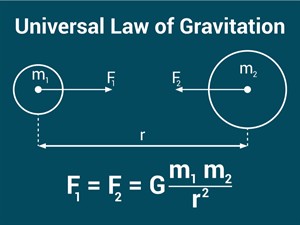
Universal law of gravitation
The SI unit of \(G\) is \(Nm^{2}kg^{−2}\). The universally accepted value of \(G\) is \(6.667\ \times\ 10^{−11}\ Nm^{2}kg^{−2}\).
Free fall:
The direction of movement of the objects does not change as they fall. However, the magnitude of the object's speed will change due to the earth's attraction.
Whenever an object falls towards the earth, and acceleration is involved. Earth’s gravitational force provides this acceleration. Therefore, this acceleration is also called acceleration due to the gravitational force of the earth (acceleration due to gravity). It is denoted by the letter \(g\). The unit of \(g\) is \(m/s^{2}\).
\(g\ =\ \frac{GM}{d^{2}}\)
\(g\ =\ 9.8\ m/s^{2}\)
The acceleration due to gravity is constant for all the objects near the earth surface. No matter how big or small, hollow or solid, all the object should fall at the same rate. Galileo dropped different objects from the top of the Leaning Tower of Pisa to prove the same. As \(g\) is fixed near the earth, all the equations for the uniformly accelerated motion of objects become true, with acceleration replaced by \(g\).
\(v\ =\ u\ +\ at\)
\(s\ =\ ut\ +\ \frac{at^{2}}{2}\)
\(v^2\ −\ u^2\ =\ 2as\)
Mass:
The mass of an object is constant, and it does not change from place to place.
Weight:
The force of attraction of the earth on an object is known as the weight of the object. It is denoted by the letter \(W\). The SI unit is Newton \((N)\).
\(W\ =\ mg\)
\(Weight\ of\ the\ object\ on\ the\ moon\ =\ \frac{Weight\ of\ the\ object\ on\ the\ earth}{6}\)
Thrust:
The force that acts on an object perpendicular to the surface is called thrust. The unit of thrust is Newton(N).
Pressure:
The force acting per unit area is pressure. It is mathematically written as
\(Pressure\ =\ \frac{Force}{Area}\)
The unit of pressure is \(N/m^{2}\) and the SI unit is pascal \(Pa\).
Pressure due to liquid, \(P\ =\ \rho\ hg\)
Where \(\rho\) is density, \(h\) is height and \(g\) is acceleration due to gravity.
All liquids and gases are called fluids. A solid exerts pressure on the surface due to its weight. Similarly, fluids have weight, and they can also exert pressure on the base and walls of the container in which they are kept.
Buoyancy:
The upward force exerted by the water or liquid on the bottle is known as upthrust or buoyant force. All objects experience a force of buoyancy when they are immersed wholly or partially in a fluid. The strength of this buoyant force depends on the density of the fluid.
Density:
The density of a substance is defined as the mass per unit volume.
\(Density\ =\ \frac{Mass}{Volume}\)
The unit of density is \(kg/m^3\).
Archimede's principle:
When a body is immersed fully or partially in a fluid, it experiences an upward force equal to the weight of the fluid displaced by it.
Relative density:
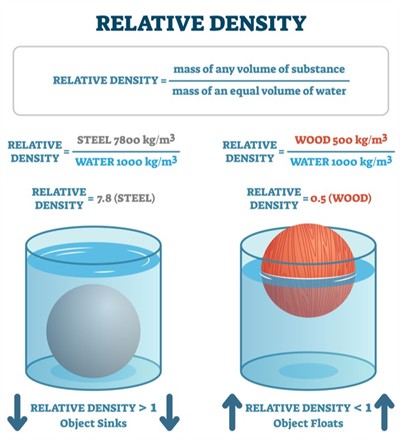
Relative density