

Properties of sound:
Some of the main features of sound energy are:
Some of the main features of sound energy are:
i. Pitch
ii. Loudness
iii. Quality (Timbre)
iv. Reflection
v. Transmission
-
Echo
-
Reverberation
Pitch:
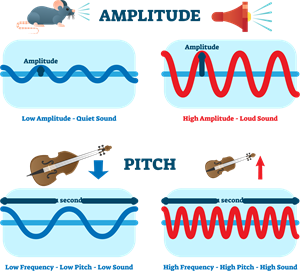
- The frequency of a sound determines its pitch or shrillness, that is, pitch is the sense of the frequency.
- Pitch is the perceived frequency of a sound. It helps differentiate between high and low voices and identify different voices, and depends on it vibration.
- The loudness of a sound is determined by its amplitude. Loudness is basically our hearing of the sound’s energy.
- The amplitude of the sound wave depends upon the force with which an object is made to vibrate.
Variation of amplitude and pitch
Quality of sound:
Reflection:
Sound bounces back when it hits on a solid or a liquid. Like light, the sound gets reflected at the surface of a solid or liquid and follows the same laws of reflection.
Laws of reflection of sound:
i. The angle of incidence is equal to the angle of reflection. \((\angle\ i\ =\ \angle\ r)\).
ii. The incident sound wave, the reflected sound wave, and the normal (the perpendicular to the reflecting surface at the point of incidence) all lie in the same plane.
Transmission:
Sound transmission occurs as a mechanical process where sound waves propagate through a medium (solid, liquid, or gas) by vibrating the particles of that medium.
Echo:
A reflected sound heard distinctly after the original sound.
Reverberation:
Multiple reflected sounds that merge with the original sound, creating a prolonged effect.
Human beings can hear sound having a frequency from \(20\ Hz\ to\ 20,000\ Hz\). A frequency range below \(20\ Hz\) are called infrasound and range above \(20,000\ Hz\) are called ultrasounds.
Uses of Ultrasonic Waves:
Quality of sound:
- The quality of sound depends on the shape of the sound wave. It is unique to each person.
- The pleasant sound is said to be a music and which is rich in quality. The unpleasant sound to hear is called noise.
- A sound of a single frequency is called a tone.
Reflection:
Sound bounces back when it hits on a solid or a liquid. Like light, the sound gets reflected at the surface of a solid or liquid and follows the same laws of reflection.
Laws of reflection of sound:
i. The angle of incidence is equal to the angle of reflection. \((\angle\ i\ =\ \angle\ r)\).
ii. The incident sound wave, the reflected sound wave, and the normal (the perpendicular to the reflecting surface at the point of incidence) all lie in the same plane.
Transmission:
Sound transmission occurs as a mechanical process where sound waves propagate through a medium (solid, liquid, or gas) by vibrating the particles of that medium.
Echo:
A reflected sound heard distinctly after the original sound.
- The sensation of sound persists in our brain for about \(0.1\ s\). To hear a distinct echo, the time interval between the original sound and the reflected one must be at least \(0.1\ s\).
- To hear a distinct echo, the distance between the sound source and the obstacle must be at least \(17.2\ m\), the range of distance changes with the air temperature.
- Echoes may be heard more than once due to multiple reflections.
Reverberation:
Multiple reflected sounds that merge with the original sound, creating a prolonged effect.
- The repeated reflection that results in the persistence of sound is called reverberation.
- In the auditorium and big halls, reverberation is highly possible.
- To reduce reverberation, the walls and roof of the auditorium are generally covered with sound-absorbent materials like compressed fibreboard, rough plaster or draperies.
Uses of multiple reflections of sound:- Horns, trumpets and megaphones. The multiple reflections in a stethoscope tube make it possible for the doctors to listen to a patient’s heartbeat.
- Generally, the ceilings of conference halls and cinema halls are curved, so that sound after reflection reaches all corners of the hall.
Human beings can hear sound having a frequency from \(20\ Hz\ to\ 20,000\ Hz\). A frequency range below \(20\ Hz\) are called infrasound and range above \(20,000\ Hz\) are called ultrasounds.
Uses of Ultrasonic Waves:
Medical field (Ultrasonography), industrial use, SONAR (Sound Navigation and Ranging), Animal Communication and Navigation..etc.