

Sound waves are longitudinal mechanical waves.
Sounds are of different frequencies, but not all the sounds are being heard by human beings. So, we classify sounds into two different categories.
- Audible sound
- Inaudible sound
Audible sound:
Sounds that human beings can hear are called audible sounds and have a frequency range from \(20\ Hz\) to \(20,000\ Hz\).
Inaudible sound:
Sounds that human beings cannot hear are called inaudible sounds and have a frequency \(<20\ Hz\) or \(>20,000\ Hz\).
Infrasonic:
The sounds waves that have a frequency range \(<20\ Hz\) is called infrasound, which are inaudible to humans.
Uses of Infrasonic waves:
Earthquake and volcanic eruption detection, study of the mechanism of the human heart, tsunami warning systems, studying explosions and rocket launches, animal communication, weather monitoring, ...etc..
Some animals like elephant, blue whale, rhinoceros, pigeon, crocodile can produce and detect infrasound. These waves can travel long distances through air, water, or the ground.
Ultrasound:
The sounds waves that have a frequency range \(>20,000\ Hz\) is called ultrasound, which are inaudible to humans.
Uses of Ultrasonic Waves:
i. Medical Field (Ultrasonography):
a. Used to create images of internal organs (like heart, liver, and kidneys). Monitor the growth of a fetus. It is safe and painless.
b. Powerful ultrasound waves are used to break kidney stones into small pieces by Lithotripsy, which then pass out through urine.
ii. Industrial Use:
Used to detect cracks or faults in metal structures or machines. Clean delicate instruments high-frequency vibrations.
ii. Industrial Use:
Used to detect cracks or faults in metal structures or machines. Clean delicate instruments high-frequency vibrations.
iii. Animal Communication and Navigation:
Mammals like bats, dogs, dolphins, rats, tarsiers and some insects like grasshoppers, certain moths and beetles use ultrasound for navigation and communication through echolocation. They produce high-frequency sounds and listen to the echoes to locate prey and avoid obstacles.
iv. SONAR (Sound Navigation And Ranging):
Sonar is a device that uses ultrasonic waves to measure the distance, direction and speed of underwater objects. Used by ships and submarines to avoid obstacles, detect other ships, detect underwater objects, measure sea depth, locate fish, study marine life, underwater geology, ocean currents...etc.
- The transmitter produces and transmits ultrasonic waves into seawater, and these waves after striking the object on the sea surface, get reflected, and the detector senses them.
- The function of the detector is to convert the ultrasonic waves into electrical signals.
- The distance of the object that reflects the sound wave can be calculated by knowing the speed of sound in water and the time interval between transmission and reception of the ultrasound.
Let us take
\(v\ -\ Speed\),
\(t\ -\ time\ interval\) and
\(2d\ -\ total\ distance\ travelled\)
\(speed\ =\ \frac{distance}{time}\)
We will get the formula to find the total distance travelled by ultrasound(reflected back).
\(2d\ =\ v\ \times\ t\)
Other related formulas are
\(speed\ =\ frequency\ \times wavelength\)
\(speed\ =\ number\ of\ waves\ per\ second\ \times wavelength\)
How do we hear sound?
How do we hear sound?
Sounds generated by the different sources reach our ear by travelling through the air.
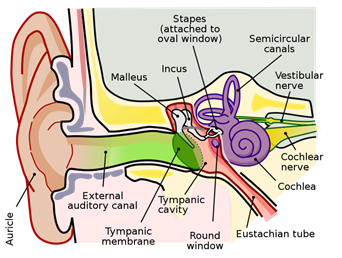
Structure of human earStructure of Human ear:
The ear is the organ of the human body that enables us to hear different sounds around us. The ear can be divided into three main parts:
The ear is the organ of the human body that enables us to hear different sounds around us. The ear can be divided into three main parts:
- Outer ear
- Middle ear
- Inner ear
Outer ear: The outer visible part of the ear.
i. Structure: It is made of skin and cartilage and includes the auricle (the visible part) and the external auditory canal (or meatus), which ends at the eardrum (tympanic membrane).
ii. Function: It collects and funnels sound waves from the environment into the ear canal.
Middle ear: The middle ear is an air-filled chamber located behind the ear drum.
i. Structure: Three tiny bones are the malleus (hammer), incus (anvil), and stapes (stirrup) is known as the ossicles.
i. Structure: Three tiny bones are the malleus (hammer), incus (anvil), and stapes (stirrup) is known as the ossicles.
ii. Function: It amplifies sound vibrations and transmits them from the eardrum to the inner ear. It also contains the Eustachian tube, which connects to the back of the nose and helps to equalize air pressure on both sides of the eardrum.
Inner ear: The inner ear send nerve impulses to brain(in the cochlea) and helps maintain body balance.
i. Structure: The inner ear is a complex, fluid-filled structure located deep inside the skull. It is mainly responsible for hearing and balance.
ii. Function: The inner ear has some tiny hairs that changes vibrations into nerve impulses (in the cochlea), which are sent to the brain through the auditory nerve. The brain interprets these signals as sound.
Inner ear: The inner ear send nerve impulses to brain(in the cochlea) and helps maintain body balance.
i. Structure: The inner ear is a complex, fluid-filled structure located deep inside the skull. It is mainly responsible for hearing and balance.
ii. Function: The inner ear has some tiny hairs that changes vibrations into nerve impulses (in the cochlea), which are sent to the brain through the auditory nerve. The brain interprets these signals as sound.