

Energy can neither be created nor destroyed, rather, it is transferred from one form of energy to another.
A sound energy is always produced by a vibrating body. Sound cannot be produced without any vibration. The SI unit for expressing the loudness of a sound is \(decibel\ (db)\).
What is vibration?
When a body moves to and fro, or up and down, about a fixed position, it is said to be in oscillatory motion. A body moves repeatedly over the same path, exhibiting a rapid oscillatory motion is said to be in vibration.
When a body moves to and fro, or up and down, about a fixed position, it is said to be in oscillatory motion. A body moves repeatedly over the same path, exhibiting a rapid oscillatory motion is said to be in vibration.
Propagation of sound:
Sound travels in a medium by disturbing the particles of the medium to vibrate from a point. The medium could be a gas, liquid or solid. Sound cannot travel in a vacuum.
Sound propagates because of the disturbance caused by a source of sound in the medium, and it travels in the form of longitudinal mechanical waves.
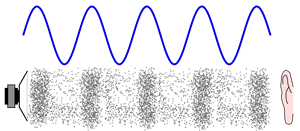
Compression and Rarefaction
When a vibrating object moves forward in the air, it pushes the air with high pressure and compresses it. Compression is denoted by letter \(C\). When the object moves backwards, it pushes the air with low pressure and creates a rarefaction. Rarefaction is denoted by letter \(R\).
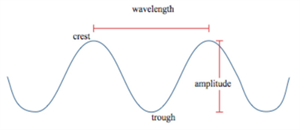
Longitudinal wave
Sound waves are longitudinal and mechanical because the particles of the medium vibrate in the direction which is parallel to the direction of the propagation of the sound waves. The particles in the medium oscillate to and fro in the case of longitudinal waves. These waves are also known as compressional waves because they are made up of compressions and rarefactions.
Sound propagates because of the disturbance caused by a source of sound in the medium, and it travels in the form of longitudinal mechanical waves.
Compression and Rarefaction
When a vibrating object moves forward in the air, it pushes the air with high pressure and compresses it. Compression is denoted by letter \(C\). When the object moves backwards, it pushes the air with low pressure and creates a rarefaction. Rarefaction is denoted by letter \(R\).
Longitudinal wave
Sound waves are longitudinal and mechanical because the particles of the medium vibrate in the direction which is parallel to the direction of the propagation of the sound waves. The particles in the medium oscillate to and fro in the case of longitudinal waves. These waves are also known as compressional waves because they are made up of compressions and rarefactions.
The characteristics of sound waves are:
i. Wavelength
ii. Frequency
iii. Time period
iv. Amplitude
v. Speed
Wavelength:
The distance between the two consecutive compressions or the two consecutive rarefactions is called the wavelength. It is denoted by a Greek letter \(Lambda\) \(\lambda\), and its unit is \(meter\ m\).
The distance between the two consecutive compressions or the two consecutive rarefactions is called the wavelength. It is denoted by a Greek letter \(Lambda\) \(\lambda\), and its unit is \(meter\ m\).
Frequency:
The number of oscillations an object takes per second is called its frequency. It is denoted by the letter \(F\). The SI unit of frequency is \(Hertz\ Hz\). Pitch is determined by the frequency of a sound wave.
\(Frequency\ =\ \frac{Number\ of\ oscillations}{Time\ taken}\)
Time period:
The time taken for one complete oscillation of a sound wave is called the time period of the sound wave. It is denoted by the letter \(T\), and the S.I.Unit is \(second\ s\).
\(Time\ period\ =\ \frac{1}{Frequency}\)
\(Time\ period\ =\ \frac{1}{Frequency}\)
Amplitude:
The maximum displacement of a particle of the medium from the mean position is called the amplitude of the wave. It determines the loudness of the sound. It is denoted by the letter \(A\), and its unit is \(meter\ m\).
Speed:
The distance travelled by a wave in one second is called the speed or velocity of the wave. It is denoted by the letter \(v\), and its unit is \(meter\ per\ second\ (m/s)\)
\(Speed\ =\ \frac{Distance}{Time}\)
\(Speed\ =\ \frac{Distance}{Time}\)