

A sound energy is always produced by a vibrating body. The SI unit for expressing the loudness of a sound is \(decibel\ (db)\).
Sound propagates because of the disturbance (vibration of particles) caused by a source of sound in the medium, and it travels in the form of longitudinal mechanical waves. Sound cannot travel in a vacuum.
Longitudinal wave
Sound propagates because of the disturbance (vibration of particles) caused by a source of sound in the medium, and it travels in the form of longitudinal mechanical waves. Sound cannot travel in a vacuum.
Longitudinal wave
The main characteristics of sound waves are:
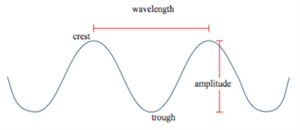
Wavelength: The distance between the two consecutive compressions or the two consecutive rarefactions is called the wavelength \(\lambda\), and its unit is \(meter\ m\).
Frequency: The number of oscillations an object takes per second is called its frequency and it's SI unit is \(Hertz\ Hz\).
\(Frequency\ =\ \frac{Number\ of\ oscillations}{Time\ take}\)
Time period: The time taken for one complete oscillation of a sound wave and the S.I. Unit is \(second\ s\).
\(Time\ period\ =\ \frac{1}{Frequency}\)
Amplitude: The maximum displacement of a particle of the medium and its unit is \(meter\ (m)\).
Speed: The distance travelled by a wave in one second is called the speed \(v\) and its unit is \(meter\ per\ second\ (m/s)\)
\(Speed\ of\ sound\ =\ \frac{distance}{time}\)
Some of the main features of sound energy are:
i. Pitch: It is determined by frequency.
ii. Loudness: It is determined by amplitude.
iii. Quality (Timbre): The quality of sound depends on the shape of the sound wave.
iv. Reflection: Sound bounces back when it hits on a medium.
ii. Loudness: It is determined by amplitude.
iii. Quality (Timbre): The quality of sound depends on the shape of the sound wave.
iv. Reflection: Sound bounces back when it hits on a medium.
v. Echo: A reflected sound heard distinctly after the original sound.
vi. Reverberation: Multiple reflected sounds that merge with the original sound, creating a prolonged effect.
vi. Reverberation: Multiple reflected sounds that merge with the original sound, creating a prolonged effect.
Note: Voice quality (timbre) and pitch remain the most reliable features for recognizing someone’s voice.
Structure of Human ear:
The ear is the organ of the human body that enables us to hear different sounds around us. The ear can be divided into three main parts:
- Outer ear
- Middle ear
- Inner ear
Outer ear: The outer visible part of the ear.
i. Structure: It is made of skin and cartilage and includes the auricle (the visible part) and the external auditory canal (or meatus), which ends at the eardrum (tympanic membrane).
ii. Function: It collects and funnels sound waves from the environment into the ear canal.
Middle ear: The middle ear is an air-filled chamber located behind the ear drum.
i. Structure: Three tiny bones are the malleus (hammer), incus (anvil), and stapes (stirrup) is known as the ossicles.
i. Structure: Three tiny bones are the malleus (hammer), incus (anvil), and stapes (stirrup) is known as the ossicles.
ii. Function: It amplifies sound vibrations and transmits them from the eardrum to the inner ear. It also contains the Eustachian tube, which connects to the back of the nose and helps to equalize air pressure on both sides of the eardrum.
Inner ear: The inner ear send nerve impulses to brain(in the cochlea) and helps maintain body balance.
i. Structure: The inner ear is a complex, fluid-filled structure located deep inside the skull. It is mainly responsible for hearing and balance.
ii. Function: The inner ear has some tiny hairs that changes vibrations into nerve impulses (in the cochlea), which are sent to the brain through the auditory nerve. The brain interprets these signals as sound.
Inner ear: The inner ear send nerve impulses to brain(in the cochlea) and helps maintain body balance.
i. Structure: The inner ear is a complex, fluid-filled structure located deep inside the skull. It is mainly responsible for hearing and balance.
ii. Function: The inner ear has some tiny hairs that changes vibrations into nerve impulses (in the cochlea), which are sent to the brain through the auditory nerve. The brain interprets these signals as sound.
Sounds are of different frequencies, but not all the sounds are being heard by human beings. So, we classify sounds into two different categories.
- Audible sound: \(20\ Hz\) to \(20,000\ Hz\) can heard by humans.
- Inaudible sound: \(<20\ Hz\) or \(>20,000\ Hz\) cannot be heard by humans.
Infrasonic: Frequency range of \(<20\ Hz\). It can travel long distances. It has very low frequency and long wavelength.
Ultrasound: Frequency range of \(>20,000\ Hz\). It cannot travel long distances. It has a very high frequency and short wavelength.
Uses of Infrasonic Waves:
Earthquake and volcanic eruption detection, study of the mechanism of the human heart, tsunami warning systems, studying explosions and rocket launches, animal communication, weather monitoring, ...etc..
Uses of Ultrasonic Waves:
Medical field (Ultrasonography), industrial use, SONAR (Sound Navigation and Ranging), Animal Communication and Navigation..etc.
Uses of Infrasonic Waves:
Earthquake and volcanic eruption detection, study of the mechanism of the human heart, tsunami warning systems, studying explosions and rocket launches, animal communication, weather monitoring, ...etc..
Uses of Ultrasonic Waves:
Medical field (Ultrasonography), industrial use, SONAR (Sound Navigation and Ranging), Animal Communication and Navigation..etc.
SONAR:
\(v\ -\ Speed\),
\(t\ -\ time\ interval\) and
\(2d\ -\ total\ distance\ travelled\)
The formula to find the total distance travelled by ultrasound.
\(2d\ =\ v\ \times\ t\)
\(t\ -\ time\ interval\) and
\(2d\ -\ total\ distance\ travelled\)
The formula to find the total distance travelled by ultrasound.
\(2d\ =\ v\ \times\ t\)