

We require energy for activities such as playing, singing, reading, speaking, writing, thinking, jumping, cycling, running, etc. The concepts of work, energy, and power help us understand how forces cause motion and how energy is transferred or transformed from one form to another.
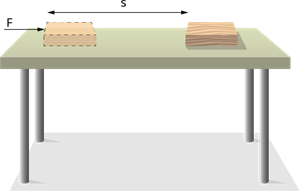
Work done
F → Constant force acting on an object
s → Displacement of the object in the direction of the force
W → Work done
Work is calculated as the product of the force and displacement
\(Workdone\ =\ Force\ \times\ Displacement\)
\(W\ =\ F\ \times\ s\)
Work done by a force acting on an object is equal to the magnitude of the force multiplied by the distance moved in the direction of the force. Work has only magnitude and no direction.
If F = 1 N, and s = 1 m then, the work done by the force will be 1 Nm.
Consider the scenario in which an object moves with a uniform velocity along a particular direction. Retarding force, F, is applied in the opposite direction to the object's movement. That is, the angle between the two directions is 180º. Let the object stops after a displacement.
In such cases, the work done by the force, F, is taken as negative and denoted by the minus sign.
\(Workdone\ =\ Force\ \times\ Displacement\)
\(W\ =\ - F\ \times\ s\)
Positive work:
When force and displacement are in the same direction, the work performed on an object is said to be positive work.
Negative work:
Negative work is performed if the displacement is opposite to the direction of the force applied.
Energy:
An object having the ability to do work is said to possess energy. The object which does the work loses energy, and the object on which the work is done gains energy.
Therefore, the unit of energy is the same as that of work: \(joule (J)\).
\(1\ J\) is the energy required to do \(1\ joule\ of\ work\). Sometimes a larger unit of energy called kilojoule (kJ) is used. \(1\ kJ\) equals \(1000\ J\).
Energy can exist in two basic mechanical forms,
- Kinetic Energy - which is the energy of motion, and
- Potential Energy - which is the stored energy due to position or state
Kinetic energy:
Kinetic energy is the energy contained by an object due to its motion. The kinetic energy of an object increases with its speed.
The kinetic energy of a body moving with a certain velocity is equal to the work done on it to make it obtain that velocity.
Derivation of kinetic energy:
Consider an object of mass (m) moving with a uniform velocity (u).
Let it now be displaced through a distance \(s\) when a constant force \(F\), acts on it in the direction of its displacement.
From the equation of work done, We know that,
\(Work\ done\ =\ F\ \times s\)
The work done on the object will cause a change in its velocity. Let its velocity change from initial velocity (u) to final velocity (v).
Let a be the acceleration produced.
\(v^2\ -\ u^2\ =\ 2as\)
Rearranging it to gets, \(s\ =\ \frac{v^2\ -\ u^2}{2a}\)
\(Force\ (F)\ =\ Mass\ (m)\ \times\ Acceleration(a)\)
Substitute the equation s and F in work done,
\(Work\ done\ =\ F\ \times s\)
\(=\ F\ \times \frac{v^2\ -\ u^2}{2a}\)
\(=\ F\ \times \frac{v^2\ -\ u^2}{2a}\)
Simplifying it we get,= \(\frac{1}{2}\ \times\ m\ \times\ (v^2\ -\ u^2)\)
If the object starts from its stationary position, that is, \(u\ =\ 0\), then,
\( Work\ done (W)\ =\ \frac{1}{2}\ \times\ m\ \times\ (v^2)\)
It is clear that the work done is equal to the change in the kinetic energy of an object.
If \(u\ =\ 0\), the work done will be \(\frac{1}{2}\ \times\ m\ \times\ (v^2)\).
Thus, the kinetic energy possessed by an object of mass (m) and moving with a uniform velocity (v) is,
\(E_k\ =\ \frac{1}{2}\ \times\ m\ \times\ (v^2)\)
Objects in motion contain energy. We define this energy as kinetic energy.
Potential Energy:
Potential energy is energy that is stored or conserved in an object or substance. This stored energy is based on the position, arrangement or state of the object or substance.
Potential energy is mainly classified into two types:
- Gravitational potential energy - Gravitational potential energy is energy in an object that is held in a vertical position.
- Elastic potential energy - Elastic potential energy is energy stored in objects that can be stretched or compressed.
Derivation of gravitational potential energy:
Let the work done on the object against gravity be W. That is,
\(Workdone\ (W)\ =\ Force(F)\ \times\ Displacement(s)\)
We know that, \(Force\ (F)\ =\ Mass(m)\ \times\ Acceleration\ due\ to\ gravity(g)\)
\(Displacement\ (s)\ =\ h\)
Subtituting the above equations in Workdone,
\(W\ =\ (m\ \times\ g)\ \times\ h\)
\(W\ =\ mgh\)
Since,
\(Workdone\ =\ mgh\),
\(Potential energy\ =\ mgh\)
The power is represented as rate of doing work, \(P\ = \frac{E}{T}\)
Total mechanical energy:
The sum of kinetic energy and potential energy of an object is its total mechanical energy. We find that during the free fall of the object, the decrease in potential energy appears as an equal amount of increase in kinetic energy at any point in its path. (Here, the effect of air resistance on the motion of the object has been ignored) There is thus a continual transformation of gravitational potential energy into kinetic energy.