

Let us try to get a basic knowledge of potential energy through the following activity.
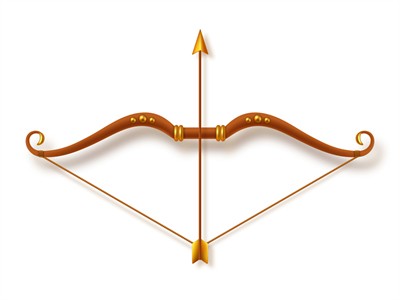
- Take a bamboo stick and create a bow, as shown in the below figure.
- Locate an arrow made of a light stick on it with one end supported by the stretched string.
- Now stretch the string and release the arrow.
- Observe the arrow flying off the bow.
- Notice the change in the shape of the bow.
Discussion and Conclusions of the activity:
- The potential energy stored in the bow due to the change of shape is thus used as kinetic energy in throwing off the arrow.
- When the arrow is released from the bow, it acquires its original configuration as the elastic potential energy of the bow and stretched string converts into kinetic energy of the arrow.
Potential Energy:
Potential energy is energy that is stored or conserved in an object or substance. This stored energy is based on the position, arrangement or state of the object or substance.
Potential energy is mainly classified into two types:
- Gravitational potential energy
- Elastic potential energy
Gravitational potential energy is energy in an object that is held in a vertical position.
Elastic potential energy is energy stored in objects that can be stretched or compressed.
The potential energy possessed by the object is the energy present in it by virtue of its position or configuration.
Gravitational Potential energy:
The potential energy of an object at a particular height depends on the ground level or the zero level you select. An object in a given position can have specific potential energy corresponding to one level and a different value of potential energy with respect to another level.
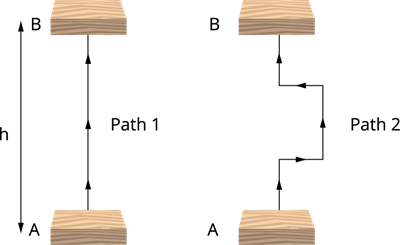
It is beneficial to note that the work done by gravity depends on the difference in vertical heights of the initial (Ground level) and final positions of the object and not on the path along which the object is moved.
Let the work done on the object against gravity be W. That is,
\(Workdone\ (W)\ =\ Force(F)\ \times\ Displacement(s)\)
We know that, \(Force\ (F)\ =\ Mass(m)\ \times\ Acceleration\ due\ to\ gravity(g)\)
\(Displacement\ (s)\ =\ h\)
Subtituting the above equations in Workdone,
\(W\ =\ (m\ \times\ g)\ \times\ h\)
\(W\ =\ mgh\)
Since,
\(Workdone\ =\ mgh\),
Energy equal to mgh units is gained by the object. mgh is the potential energy of the object.
\(Potential\ energy\ (Ep)\ =\ mgh\)
The sum of kinetic energy and potential energy of an object is its total mechanical energy. We find that during the free fall of the object, the decrease in potential energy appears as an equal amount of increase in kinetic energy at any point in its path. (Here, the effect of air resistance on the motion of the object has been ignored.) There is thus a continual transformation of gravitational potential energy into kinetic energy.