

Types of glands:
- Glands are vital organs that can be found all over the body.
- They produce and release chemicals that serve certain purposes.
- Even though you have numerous glands throughout your body, they are divided into endocrine and exocrine.
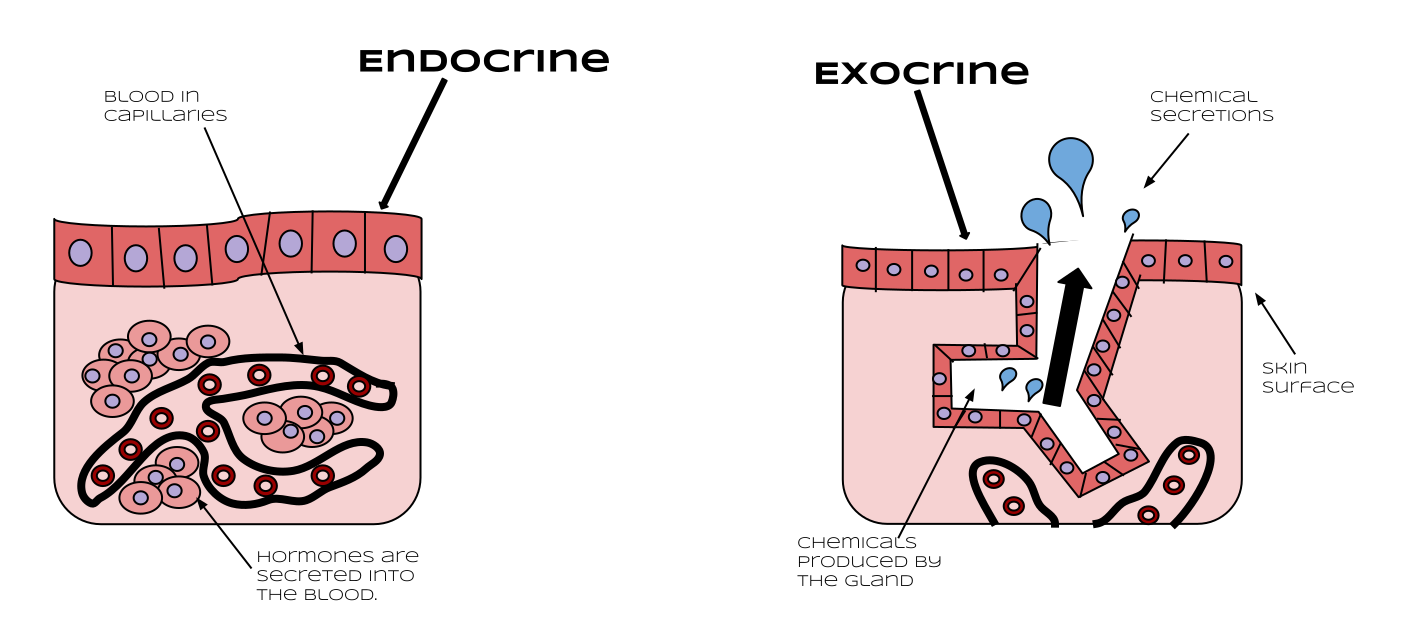
Endocrine and Exocrine glands
| Endocrine gland | Exocrine gland |
| Ductless glands that release hormones directly into the bloodstream. | Secretes substances through ducts to a specific place in the body or onto the body surface. |
| Release hormones that travel through the blood to target organs. | Release substances like sweat, saliva, tears, and digestive juices. |
| Hormones regulate growth, metabolism, and homeostasis. | Secretions perform local body functions. |
Hormones are non-nutrient chemicals that act as intercellular messengers and are produced in trace amounts.
Holocrine Gland:
- A gland that secretes both its secretory output and its own destroyed secretory cells.
- Holocrine glands are the name for these glands.
- Example: Sebaceous glands.
Heterocrine gland:
- Heterocrine glands also known as mixed glands.
- They are glands that perform both exocrine and endocrine functions.
- Example, Pancreas because it releases insulin and glucagon into the bloodstream (endocrine function) and digestive enzymes via ducts in the digestive tract (exocrine function).
Discovery of Hormones:
- In \(1903\), English physiologists William M Bayliss and Ernest H Starling discovered the first hormone. In \(1905\), Starling coined the term hormone. They first discovered the hormone secretin.
- Thomas Addison is known as the Father of Endocrinology, because he described a disorder of the adrenal glands called Addison's disease. This discovery helped scientists understand that glands produce substances (later called hormones) that control body functions.
- The word hormone is derived from the Greek word "hormon", meaning "to excite", "to stimulate". Hormones are organic chemical messengers produced and released by specialized glands called endocrine glands.
- They can either speed up or slow down a physiological process. Many hormones are generated as prohormones, which are inactive hormones. Insulin, for example, is secreted as proinsulin.
Hormones:
Hormones are chemical substances released directly into the bloodstream in reaction to changes inside or outside the body and then transferred to organs and tissues to perform their activities.The video explaining the how hormones work in the body
Characteristics of hormones:
The main characteristics of hormones are listed below.
-
Hormones are chemical messengers in the body.
-
They travel through the bloodstream.
-
They are produced in one organ and act on another organ.
-
Hormones may be protein-based (proteinaceous - Amino acids, peptides and proteins) or steroid-based (non-proteinaceous - steroids).
-
They are produced in very small amounts.
-
Hormone secretion is controlled by the nervous system and feedback mechanisms.
-
Hormones do not act like enzymes.
-
An imbalance of hormones (excess or deficiency) can cause disorders.
Feedback mechanism of hormones:
If a hormone's concentration in the circulatory system is kept within normal limits, it can work efficiently. Deviation from the typical range has a significant impact on the body. Chemical stimuli trigger hormone secretion, and the hormone itself can stop hormone secretion.
The hormone feedback mechanism is the mechanism that keeps the hormone balance in the blood/body in balance.
An increase or decrease in the concentration of a hormone can occasionally stimulate and increase the hormone's release or inhibit the hormone's secretion. It's known as feedback.
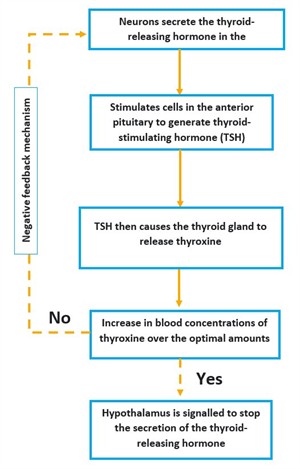
The endocrine system relies on feedback mechanisms to regulate hormone production and secretion.
Role of Negative Feedback in Hormone Regulation:
- Negative feedback is the main mechanism that controls the release of hormones in the body.
- When the level of a substance in the blood increases, the gland releases a hormone to reduce it.
- Once the level returns to normal, the secretion of the hormone decreases. In this way, the concentration of hormones in the blood is maintained within a proper range.
Role of Positive Feedback in Hormone Regulation:
-
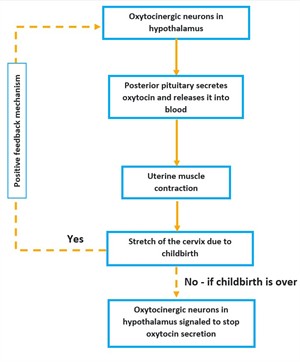
Positive feedback is a mechanism in which the release of a hormone stimulates the production of more of the same hormone.
-
It amplifies or increases the response until a specific process or event is completed.
-
This mechanism is usually involved in special situations rather than maintaining balance in the body.
-
After the required event is completed, the process stops automatically.
Reference:
https://upload.wikimedia.org/wikipedia/commons/f/fa/ThomasAddison.jpg
https://upload.wikimedia.org/wikipedia/commons/7/7e/Blausen_0699_PancreasAnatomy2.png
https://commons.wikimedia.org/wiki/File:405_Modes_of_Secretion_by_Glands_Holocrine.png
https://upload.wikimedia.org/wikipedia/commons/e/e9/Hormone.jpg