

Receptors:
Receptors are specialised ends of nerve cells that detect stimuli (changes) in the environment and send this information to the nervous system as nerve impulses. These receptors are situated in the sense organs such as the eyes, nose, tongue, ears and skin. These receptors help us see, smell, taste, hear, sense touch, sense temperature etc.
Pathway of Signal Transmission with example:
Stimulus (The heat from the hot object acts as the stimulus)
Receptors (Heat receptors in the skin detect the stimulus)
Sensory neuron (The receptors convert the stimulus into a nerve impulse and send it through the sensory neuron to the spinal cord)
Brain/Spinal cord (The spinal cord processes the information quickly)
Motor neuron (A signal is sent through the motor neuron to the arm muscles)
Effector (The arm muscles act as the effector)
Response (The muscles contract, and the hand is withdrawn immediately)
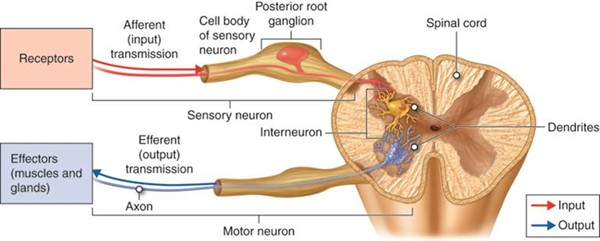
The action of sensory and motor neuron
When a stimulus is detected, receptors present at the dendritic tip of a neuron receive the information. The stimulus causes a chemical reaction that generates an electrical impulse. This impulse then travels through the dendrite to the cell body and along the axon to transmit the information.
Animals receive external information through specialised sense organs or receptors. Human beings have five different sensory organs. The following is a list of them.
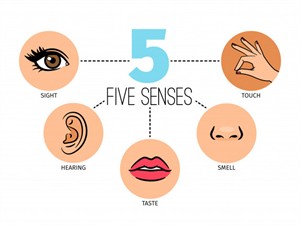
Five senses concepts with human organs
| Location of the receptor | Name of Receptor | Stimulus |
|
Eyes
|
Photoreceptor
|
Light
|
|
Ears
|
Phonoreceptor
|
Sound
|
|
Nose
|
Olfactory receptors
|
Smell
|
|
Tongue
|
Gustatory receptors
|
Taste
|
|
Skin
|
Mechanoreceptors
Thermo receptor
|
Touch/Pressure
Heat/cold
|
|
All over the body
|
Algesireceptors
|
Pain
|
|
All over the body
|
Nociceptors
|
Pain (Modern scientific term)
|
|
Internal ear
|
Statoreceptors
|
Acceleration/gravity
|
INTRODUCTION TO ENDOCRINE GLANDS:
We studied the reflex arc and its necessity. In the absence of true thought, the reflex arc helps the animal act quickly in dangerous situations. But there is another system that also helps the animal in a dangerous situation, called the hormonal system.
Example:
A Squirrel in a Dangerous Situation must prepare for either fighting or running away.
- Either for fighting or running away, a squirrel needs energy and coordination of multiple tissues.
- If a squirrel relied only on nerve impulses, only a limited range of tissues would respond, but hormones like adrenaline reach all cells, preparing the body for action by increasing heart rate, breathing, and muscle oxygen supply. The endocrine system thus provides a second, body-wide level of control and coordination.
The most significant distinction between the nervous system and the hormonal system is:
- The nervous system sends information through neurons using electrical impulses. In contrast, the hormonal system employs chemical messengers carried through blood plasma to target cells.
- The nervous system's transmission is short-lived yet rapid, whereas the hormonal system's transmission is long-lived but takes much longer.
- Responses in the nervous system are localised, i.e., specific to a particular muscle, but responses in the hormonal system are extensive, i.e., acts upon a wide range of muscles.
- In the hormonal system, responses are often permanent, while they are transitory and reversible in the nervous system.
The endocrine system consists of the following parts or glands which helps in the production of various hormones:
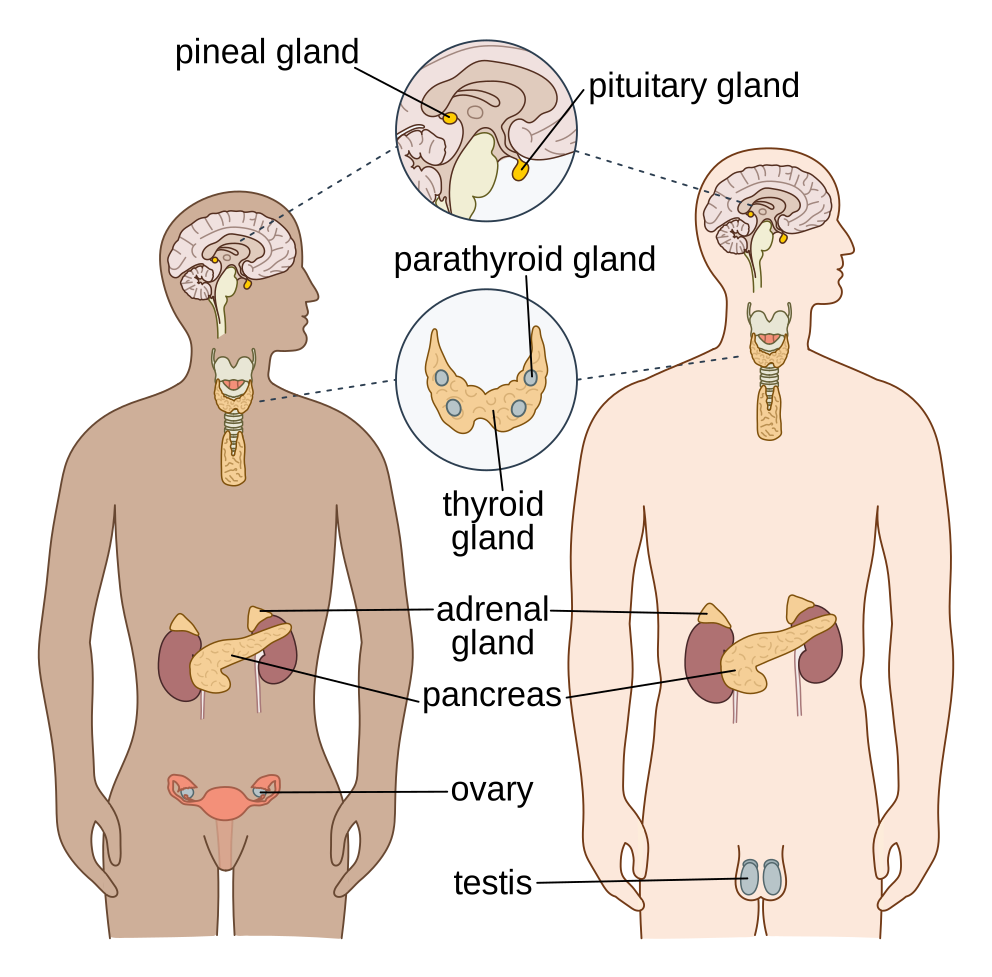
Picture showing the different endocrine glands in the human being (Both female and male)
|
Gland
|
Function
|
| Hypothalamus | This region maintains homeostasis and controls the urge to eat and drink. |
| Pineal | Melatonin, a serotonin-derived hormone that regulates sleep patterns, is produced by the pineal gland. |
| Parathyroid | This gland aids in the regulation of calcium levels in the body. |
| Thymus | It aids in developing T-cells, the adaptive immune system's function, and the maturation of the thymus. |
| Thyroid | It controls the metabolism of carbohydrates, proteins and fats |
| Adrenal | Secretes cortisol hormone and sex hormones. |
| Pituitary | It is also known as the body's "Master endocrine gland" or the "Chief executive of the endocrine system" because it secretes several hormones (\(TSH\), \(ACTH\), and others) that regulate the functioning of other endocrine glands. |
| Pancreas | This gland is responsible for synthesising insulin hormones, which are essential for blood sugar regulation. |
| Testes | These hormones promote muscle growth, facial and axillary hair growth, aggression, low voice tone etc. |
| Ovaries | The ovary generates oestrogen and progesterone, which are steroid hormones. The oestrogen is mainly secreted by the developing ovarian follicles. After ovulation, the ruptured follicle is converted to a corpus luteum, which secretes mainly progesterone |
