

Food chain and trophic levels
A food chain shows the linear flow of energy in an ecosystem.
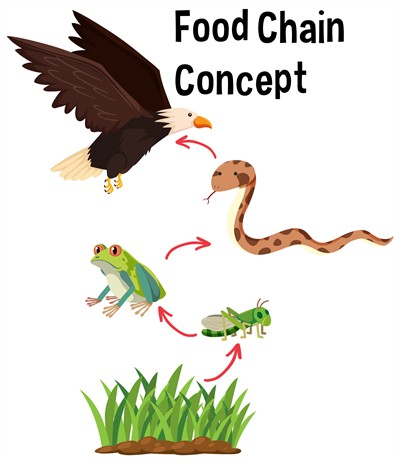
Food chain
Importance of food chain
Food chains help trace the flow of energy, show interactions among organisms, reveal inter-dependence, and explain the impact of population changes at different levels. They also help study how harmful non-biodegradable substances increase in concentration along the chain.
Trophic levels
Each step in a food chain is called a trophic level, and organisms at the same level have the same food habit. The main trophic levels are producers and consumers, and they can be represented in an ecological or energy pyramid.
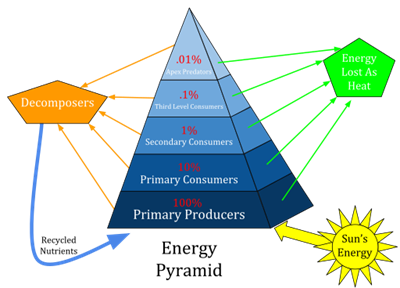
Trophic levels or energy pyramid
First trophic level
Producers such as green plants and algae occupy the first level. They use photosynthesis to trap solar energy, of which only \(1%\) is converted into food. Their number is the highest among all levels.
Second trophic level
Primary consumers or herbivores such as deer and cattle occupy the second level. They use most of the energy for life functions, and only \(10% \)of it is stored and passed to the next level.
Third trophic level
Secondary consumers such as small carnivores and omnivores depend on primary consumers for food. Their population is smaller than herbivores.
Fourth trophic level
Tertiary consumers such as large carnivores feed on both primary and secondary consumers. They are the least in number.
Reference:
https://commons.wikimedia.org/wiki/File:Ecological_Pyramid.svg