

Introduction:
All are parts of the environment, but the environment is much more. The environment includes everything around us, living (biotic) and non-living (abiotic) components. These interact continuously, maintaining balance. Any disturbance affects the whole system.
The interaction of living and non-living components forms an ecosystem. Ecology (Greek: Oikos = home, Logos = study) is the study of relationships between organisms and their environment.
Ecosystem: A community where biotic and abiotic components are connected through energy flow and nutrient cycling.
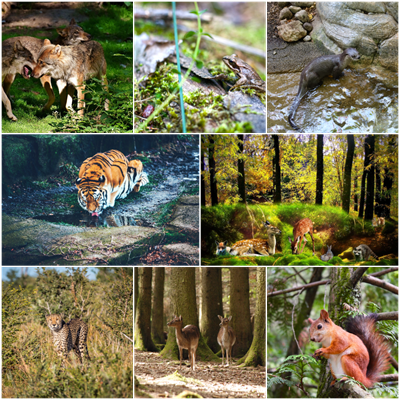
A forest ecosystem
Example – Forest ecosystem:
Plants use sunlight, air, and water to grow. Insects, birds, and frogs feed on the plants, while snakes and other higher animals feed on them. Together with the abiotic factors, these interactions maintain balance in the ecosystem. Other ecosystems include pond, river, lake, garden.
Components of an ecosystem:
Abiotic components:
These are non-living factors like air, water, soil, light, temperature, rainfall, and wind.
Biotic components:
These are living factors such as plants, animals, microorganisms, and humans. They include producers, consumers, and decomposers.
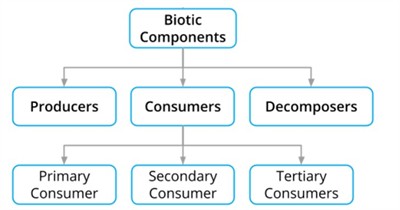
Classification of biotic consumers
Producers:
Producers are autotrophs like green plants, algae, and cyanobacteria that make food by photosynthesis and maintain the oxygen–carbon dioxide balance.
Consumers:
Consumers are heterotrophs. Herbivores like deer and cattle are primary consumers, carnivores like snakes and eagles and omnivores like humans and crows are secondary consumers, while lions and tigers are tertiary consumers.
Decomposers:
Decomposers such as bacteria, fungi, and earthworms break down dead matter and recycle nutrients back into the soil.
Classification of ecosystems:
Ecosystems are classified in three ways, based on formation, region, and size.
Based on formation:
Natural ecosystems like ponds, lakes, rivers, and forests develop on their own without human help. Artificial ecosystems such as gardens, parks, agricultural fields, aquariums, and zoos are man-made and maintained by humans.
Based on region:
Terrestrial ecosystems exist on land, for example forests, deserts, grasslands, mountains, and tundra. Aquatic ecosystems exist in water, such as freshwater ecosystems (ponds, lakes, rivers), marine ecosystems (oceans and seas), and estuarine ecosystems.
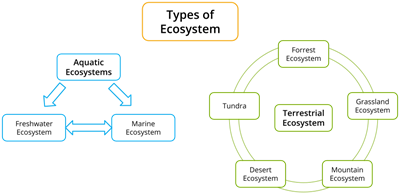
Ecosystem based on region
Based on size:
Micro ecosystems are very small, like a pond or tree trunk. Meso ecosystems are medium-sized, like lakes, coral reefs, and sand dunes. Macro ecosystems are very large, such as rainforests or biomes.