

Many great scientific discoveries did not begin in large laboratories or with complex machines. They started with simple observations from everyday life. One such inspiring example is the story of the Wright brothers, Wilbur and Orville Wright.
Simple curiosity sparks big discoveries:
Many years ago, the Wright brothers closely watched birds flying in the sky. They noticed how birds spread their wings, balanced their bodies, and changed direction in the air. They also enjoyed flying kites and making paper planes.
This made them wonder: If birds can fly and paper planes can glide, can humans also build a machine that flies?
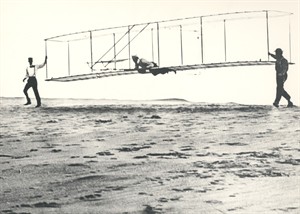
Wright brothers with their first human flight
Their curiosity pushed them to experiment. They designed and tested gliders, changed the shapes of wings, and learned from each failure. Finally, in 1903, they succeeded in building the world’s first aeroplane. What began as simple observation and play led to one of the greatest inventions in human history; human flight.
This example clearly shows that big ideas often begin with small questions.
Everyday observations lead to scientific thinking:
Science progresses when ordinary experiences make us ask “why” and “how.” Simple everyday events such as:
Noticing shadows change during the day: Shadows are long in the morning and evening and short at noon because the Sun’s position changes in the sky and light travels in a straight line.
Watching ice melt in sunlight: Ice melts faster in sunlight because it absorbs heat energy, helping us understand heat transfer and change of state.

Melting of ice
Seeing stains change colour with soap: Turmeric stains change colour when soap is applied because turmeric acts as a natural indicator and soap is basic in nature.
Observing birds and butterflies fly: Their movement in air shows balance, lift, and the effect of air on motion.
All these simple observations help develop scientific thinking.
A paper plane, for example, may seem like a simple toy. But when we observe it carefully, many questions arise:
Why does it glide instead of falling straight down?
Why does it fall after some time?
Why does changing its folds or adding weight affect its flight?
Why does it fall after some time?
Why does changing its folds or adding weight affect its flight?
These questions lead us to scientific ideas such as air resistance, lift, thrust, and gravity, the same principles used in real aeroplanes. Thus, a small classroom activity helps us understand advanced scientific concepts in a simple way.
Nature as a teacher: Learning from real life
Nature is one of the greatest teachers of science. The flight of a butterfly is a wonderful example. A butterfly’s light body, wide wings, and gentle flapping help it stay airborne. Scientists study these movements to design drones, helicopters, and robotic wings, showing how nature inspires modern technology.
Scientific ideas from careful observation of living organisms:
Observing fish swimming helped scientists design submarines and underwater vehicles that move smoothly through water.
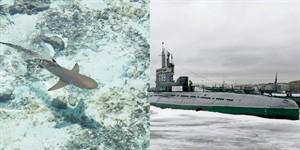
A fish and a submairne
Watching birds glide inspired the design of aeroplane wings and gliders.

A bird and an airplane
Studying ants working together led to ideas in robotics, traffic control, and teamwork algorithms.

Ants and teamwork
Studying gecko feet helped develop special sticky materials that work without glue and wall climbing robots.
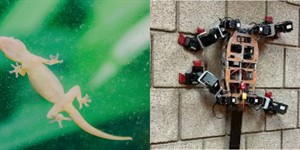
A gecko and a wall climbing robot
Observing the shape of lotus leaves inspired water-repellent and self-cleaning surfaces.
These examples show that nature provides solutions, if we observe it carefully.

Lotus leaves and water-repellent surface
How curiosity leads to discovery?
The journey from curiosity to discovery usually follows four important steps:
Observation: Noticing small details, such as how a paper plane flies or how a butterfly balances.
Questioning: Asking “Why does this happen?” or “What will happen if I change something?”
Experimenting: Trying different folds in a paper plane or studying different wing shapes.
Understanding and Application: Discovering scientific principles like aerodynamics and applying them to real machines.
This shows that science grows from everyday experiences, not just from complex experiments or laboratories.
Imagination + Curiosity = Science
Imagination plays an important role in science. Without imagination, a paper plane would remain only a toy. But when imagination combines with curiosity, it leads to invention. Every great discovery; from fire and electricity to computers and space travel; began with a simple idea inspired by ordinary life.
Simple curiosity can lead to big discoveries. Watching a butterfly, flying a paper plane, or observing melting ice can open the door to scientific understanding. When curiosity is combined with creativity, careful observation, and persistence, learning truly takes flight; just like a paper plane soaring high in the sky.
Reference: