

What keeps life from disappearing?
Life on Earth continues from one generation to the next because living organisms reproduce. If plants and animals did not reproduce, all life forms would eventually disappear.
What is reproduction?
Reproduction is the biological process through which organisms produce offspring that are genetically identical to themselves.
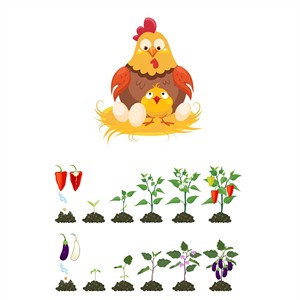
Reproduction in animals and plants, respectively
Why is reproduction Important?
Among the various life processes, reproduction is an important one.
- Continuity of species: Reproduction helps maintain a species survival and continuity.
- Population organisation: Reproduction keeps a balance of young, adult, and aged individuals in a population.
- Variations: Reproduction creates variations necessary for adaptation and evolution.
- Life: Reproduction ensures the existence of life, and without it, a species would become extinct.
Genetic Material – The Instruction Manual of Life
Genes are units of inheritance found inside cells that carry instructions for building and maintaining an organism.
Chromosomes are tightly packed chromatin fibres with histone proteins made of DNA and proteins that carry hereditary genetic information.
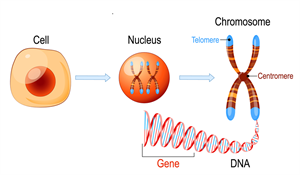
A Picture showing the location of the gene inside a cell
Genes can also be defined as:
Genes are DNA segments that act as units of heredity, controlling inherited traits; the study of genes, along with variation and inheritance, is called Genetics.
Importance of genes:
- Genes control features like the colour of the eye, the colour of the hair, the shape of the nose, and the type of earlobe, among others.
- They ensure that a calf becomes a cow and a kitten becomes a cat.
- Variations arise when genes mix or change slightly.
Variations are differences between cells or individuals within a species caused either by genetic differences or environmental factors.
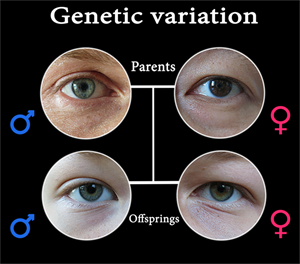
Genetic variations between the parents and offspring
In the sexual reproduction of animals, including human beings, the number of successful distinct variations among individuals is high. Even in asexual reproduction, there is some amount of variation.
Important!
The presence of genes was first proposed by Mendel in \(1865\). He called it a factor. Johansson coined the word gene in \(1909\).
Variations in living organisms:
1. Variations in microbes: Bacteria develop resistance to antibiotics and different shapes of bacteria.
2. Variations in animals: Camels developed humps to store fat and for survival in deserts, and Arctic fox has thick white fur for camouflage and insulation in snow.
3. Variations in plants: Cactus has thick stems and spines, which store water and reduce evaporation for desert survival and colour changes in other flowers.
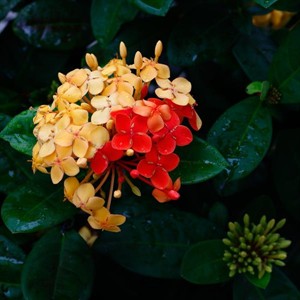
Mutation leads to variation in plants