-
Pollination is the process by which pollen is transferred to another flower by wind, insects, or animals.
-
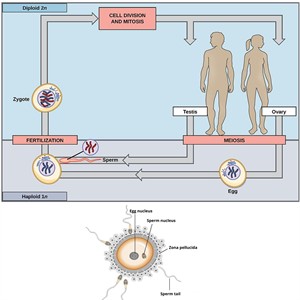
Fertilisation occurs when the male and female gametes fuse to form a zygote.
-
Seed formation occurs when the zygote develops into a seed.
-
Fruit formation happens when the ovary of the flower grows and develops into a fruit.
-
Seed dispersal occurs when birds, animals, wind, or water spread the seeds away from the parent plant.
-
Germination happens when a seed receives water and begins to grow into a new plant.
Based on the structural complexity, physiology and habitat of the organisms, reproduction is divided into two types:
1. Asexual reproduction
2. Sexual reproduction
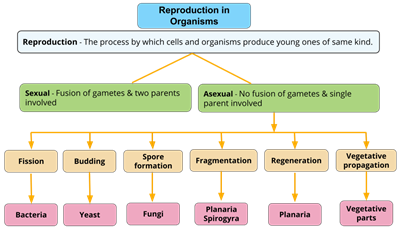
Types of reproduction
1. Asexual reproduction:
A process in which only one parent is involved in producing new plants, without producing seeds or spores, is called asexual reproduction.
Characteristics of asexual reproduction:
1. A single parent is involved in the process of reproduction (uniparental).
2. Gametes are not produced.
3. There is no fertilisation process, and thus it is called agamogenesis or agamogeny.
4. In asexual reproduction, only mitotic cell divisions are involved.
5. Asexual reproduction is quick and is a rapid mode of multiplication.
The process of asexual reproduction occurs through:
a. Binary fission
b. Budding
c. Fragmentation
d. Spore formation
e. Regeneration
f. Vegetative propagation
a. Binary fission:
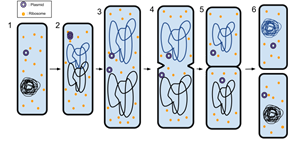
Binary fission
In this mode of reproduction, the parent cell divides into two daughter cells, and each cell develops into a new adult organism. It is seen in organisms such as amoebas and bacteria.
b. Budding:
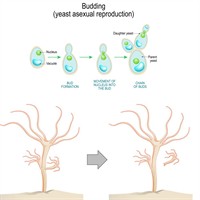
Budding in Yeast and Hydra, respectively
In this process, a daughter individual forms from a small, bulb-like projection on the parent body called a bud. The bud detaches from the parent body and forms a new daughter cell. It is seen in organisms such as Yeast and Hydra.
c. Fragmentation
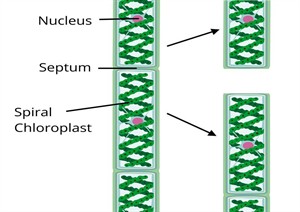
Fragmentation in Spirogyra
The broken filaments of the organism that develops into a new organism are known as Fragmentation. Each of these fragments contains a protoplast, so they grow into a new filament of the algae by cell division. Fragmentation occurs when the parent is matured and broken into pieces. It is seen in Spirogyra.
d. Spore formation
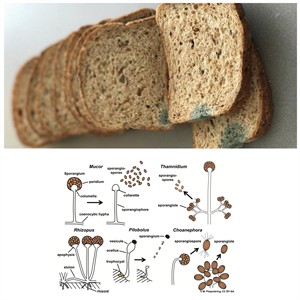
Growth of mould on bread and spore formation in Rhizopus
When a moist bread slice is kept in a cool, dark place, a fungus called Rhizopus (bread mould) grows from spores carried by the wind and uses the bread’s nutrients and moisture to develop.
e. Regeneration
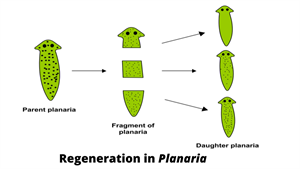
Regeneration of Planaria
The ability of an individual organism's lost bodily components to regenerate into a whole new organism is known as Regeneration. It is observed in organisms such as Hydra and Planaria.
Activity : Plant stem cuttings or parts of plants (money plant, potato eye, ginger) in moist soil, provide water, air and sunlight, and observe daily how roots, stems, and new leaves develop.
f. Vegetative propagation
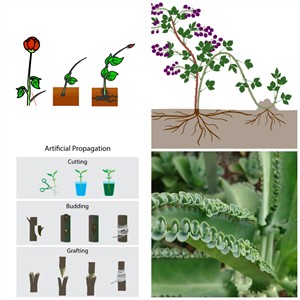
Vegetative propagation techniques and Bryophyllum
Reproduction through vegetative parts like the root, stem, leaf, and buds. Bryophyllum (also called the sprout leaf plant) has buds in the leaf margin. If a leaf is buried in moist soil, its margins form a new plant that resembles the parent.
|
Vegetative Propagation
|
Example
|
|
Stem cuttings
|
Sugarcane, rose, champa, grapes, jasmine, banana, cactus
|
|
Modified stem
|
Potato, ginger, and turmeric
|
|
Leaf
|
Bryophyllum
|
|
Root cuttings
|
Sweet potato, dahlia, blackberry
|
Advantages of asexual reproduction:
1. It involves a simple process of division and mitosis.
2. A quick mode of reproduction.
3. A single parent can produce a large number of offspring.
4. The produced daughter cells are genetically similar to their parent.
Disadvantages of asexual reproduction:
1. There is no variation as there is no mixing of genetic material.
2. As variations do not take place, asexual reproduction has no role in evolution.
3. As there is rapid multiplication, it may cause overcrowding and overpopulation.
4. Organisms produced through asexual reproduction have low resistance or adaptability to a changing environment.
2. Sexual reproduction
Sexual reproduction is the development of new individuals through the fusion of two types of gametes or sex cells (biparental).
Characteristics of sexual reproduction:
- It involves two parents, i.e., biparental.
- Gametes are haploids produced by cell division and are specialised cells carrying half the parent's genes.
- The process called fertilisation occurs during sexual reproduction and results in the formation of a zygote, leading to variations in the generations.
- Variations occur due to the combination or mixing of genes during crossing over.
- Daughter cells are genetically different from the parents.
Sexual reproduction in plants
The fusion of a pollen grain and an embryo sac, resulting in the formation of a seed, is known as sexual reproduction in flowering plants.
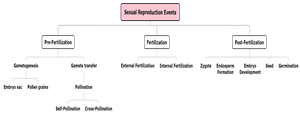
Stages of sexual reproduction in flowering plants
Flowers are the reproductive part of the plant and help in sexual reproduction to produce fruits and seeds.
A flower is a modified shoot to carry out sexual reproduction. A typical flower consists of four whorls born on the thalamus.
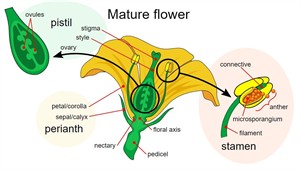
Parts of a flower
Flowers are the reproductive part of the plant and help in sexual reproduction to produce fruits and seeds.
Androecium- Male part of the flower
Stamens are the male part of a flower, made of a filament and an anther, where pollen grains with a tough protective coat produce the male gametes.
Gynoecium- Female part of the flower
The pistil is the female reproductive part of a flower made up of the stigma, style, and ovary, which contains the ovules.
Types of flowers
1. Flowers that contain either pistils or stamens alone are called unisexual flowers or incomplete flowers. Example: Watermelon, papaya and cucumber, etc.
2. Flowers that contain both stamens and a pistil are called bisexual flowers or complete flowers. Example: sunflower, rose, hibiscus, and mustard, etc.
Reproduction in plants starts with pollination.
Steps of Reproduction in Flowers: