

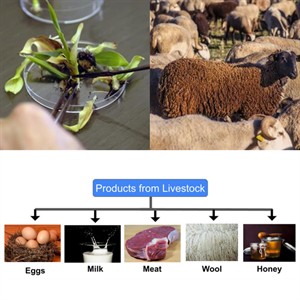
Modern agricultural practices improve plant cultivation by preparing the soil, sowing, fertilising, irrigating, controlling pests, harvesting, storing, and improving crop quality, yields, and disease resistance.
Green Revolution:
The Green Revolution increased food production by introducing high-yielding, disease-resistant crop varieties and by improving farming practices. It greatly boosted wheat and rice production (\(1960–2000\)), helping meet food demand and support exports. Dr Norman E. Borlaug and Dr M. S. Swaminathan introduced these varieties in India; Swaminathan is known as the Father of the Indian Green Revolution.
Plant breeding:
Plant breeding is the genetic improvement of crops through hybridisation and selection to produce plants with higher yield, better nutrition, and disease resistance. The purpose of plant breeding was to increase food production in India to meet the needs of its rapidly growing population.
Breeding for high yield and better quality:
Wheat: Production increased from \(11\) million tonnes to \(75\) million tonnes (\(1960–2000\)) due to semi-dwarf, high-yield varieties such as Sonalika and Kalyan Sona developed from Mexican cultivars.
Rice: Production increased from \(35\ million\) tonnes to \(90\ million\) tonnes, driven by semi-dwarf, high-yield varieties such as \(IR-8\) (Miracle rice) and later Jaya and Ratna.
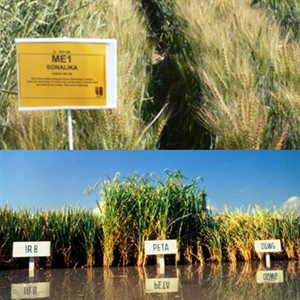
Sonalika wheat variety and IR-8 rice variety
Plant Breeding for Disease Resistance:
Plant pathogens (viruses, bacteria, fungi) can cause \(20–30%\) crop loss, so plant breeding develops disease-resistant varieties like Himgiri wheat, Pusa Shubhra cauliflower, Pusa Komal cowpea, and Pusa Sadabahar chilli.
Plant breeding for Insect/Pest Resistance:
Plant breeding develops insect and pest-resistant crop varieties (based on morphological or biochemical traits), such as Pusa Gaurav Brassica (aphids), Pusa Sem beans (leafhopper, aphids, fruit borer), and Pusa Sawani okra (shoot and fruit borer).
Plant Breeding for Improved Nutritional Quality:
- Biofortification improves the nutritional quality of crops to combat malnutrition and hidden hunger affecting billions worldwide.
- It enhances the protein, oil, vitamin, and mineral content of crops through plant breeding.
- Examples include lysine-rich maise (Protina, Shakti, Rathna), protein-rich wheat (\(Atlas\ 66\)), iron-rich rice, and vitamin-enriched vegetables.
Methods of plant breeding for crop improvement:
The methods of plant breeding for developing high-yielding varieties are:
1. Introduction of New Varieties:
- Transfer of high-yielding plant varieties (exotic species) from one region or country to another.
- Introduced plants are tested in plant quarantine to prevent the entry of pests and pathogens.
- Helps improve crop yield and adaptability in new regions.
Example: Phaseolus mungo was introduced from China.
2. Selection:
- One of the oldest plant breeding methods is selecting plants with desirable traits from a mixed population.
- Mass selection: Seeds from the best plants selected for several generations (e.g., \(TMV-2\) groundnut).
- Pureline selection: Progeny from a single self-pollinated plant, producing uniform varieties.
- Clonal selection: Selection of desirable vegetatively propagated clones that maintain genetic stability.
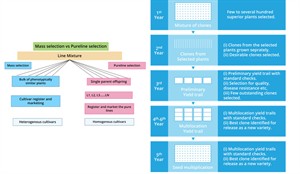
Mass selection, Pureline selection, and Clonal selection
3. Polyploidy Breeding:
- Polyploidy refers to organisms with more than two sets of chromosomes (\(3n\), \(4n\), etc.).
- It occurs naturally or is induced by physical agents (X-rays, temperature) or by chemicals such as colchicine.
- Odd polyploids are usually sterile and propagated vegetatively.
Examples: Seedless watermelon, banana, triticale (wheat × rye hybrid).
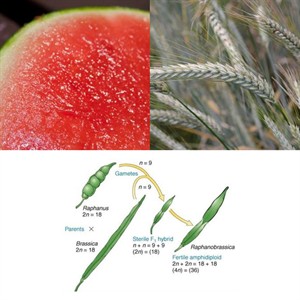
Seedless watermelon, Triticale, and Raphnobrassica
4. Mutation Breeding:
A mutation is a sudden heritable change in a DNA sequence or chromosome structure. Mutations occur naturally or are induced by mutagens such as radiation or chemicals—physical mutagens (X-rays, gamma rays, UV) and chemical mutagens (EMS, sodium azide).
Examples: Sharbati Sonora wheat, Atomita-2 rice, and the gamma garden technique.
Examples: Sharbati Sonora wheat, Atomita-2 rice, and the gamma garden technique.
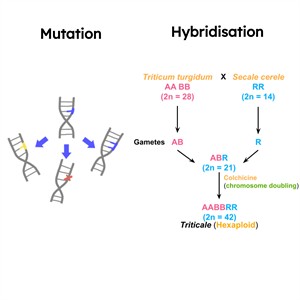
Mutation and Triticale crossing over
5. Hybridisation:
Crossing two or more genetically different plants to combine desirable traits into a hybrid. Hybrids often exhibit hybrid vigour (heterosis), with superior qualities compared to their parents. Widely used to create genetic variation and improve crop varieties. Example: Triticale, produced by crossing wheat and rye, was later made fertile by chromosome doubling.
Animal breeding:
Animal breeding is the selective mating of animals within the same breed (a group with a common origin and traits) to improve desirable characteristics and produce better offspring.
Objectives of animal breeding:
Animal breeding improves the genotypes of domesticated animals. The main objectives of animals breeding are:
a. Improved growth rate
b. Increased production or increased yield of milk, egg, meat, wool etc. To improve the desirable traits that enhance the yield.
c. Superior quality of milk, egg, meat, wool etc.
d. Improved resistance to the different types of diseases.
e. Increased productive life and reproduction rate.
Methods of Animal Breeding:
1. Inbreeding:
Mating of closely related animals of the same breed for several generations to develop purelines. Helps accumulate desirable genes and increase homozygosity, but prolonged use may cause inbreeding depression.
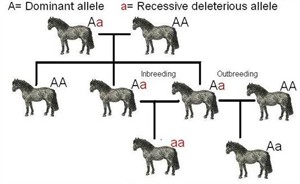
Inbreeding depression exposes the harmful recessive genes
2. Outbreeding:
Mating of unrelated animals to produce stronger hybrids with hybrid vigour (heterosis). Includes outcrossing, cross-breeding, and interspecific hybridisation to improve productivity and traits.
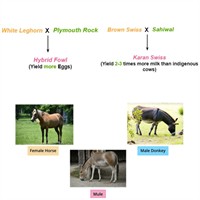
Cross-breeding of fowls, cows and mule produced by cross breeding